


Securing expensive circuit boards requires unyielding internal mounting points. Engineers frequently design massive, solid structural pillars to hold heavy components, completely ignoring the thermodynamic disaster these thick cylinders create during manufacturing. Pouring liquid metal into massive clusters guarantees aggressive internal sink marks and severe porosity. Relying on a rigid die casting design guide forces hardware teams to rethink how they connect internal assemblies. Executing optimized die casting bosses and holes prevents your critical mounting tabs from violently shearing off the moment a technician applies torque with an electric screwdriver.

Drilling thousands of microscopic features manually destroys your commercial profit margins. Hardware founders desperately want the hydraulic press to form every single geometric detail instantly to save money. Pushing this raw injection capability past its physical limit actively destroys expensive H13 steel tool pins.
Balancing raw formation against secondary milling separates amateur designers from industry veterans. Let's dissect why sharp cylinders snap under pressure, exactly how deep you can safely push a blind cavity, and when utilizing precision subtractive cutting ultimately saves your manufacturing budget.
content:
Mounting Points: Stopping Snapped Stand-Offs
Depth Limits: Preventing Broken Core Pins
Subtractive Milling: Casting vs Drilling
Jucheng Precision: Turnkey CNC Integration
FAQ: Honest Answers About Tapping and Shrinkage
Mounting Points: Stopping Snapped Stand-Offs
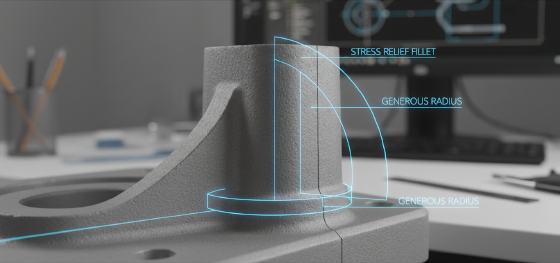
What causes heavy mounting cylinders to shear off instantly under screw torque?
Failing to blend the cylinder into the main wall with generous radii concentrates severe mechanical stress exactly at the sharp ninety-degree base, creating a highly fragile fracture point.
Bulking up the cylinder to make it stronger actually triggers a massive thermal nightmare. Massive chunks of hot metal cool incredibly slowly, sucking material away from the exterior cosmetic skin and leaving horrific, highly visible sink marks on your flagship product.
Hollowing out the center of the pillar solves this thermodynamic trap beautifully. Engineers maintain unyielding structural rigidity by linking the thinned-out mounting tab to the exterior walls using intersecting support ribs, slashing part weight while completely eliminating heat accumulation.
Depth Limits: Preventing Broken Core Pins

Why do factories fiercely refuse to cast incredibly deep, narrow blind cavities?
Long, paper-thin steel core pins will violently warp or snap off completely when struck by hundred-mile-per-hour liquid metal, destroying the expensive tooling block immediately.
Respecting mathematical depth-to-diameter ratios prevents these catastrophic tooling blowouts. For highly fluid zinc alloys, you can push the core pin slightly deeper. Aggressive aerospace aluminum fights back significantly harder, forcing designers to strictly limit narrow cavities to extremely shallow depths.
Sloping the interior walls of these cavities remains absolutely mandatory. If the hot metal shrinks and locks onto a perfectly straight steel pin, the ejection mechanics will physically tear the hardware apart. Incorporating heavy interior drafting ensures the part slides off the tool safely.
Subtractive Milling: Casting vs Drilling

How do procurement teams decide between forming a feature directly versus drilling it later?
Calculating the exact die casting machining allowance determines commercial profitability; if strict zero-gap tolerances or microscopic internal threads are mandatory, secondary cutting always wins the financial argument.
Casting microscopic threads directly into aluminum usually ends in total failure. The aggressive thermal contraction warps the tiny geometric pitches, making it physically impossible to drive a steel screw into the housing without stripping the surrounding alloy.
| Feature Geometry | Recommended Manufacturing Path | Primary Engineering Reason |
|---|---|---|
| Massive Weight-Reduction Voids | Raw Injection (Cored) | Saves raw material costs; milling large pockets wastes intense machine time. |
| Fine Internal Threads (M4 or smaller) | Secondary CNC Tapping | Thermal shrinkage ruins delicate cast threads; cutting ensures perfection. |
| Deep, Narrow Blind Channels | Secondary CNC Drilling | Prevents fragile steel mold pins from snapping under high hydraulic pressure. |
Jucheng Precision: Turnkey CNC Integration
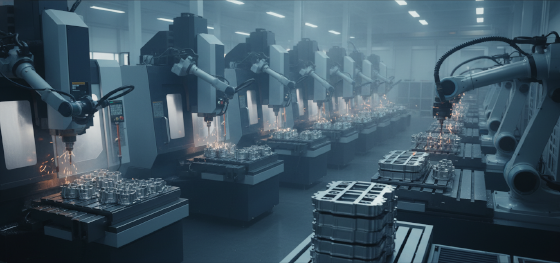
Forcing a raw foundry to handle complex threading without owning proper milling equipment invites logistical disaster. They will outsource your critical enclosures to a cheap third-party shop, entirely losing control over your strict assembly tolerances.
Operating our massive precision manufacturing hub ensures Jucheng Precision handles both the brutal raw injection and the final microscopic drilling seamlessly. We leave the exact mathematical allowance of raw metal on your standoffs, guaranteeing our 5-axis cutters have enough material to execute a flawless finish.
Stop risking broken molds and snapped hardware. Send your intricate CAD assemblies to our engineering team today for a rigorous DFM analysis. We map the ultimate thermodynamic pathways and deliver structural enclosures that assemble perfectly on the first try.
FAQ: Honest Answers About Tapping and Shrinkage
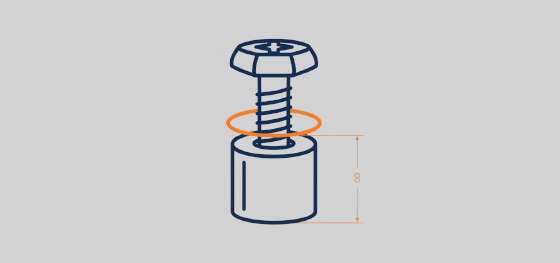
Will hollowing out a mounting cylinder compromise its overall load-bearing strength?
Not if properly supported. Integrating connecting webs seamlessly into the surrounding exterior walls distributes the mechanical torque broadly, actually increasing rigidity compared to an unsupported solid block.
Can draft angles be completely eliminated for internal fastening cavities?
Never. Internal features endure the most aggressive thermal gripping forces. Erasing the extraction slope guarantees the metal will permanently fuse to the steel pin, ruining the tool.
Does adding multiple intersecting ribs around a cylinder prevent thermal shrinking?
It severely limits massive warping by breaking up the thermal mass. The liquid metal freezes much faster in thinner sections, drastically reducing the formation of surface depressions.
Why do threaded fasteners sometimes strip completely out of raw cast alloys?
Internal gas porosity often hides silently inside massive un-cored pillars. When the CNC drill taps the hole, it cuts into a fragile, sponge-like void that physically cannot hold screw tension.

