


Imagine standing in a warehouse holding two silvery-gray metal bars. One is Grade 2 Titanium; the other is Grade 5 Titanium. To the naked eye, they are indistinguishable. They weigh roughly the same, feel the same, and look the same. Yet, if you use the wrong one for an aerospace fastener, the wing could shear off. If you use the wrong one for a chemical tank liner, it might corrode prematurely.
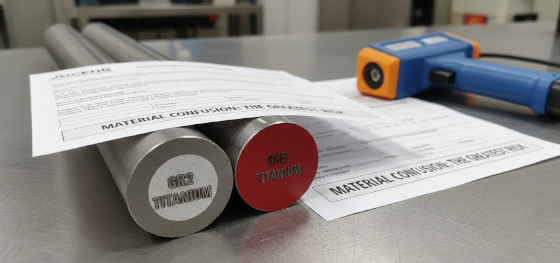
The debate of grade 2 vs grade 5 titanium is the most common dilemma engineers face when specifying titanium parts. It is a choice between the "Commercially Pure" ductility of Grade 2 and the "Aerospace Alloy" strength of Grade 5. As a leading provider of titanium cnc machining services, Jucheng Precision works with both alloys daily. We know that the right choice depends entirely on your specific balance of strength, environment, and budget.
This guide strips away the metallurgical jargon to give you a clear, practical comparison. By the end, you will know exactly which grade belongs in your CAD file.
The Strength Gap: 275 MPa vs 900 MPa
Corrosion Resistance: The Gr2 Advantage
Machinability: Gummy vs Hard
Cost Reality: Material and Machine Time
Critical Applications: Where They Shine
JUCHENG's Verdict: How to Decide
The Strength Gap: 275 MPa vs 900 MPa
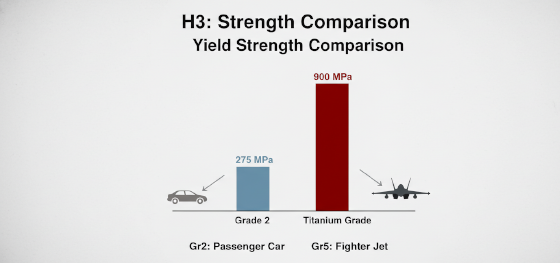
The most significant difference lies in mechanical properties. This is where the distinction between "Pure" and "Alloy" becomes obvious.
Grade 2 (Commercially Pure): Think of this as the "Mild Steel" of the titanium world. It has a typical yield strength of around 275-350 MPa (40-50 ksi). It is strong, certainly stronger than aluminum, but it is not a superhero. Its primary mechanical asset is ductility—it can be bent, formed, and welded without cracking.
Grade 5 (Ti-6Al-4V): This is the "Heat-Treated Steel" equivalent. By alloying titanium with 6% Aluminum and 4% Vanadium, the yield strength skyrockets to approximately 900-1100 MPa (130-160 ksi). This is nearly 3 to 4 times stronger than Grade 2. If your part is a structural bracket, a suspension arm, or a turbine blade that must carry a load, Grade 5 is the only option.
Corrosion Resistance: The Gr2 Advantage
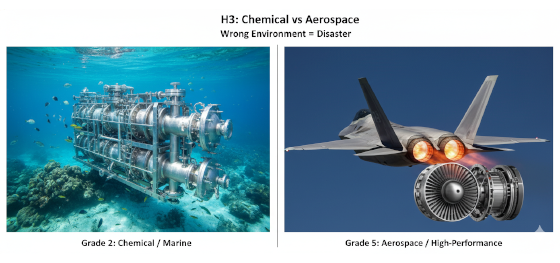
If Grade 5 is so strong, why do we use Grade 2 at all? The answer is corrosion chemistry. While both grades form a protective oxide layer that makes them virtually immune to saltwater, Grade 2 has the edge in extreme chemical environments.
Because Grade 2 is commercially pure (99% Ti), its oxide film is uniform and highly stable. Grade 5 contains aluminum and vanadium. In highly oxidizing acids (like concentrated nitric acid) or high-temperature chlorine environments, the alloying elements in Grade 5 can become weak points for localized corrosion. This is why the chemical processing and desalination industries overwhelmingly prefer Grade 2 for their heat exchangers, piping, and tank liners. It offers a slightly higher safety margin against chemical attack.
Machinability: Gummy vs Hard
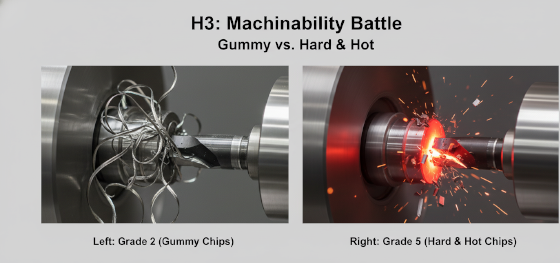
From a manufacturing perspective at Jucheng Precision, the battle of grade 2 vs grade 5 titanium is a battle between two different headaches.
Grade 2 is "Gummy": Because it is softer and more ductile, it hates to break into chips. It wants to smear. The primary risk is the material welding itself to the cutting tool (Built-Up Edge). We have to use extremely sharp, polished tools to slice it cleanly.
Grade 5 is "Hard & Hot": It is much harder and generates intense heat at the cutting edge. It doesn't smear as much, but it wears out tools rapidly through abrasion and heat. We must use premium coatings (like AlTiN) and run at specific speeds to prevent the tool from burning up.
In short: Grade 2 kills tools by sticking; Grade 5 kills tools by burning. Both require specialized CNC strategies.
Cost Reality: Material and Machine Time

Budget often dictates the final choice. Generally speaking, Grade 5 is more expensive, but the gap involves two factors: raw material and processing.
Material Cost: Vanadium is expensive. Therefore, Grade 5 raw stock typically costs higher per kilogram than Grade 2.
Machining Cost: This is where the gap widens. Because Grade 5 wears out tools faster and often requires slower cutting speeds to manage heat, the "machine time" per part is higher. Additionally, the tooling consumable cost (end mills, drills) for Grade 5 is significantly higher.
Expect a finished Grade 5 component to cost anywhere from 20% to 50% more than an identical Grade 2 component, depending on complexity.
Critical Applications: Where They Shine
Let's look at real-world examples to see where engineers draw the line.
Choose Grade 2 for:
• Marine Hardware: Propeller guards, hull fittings.
• Chemical Processing: Flanges, valves, and heat exchanger tubes.
• Medical Trays: Non-implantable surgical equipment housings.
• Anodizing Racks: Jigs used in electroplating baths.
Choose Grade 5 for:
• Aerospace: Turbine blades, airframe fasteners, landing gear.
• Motorsports: Valve springs, connecting rods, suspension axles.
• Medical Implants: Bone plates and screws (often the ELI - Extra Low Interstitial version) where strength is vital for load-bearing.
JUCHENG's Verdict: How to Decide
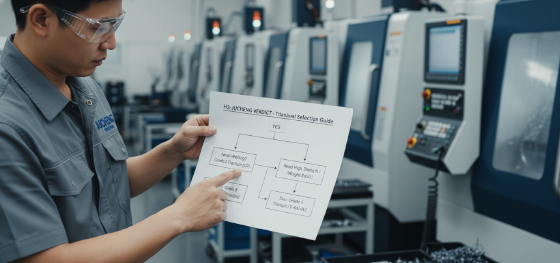
Still unsure? Jucheng Precision uses a simple decision matrix during our DFM reviews:
1. Do you need to weld it extensively? If yes, choose Grade 2. Grade 5 is weldable but difficult and requires heat treatment after welding to restore properties.
2. Is it a load-bearing part? If yes, choose Grade 5. Grade 2 will deform under high stress.
3. Is maximum corrosion resistance the priority? If yes, stick to Grade 2.
Whichever alloy you choose, Jucheng Precision has the dedicated tooling and verification processes to manufacture it correctly. We separate our production lines to prevent cross-contamination and use XRF verification to ensure you get exactly the grade you paid for. Contact us today to discuss your titanium project.

