


Linguistic confusion often masks mechanical reality on the production floor. In the sophisticated landscape of vacuum casting materials, one of the most persistent misunderstandings occurs when an engineer requests "Silicone Molding" but actually requires an industrial-grade plastic prototype. This is the technical standoff of Urethane Casting vs Silicone Molding. At first glance, these terms appear to be synonyms because both involve liquid polymers and flexible tools. However, they represent two diametrically opposite manufacturing philosophies. One utilizes silicone as the vessel to create high-fidelity plastic replicas; the other treats silicone as the end-use material for components that must survive extreme heat or human contact. Choosing the wrong terminology leads to failed quotes and, more dangerously, material choices that are unsuited for the functional destiny of your part.
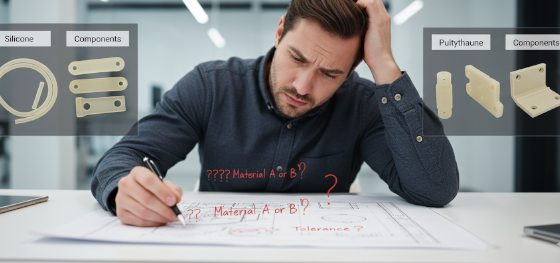
At Jucheng Precision, we act as technical auditors for your specifications. We understand that a medical gasket requiring the biocompatibility of liquid silicone rubber (LSR) demands a completely different tooling strategy than a consumer enclosure that needs the rigidity of an ABS-simulant polyurethane. By integrating our 5-axis CNC machining centers for hard-tooling with our vacuum-assisted casting chambers for soft-tooling, we offer an unbiased manufacturing roadmap. This guide moves past the basic definitions to explore the molecular mechanics of polyurethanes versus silicones, the economic logic of mold longevity, and why JUCHENG’s integrated approach ensures your designs move from a conceptual sketch to a verified physical reality with zero semantic ambiguity.
Efficiency in product development is found in the clarity of the material choice. You aren't just buying a shape; you are buying the chemical and mechanical survival of your design. Let us break down the physical pillars of casting versus molding and see how technical foresight can lock the integrity of your next project into reality.
Terminology Conflict: Defining the Tool vs. the Material
Mechanics of Urethane Casting: The Soft Tooling Standard
Mechanics of Silicone Molding: Engineering End-Use Elastomers
Material Physics: Polyurethanes vs. Pure Silicones
Strategic Comparison: A Technical Decision Matrix
JUCHENG’s Technical Verdict: Matching Process to Lifespan
Terminology Conflict: Defining the Tool vs. the Material
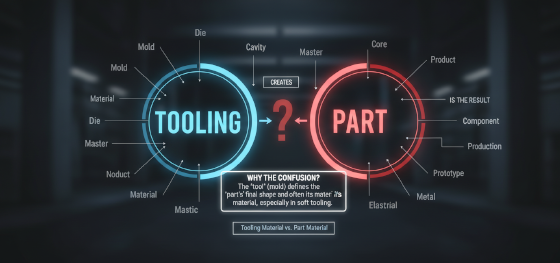
The confusion in the Urethane Casting vs Silicone Molding debate stems from the word "Silicone." In Urethane Casting, silicone is the tool. We build a flexible mold out of liquid silicone rubber to replicate a high-precision master pattern. The end-product, however, is almost always a polyurethane resin. Conversely, in true Silicone Molding, silicone is the material of the part itself. The mold used to shape that silicone is typically a rigid, CNC-machined tool made from aluminum or steel.
At Jucheng Precision, we clarify this distinction during the first DFM review. If you say you need "Silicone Molding" for an electronic bezel, we will ask: "Do you want the part to be squishy and heat-resistant like a baking mat, or do you want it to be rigid and professional like a consumer device?" Understanding whether you are specifying the vessel or the substance is the first step in industrial success. We help our clients move past the linguistic shortcuts, ensuring that the manufacturing process selected satisfies the mechanical requirements of the design rather than just the convenience of the vocabulary. This technical clarity is why JUCHENG is the preferred partner for complex global supply chains where a mix-up in terminology could result in thousands of dollars of unusable prototypes.
Mechanics of Urethane Casting: The Soft Tooling Standard
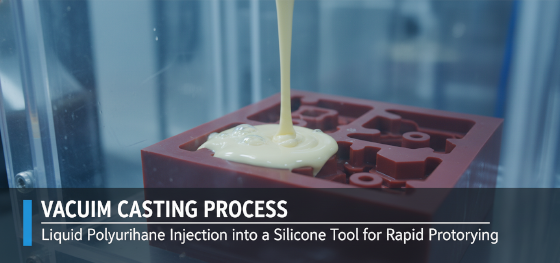
Urethane Casting is the undisputed champion of the high-fidelity prototype. The process begins with a high-precision master pattern—often carved on our 5-axis CNC mills to achieve sub-micron surface finishes. This master is encapsulated in liquid silicone, which is then cured to form a flexible "soft tool." Once the master is removed, we inject two-part polyurethane resins into the cavity under a deep vacuum to ensure every microscopic detail is captured without air bubbles.
This technology thrives in the "Grey Area" of manufacturing—batches of 10 to 50 parts. The flexible nature of the silicone mold allows for extreme geometric freedom; it can stretch to release complex undercuts and internal mounting features that would require expensive slides and cams in a rigid metal tool. At Jucheng Precision, we utilize this "Soft Tooling Standard" to deliver parts that simulate the exact Shore hardness and impact resistance of mass-production plastics. Whether you need a simulated ABS housing or a clear PC lens, the urethane casting path provides a production-grade visual and tactile experience without the six-figure investment of hard tooling. It is the tactical choice for functional validation and pilot marketing runs where the "feel" of the part is a primary mission parameter.
Mechanics of Silicone Molding: Engineering End-Use Elastomers
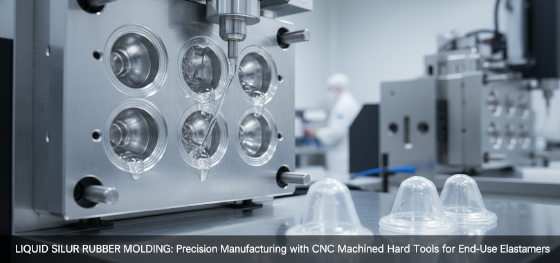
When a design calls for a component that must operate at 200°C or remain non-toxic in a medical fluid path, the choice inevitably shifts toward Urethane Casting vs Silicone Molding in favor of the latter. True silicone molding (often Liquid Silicone Rubber or LSR) is a production process meant for final parts. Instead of a flexible silicone tool, we utilize a rigid, CNC-machined mold. The liquid silicone is injected into this heated tool where it undergoes a rapid thermal cure to become a permanent, durable solid.
The mechanics here are defined by "Hard-Tooling Rigidity." Because the mold is metal, we can hold much tighter dimensional tolerances than a flexible silicone mold. This is why medical tubing connectors, high-heat kitchenware, and industrial vibration mounts are produced via silicone molding. At Jucheng Precision, we leverage our 5-axis milling expertise to carve these metal tools with surgical precision. We treat silicone molding as an end-use manufacturing strategy for elastomers that must survive environments where polyurethanes would soften or degrade. If your part needs the extreme chemical inertness and thermal stability of pure silicone, the metal-mold pathway is the only way to lock in the required structural integrity. We don't just "mold" parts; we engineer the tooling logic that ensures your high-performance elastomers reach the field without a single manufacturing compromise.
Material Physics: Polyurethanes vs. Pure Silicones
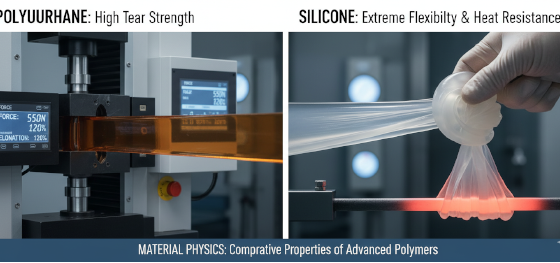
To settle the Urethane Casting vs Silicone Molding debate, one must look at the mechanical destiny of the part. Polyurethanes (the result of urethane casting) are incredibly versatile. They can be engineered to be rock-hard like ABS or flexible like rubber. Their greatest technical asset is "Tear Strength" and "Abrasion Resistance." A urethane part is tough; it is designed to be dropped, hit, and rubbed millions of times without failing. This makes it the premier choice for functional prototypes of gears, handles, and industrial enclosures.
Silicones (the result of silicone molding) win on the "Inertia and Thermal" front. Pure silicone is virtually unaffected by sunlight, ozone, or extreme temperature cycling from -60°C to 250°C. It is naturally biocompatible and hypoallergenic, which is why it dominates the medical device sector. However, silicone is mechanically weak compared to urethane. If you pull on a silicone part, it will stretch significantly but will eventually tear with much less force than a high-performance polyurethane. At Jucheng Precision, we use this material standoff to guide our clients. If your part needs to take a mechanical beating, we recommend a vacuum casting materials strategy using tough polyurethanes. If your part must survive in a high-heat sterilized environment or contact the human body, we advocate for the stability of pure silicone. We bridge the gap between material science and functional survival, ensuring your polymer choice is as resilient as the design intent.
Strategic Comparison: A Technical Decision Matrix
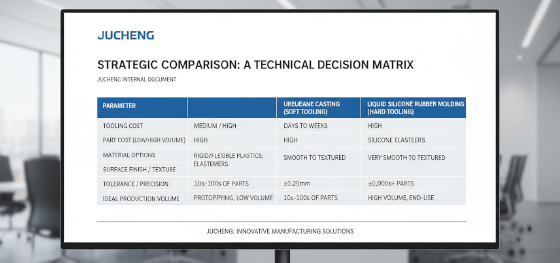
Final selection in the Urethane Casting vs Silicone Molding choice is a matter of strategic pragmatism. To help our clients navigate these options, Jucheng Precision has developed a realistic technical matrix. We look at the quantity, the environment, and the budget to ensure you don't over-invest in hard tooling when a soft tool will suffice.
| Project Variable | Urethane Casting (Soft Tool) | Silicone Molding (Hard Tool) |
|---|---|---|
| Primary Use | High-Fidelity Prototyping | Production End-Use Parts |
| Tooling Material | Liquid Silicone Rubber | Aluminum or Steel |
| Part Material | Polyurethane Resins | Pure Silicone Rubber |
| Typical Volume | 10 - 50 units | 500 - 100,000+ units |
| Lead Time | Fast (5-7 days) | Moderate (3-5 weeks) |
JUCHENG’s Technical Verdict: Matching Process to Lifespan
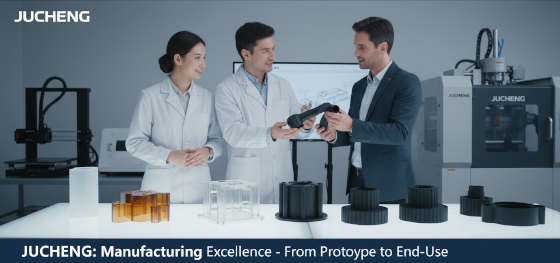
The final hallmark of a world-class manufacturing partner is the ability to provide an unbiased path forward. Jucheng Precision operates a unified facility where the soft-tooling lab and the hard-tooling mill exist in technical harmony. We don't just "sell a process"; we coordinate a solution. We understand that your product development lifecycle is a journey from the flexible to the rigid.
For urgent iterations where you need twenty parts that feel like real plastic, we leverage our urethane casting process to deliver results in days. If your project matures into a permanent medical application requiring liquid silicone, we utilize our secondary manufacturing expertise to scale your production. We provide full material traceability and documented Shore hardness verification for both pathways, giving you the audit trail needed for ISO 13485 and IATF 16949 compliance. When you partner with JUCHENG, you aren't just getting parts; you are getting the benefit of optimized engineering and massive manufacturing capacity. Whether you are building an innovative heart pump or a high-performance EV battery housing, our dual-modality protocols clarify and elevate your most ambitious designs. Contact Jucheng Precision today for a comprehensive technical review and see how our integrated casting and molding solutions can armor your next breakthrough.

