


Your part needs to survive inside a car's engine bay. It will be baked at 150°C. It will be splashed with oil, fuel, and coolant. And it needs to be strong enough to hold its shape for a decade.
An elite material like PEEK can do the job. But PEEK is incredibly expensive. It might make your project's budget impossible. A cheaper material like Nylon will melt or degrade in that environment.
This is a classic engineering dilemma. You need extreme performance, but you also have a real-world budget. The solution is a material that is often overlooked. A high-performance champion that delivers amazing value. This is the world of pps plastic material.
content:
The Engineer's 'Impossible Triangle'
PPS: The Master of Balance
Exceptional Chemical Resistance
A Manufacturer's Perspective
When to Choose PPS
The Engineer's 'Impossible Triangle'

In material selection, engineers often face an "impossible triangle" of choices. You can have two, but it is hard to get all three.
The three choices are: Extreme Performance (heat and chemical resistance), High Mechanical Strength, and Affordable Cost.
PEEK gives you extreme performance and high strength, but it is not affordable. Nylon is affordable and has good strength, but it cannot handle extreme performance.
This is where Polyphenylene Sulfide, or PPS, comes in. It is one of the few materials that finds a brilliant balance in the middle of this triangle.
PPS: The Master of Balance

The personality of pps plastic material is that of a tough, reliable problem-solver. It is one of the most balanced of all high-performance types of plastics.
Its first major strength is its excellent heat resistance. It can operate continuously at temperatures up to 220°C (428°F). This is not as high as PEEK, but it is far higher than most other engineering plastics. This makes it perfect for parts that live in hot environments, like under the hood of a car.
Its second strength is its high rigidity and dimensional stability. PPS is a very stiff material that does not deform under load, even at high temperatures. It also has a very low rate of moisture absorption, so its properties do not change in humid environments.
Exceptional Chemical Resistance

Perhaps the greatest superpower of PPS is its phenomenal resistance to chemicals.
Below 200°C, PPS is resistant to virtually all known solvents. It stands up extremely well to acids, bases, fuels, and automotive fluids. This is a level of resistance that few other plastics can match.
This makes it an essential material in the chemical processing industry. It is used to make pumps, valves, and seals that handle aggressive chemicals all day long.
This combination of heat resistance and chemical resistance is what makes PPS such a unique and valuable problem-solver.
A Manufacturer's Perspective

From a manufacturing point of view, PPS is a well-behaved high-performance material.
In injection molding, it has excellent flow properties. This is especially true for grades that are reinforced with glass fibers or minerals. These reinforcements also dramatically increase its strength and stiffness.
Because of its crystalline structure, it has very low and predictable mold shrinkage. This allows us to mold parts with very tight tolerances and high repeatability.
In CNC machining, PPS is a stable and predictable partner. It is a hard material, so it requires the right tools and speeds. But it does not have some of the internal stress problems that can make other high-performance plastics difficult to machine.
When to Choose PPS
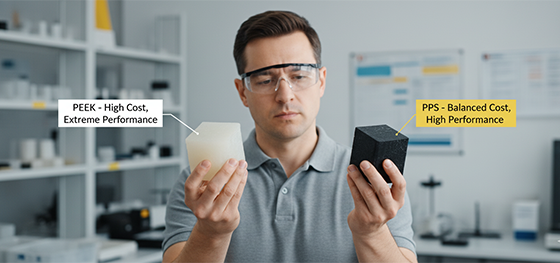
So, when should an engineer choose PPS over other materials?
You should choose pps plastic material when you need a part to survive in a hot, chemically aggressive environment, but the ultimate performance (and ultimate cost) of PEEK is not necessary.
It is the perfect "sweet spot" for many demanding applications. It offers about 80% of the performance of PEEK, but often at a fraction of the cost. This makes it an incredibly smart and value-driven choice.
Think of automotive sensor housings, fuel system components, or industrial pump bodies. These are all jobs where PPS is the perfect champion.
A knowledgeable manufacturing partner can help you analyze your project's specific needs. At JUCHENG, we can help you determine if the balanced, high-value performance of PPS is the right solution to solve your impossible triangle.

