


Integrating thread strength into thin-gauge panels without compromising cosmetic surfaces requires smart mechanical design. Choosing sheet metal rivets over thermal fusing eliminates the risk of warping, while executing precise hardware insertion allows you to build modular, threaded assemblies on thin sheet stock. For hardware engineers, understanding these cold-joining mechanisms is the secret to building lightweight, durable enclosures that survive heavy field vibrations.
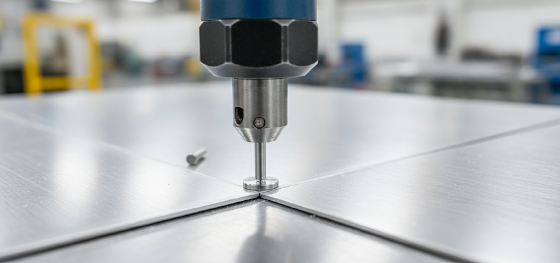
Forcing standard screws directly into thin-gauge metals is a major design failure, as the limited thickness cannot support enough thread engagements, leading to stripped threads and loose joints. Welding is also problematic, as it warps panels and destroys pre-plated or pre-painted finishes. Utilizing self-clinching fasteners and rivets bypasses these thermal and mechanical limits, delivering robust, professional threads on sheets under 1.0mm thick.
Let's analyze why cold-joining outperforms welding on delicate enclosures, compare blind pop rivets against solid structural rivets, and review how to select self-clinching PEM nuts and standoffs for maximum thread reliability.
content:
Why Use Rivets Instead of Welding?
Types of Rivets: Pop Rivets vs. Solid Rivets
Hardware Insertion: PEM Nuts, Standoffs, and Studs
Streamlining Enclosure Assembly
FAQ: Critical Questions About Sheet Metal Rivets
Why Use Rivets Instead of Welding?
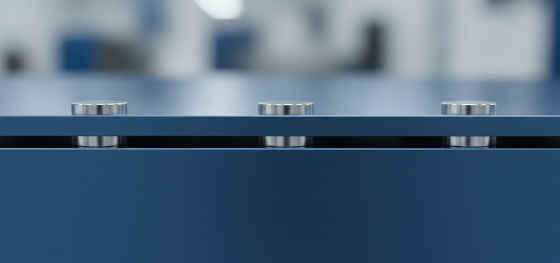
What makes mechanical riveting superior to arc welding on thin enclosures?
Mechanical riveting requires zero heat, completely eliminating thermal warping, protecting pre-plated coatings, and allowing for secure joints between dissimilar metals like steel and aluminum.
Relying on welding for thin sheets often leads to extensive post-weld grinding and straightening labor. The intense heat of an arc warps the metal plate, leaving permanent cosmetic waves that cannot be hidden by paint. Furthermore, welding is restricted to compatible metals; you physically cannot weld aluminum to steel due to metallurgical incompatibility.
Mechanical rivets resolve this by operating entirely at room temperature. The riveting process relies on cold displacement to expand a hollow rivet shank inside pre-punched holes, clamping the sheets together with high force. This allows engineers to combine a lightweight aluminum skin with a strong steel support frame, optimizing both weight and mechanical strength.
Types of Rivets: Pop Rivets vs. Solid Rivets
What is the difference between pop rivets and solid structural rivets?
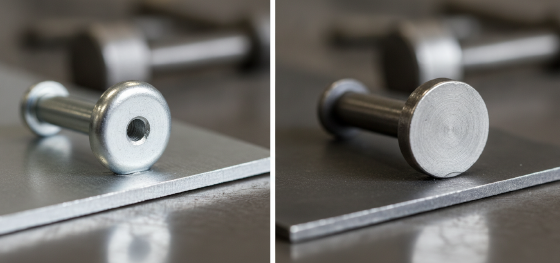
Pop rivets are blind fasteners installed from a single side of the sheet, while solid rivets require access to both sides of the joint to mechanically compress and deform the entire rivet body.
When selecting sheet metal rivets for structural frames, engineers must decide between pop rivets and solid rivets based on load requirements. Blind pop rivets utilize a central mandrel that is pulled by a pneumatic tool. As the tool pulls, the mandrel head expands the hollow sleeve against the back sheet and then snaps off at a pre-cut groove. This makes pop rivets incredibly fast to install on enclosed boxes where the back of the joint is inaccessible.
For maximum shear capacity and vibration resistance, solid rivets are preferred. Installing a solid rivet requires a pneumatic hammer on one side and a heavy bucking bar on the other. This intense squeezing force deforms the solid metal shank to fill the entire mounting hole, creating an exceptionally rigid joint. Solid rivets are highly utilized in aerospace frames and heavy industrial chassis where joint failure is not an option.
Hardware Insertion: PEM Nuts, Standoffs, and Studs
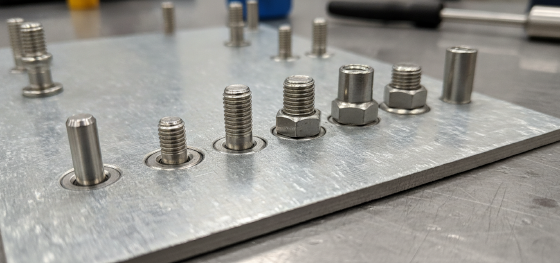
How do self-clinching PEM fasteners integrate secure threads into thin sheets?
PEM fasteners feature a corrugated clinching ring that forces the parent sheet metal to cold-flow into its undercut groove, permanently locking the fastener against high torque-out forces.
Automated hardware insertion utilizing pneumatic presses cold-flows sheet metal around the fastener's groove. This is where self-clinching PEM nuts, standoffs, and threaded studs become the backbone of modern electronics packaging. Instead of tapping threads into thin panels, which strip instantly under minimal load, pressing a PEM nut into a laser-cut hole provides high-strength machine threads that can handle repeated screw engagements.
To ensure successful clinching, the fastener must possess a higher hardness rating than the parent plate. For instance, carbon steel PEM hardware works beautifully in soft aluminum, but stainless steel plates require specialized, hardened stainless fasteners to prevent the clinching groove from collapsing. We utilize specialized hydraulic presses with precise tonnage controls to prevent sheet crushing.
Streamlining Enclosure Assembly

How do JUCHENG's mechanical fastening and PEM insertion services optimize hardware lead times?
We operate high-precision pneumatic press workstations with automated bowl-feeders, rapidly inserting hundreds of PEM fasteners per hour while maintaining exact parallel alignments.
As the critical final step in the comprehensive sheet metal fabrication process, hardware integration dictates the structural alignment of the final assembly. JUCHENG integrates these advanced cold-joining and PEM insertion systems into our full-service production lines. This allows us to transition your flat plates into fully assembled, modular enclosures with high geometric precision.
We manage a diverse inventory of raw sheets, including lightweight aluminum, high-strength stainless steel, and easily formable carbon steel. Our engineering queue provides a 24-hour free DFM analysis, checking your CAD models for hole clearances and flange-to-edge limits to prevent deformation near the press lines. Supported by our no MOQ policy and rapid delivery cycles, we provide a unified partner for your custom sheet metal assembly and enclosure manufacturing needs.
FAQ: Critical Questions About Sheet Metal Rivets

What is the difference between pull-out force and torque-out resistance in self-clinching hardware?
Pull-out force measures the axial load required to physically strip or pull the PEM insert straight out of the sheet, while torque-out resistance measures the rotational force required to spin the fastener inside the hole, which would ruin the joint. Both metrics must be calculated based on the sheet hardness and thickness to prevent assembly failures.
Can self-clinching PEM fasteners be installed in pre-painted or powder-coated sheets?
No, PEM hardware must be pressed into bare, uncoated sheets. Pressing the serrated clinching ring through a hard powder-coated surface will crack the paint, compromising the local corrosion resistance and preventing the metal from cold-flowing cleanly into the undercut groove.
How do you calculate the correct hole size for self-clinching fasteners?
The mounting hole must be laser-cut or punched to an extremely tight tolerance, typically within +0.08mm. If the hole is too large, there will not be enough sheet metal to flow into the clinching groove, resulting in a joint with poor torque-out resistance; if the hole is too small, the sheet will warp or buckle under the press.
Do sheet metal rivets provide airtight seals?
Standard hollow pop rivets are not airtight because the mandrel path leaves a small channel through the center. However, we resolve this on airtight enclosures by utilizing closed-end blind rivets, which feature a solid, sealed cup-shaped sleeve that prevents any moisture or gas ingress.

