


Structuring reliable, cost-effective industrial control housings, battery containers, or electronics casings requires deep mechanical insight. Executing robust sheet metal box design allows engineers to optimize manufacturing efficiency and minimize raw material waste while ensuring high structural rigidity under heavy mechanical stress. For product developers, this foundational mechanical assembly is the most common geometry used to isolate and protect high-value circuit boards and delicate power supplies.
Suffer from loose enclosure corners, misaligned mounting screw holes, or warped panels that require tedious manual correction on the line? When a simple casing is modeled without proper bend clearances, relief cuts, or joint selection, it leads to high reject rates and slow, labor-intensive welding steps. Proactively optimizing your casing split style, fastening method, and surface treatment is the best way to secure your product's dimensional accuracy.
Let's compare U-shape and L-shape assembly configurations, analyze the mechanical trade-offs between thermal welding and cold mechanical riveting, and explore how professional powder coatings protect raw panels from rust.
content:
U-Shape vs. L-Shape Box Assemblies
Joining the Box: Spot Welding vs. Rivets
Surface Treatments for Industrial Boxes
Low-Volume Sheet Metal Box Production at JUCHENG
FAQ: Critical Questions About Sheet Metal Box Design
U-Shape vs. L-Shape Box Assemblies
What are the primary geometry options when splitting a custom metal box into multiple parts?
The most common configurations are U-shape splits, which utilize two nested U-shaped channels, and L-shape splits, which utilize two L-shaped panels combined with flat walls.
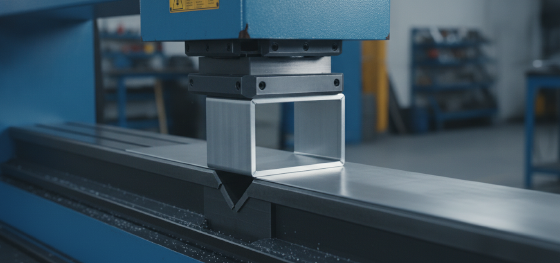
The primary structural goal of any enclosure assembly is to maximize structural rigidity while keeping material thickness minimal. For standard rectangular cases, designers frequently deploy a nested U-shape split. This assembly utilizes a bottom U-shaped channel that serves as the base and side walls, mated to a top U-shaped cover. This nested geometry is highly rigid and simplifies slide-in mounting rails for internal components.
Alternatively, an L-shape split utilizes two identical L-shaped panels that interlock. This design is highly economical for low-volume production because it standardizes the flat patterns, allowing operators to run identical programs on press brakes. However, L-shape splits require fastening along three distinct seam lines, which demands more hardware or longer welding run times compared to U-shape configurations.
Joining the Box: Spot Welding vs. Rivets

What is the best joining method to secure overlapping flanges on custom boxes?
We utilize high-speed spot welding for permanent, sealable seams, or specify mechanical pop rivets to join dissimilar metals without thermal warping.
When implementing sheet metal box design projects, choosing the most efficient joining method is critical to minimizing localized warping. Resistance spot welding is the industry standard for securing overlapping steel flanges. It uses high electrical currents to fuse the metal instantly, creating a clean, permanent joint with zero external hardware protrusions.
However, spot welding is restricted to compatible metals and can destroy pre-plated or pre-painted surface layers. To avoid thermal damage, designers utilize mechanical blind rivets. Riveting operates entirely at room temperature, allowing you to secure pre-coated sheets or join aluminum covers to carbon steel bases without any risk of thermal warping or paint chipping.
Surface Treatments for Industrial Boxes
How do you protect raw steel and aluminum boxes from environmental corrosion?
We apply electrostatic powder coatings to seal steel surfaces, or perform chemical passivation and anodizing to protect raw aluminum.
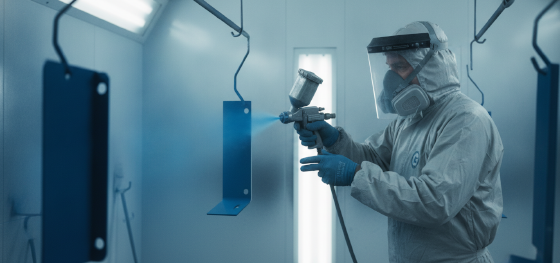
Raw metal straight out of the welding booth is highly vulnerable to oxidation. For carbon steel enclosures, applying a robust, durable coating is mandatory to prevent rapid rust. We execute multi-stage chemical pre-treatment washes to degrease and etch the surfaces, followed by electro-statically spraying high-grade powder coating over the entire body, creating a continuous, impact-resistant protective barrier.
For lightweight aluminum and stainless steel cases, we utilize chemical conversion coatings (such as chromate conversion or passivation). This treatment builds a microscopic protective film without altering the part's electrical grounding capabilities. It provides a clean, conductive contact point, which is crucial for grounding internal electronic components inside custom housings.
Low-Volume Sheet Metal Box Production at JUCHENG
How does JUCHENG ensure consistent tolerances and finishes on custom boxes?
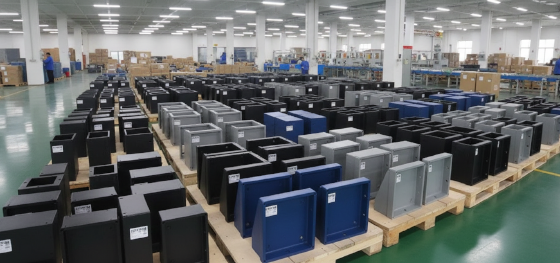
We operate high-power fiber laser cutters, CNC press brakes, and automated insertion lines managed by skilled technicians, checking alignments before cutting.
Integrating these calculated bend limits, assembly styles, and surface finishes into your early sheet metal design cycle is the single most effective way to eliminate production defects. JUCHENG integrates these advanced geometric and material validations into our digital manufacturing network, ensuring that your CAD files translate into fully finished, durable assemblies with extreme dimensional precision.
We process a wide range of raw sheets, including lightweight aluminum, high-yield stainless steel, and easily formable carbon steel. Our technical department provides a 24-hour free DFM analysis to check your CAD models, checking tolerances and tool clearances before production. Supported by our no MOQ policy and rapid delivery guarantee, we manage your project from initial flat pattern cutting to final packaging and assembly.
FAQ: Critical Questions About Sheet Metal Box Design
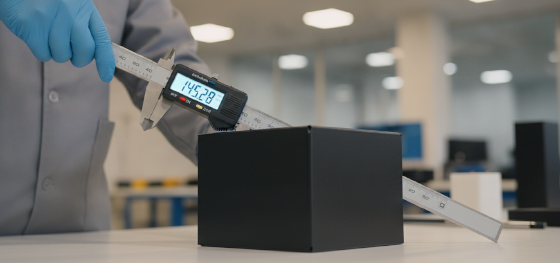
What causes corner gaps in U-shaped box lids, and how do we prevent them?
Corner gaps occur when the flat pattern unfolding software neglects the physical bend deduction or when the press operator uses incorrect die openings. We prevent these gaps by calibrating our CAD software with empirical K-factor data for every gauge we stock, ensuring the folded flanges meet exactly to form a tight, dustproof seam.
How do you design a custom box to handle heavy internal mounting weights?
To support heavy components like transformers, we recommend designing internal structural ribs or utilizing thicker gauge plates for the base panel. Designing formed flanges along the bottom edges also acts as integrated support beams, significantly increasing the structural load limit without adding extra parts.
Why is pre-plating important before joining overlapping steel flanges?
Welding raw carbon steel overlaps creates enclosed gaps that are inaccessible to powder spray nozzles. These bare areas are highly prone to moisture condensation and rapid interior rust. Applying electro-galvanized or pre-plated steel sheets ensures that the hidden overlaps are protected, preventing rust from creeping from the inside out.
How does JUCHENG prevent tool marks on delicate cosmetic surfaces?
We protect the soft, delicate surfaces of raw aluminum and polished stainless steel sheets during press brake operations by utilizing specialized polyurethane die inserts or applying high-density protective vinyl masking films. This prevents direct metal-on-metal friction between the steel tooling and the sheet, delivering clean, scratch-free decorative faceplates ready for immediate coating.

