


Transitioning a new hardware enclosure from high-mix prototyping into continuous mass production is a massive economic milestone. When your assembly requires complex sheet profiles and repeatable tolerances, opting for sheet metal stamping provides the extreme speed and low per-piece costs needed to secure your market margins. This process utilizes high-pressure mechanical press lines to deform flat raw coils into fully formed components in a single, continuous stroke.

Traditional hand-crafted fabrication becomes a massive financial drain once you surpass a few hundred units. Running laser cutters and manual press brakes all day drags down your profit margins and leaves your project vulnerable to dimensional variation. Transitioning to a dedicated die press system completely bypasses these bottlenecks.
Balancing upfront tooling expenses against low per-piece costs is the central challenge for procurement managers. Let's dissect the engineering physics behind progressive and compound dies, evaluate how stamping outperforms standard bending, and learn how our agile tooling strategies protect your launch budget.
content:
How Sheet Metal Stamping Works
Stamping Dies vs. Traditional Fabrication
Rapid Tooling for Stamping Dies
Cost-Effective Stamping Production at JUCHENG
FAQ: Critical Questions About Sheet Metal Stamping
How Sheet Metal Stamping Works
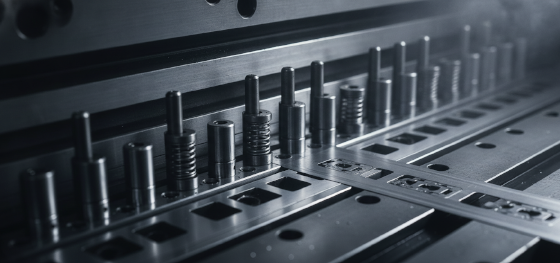
What is the physical mechanism of sheet metal stamping?
The process drives a raw metal plate between a customized punch and die set under high force, causing the material to plastically deform or shear into a targeted shape.
Understanding the difference between compound and progressive dies is essential to managing your capital investment. Progressive tooling feeds a continuous strip of raw alloy through a sequence of multiple stations, with each station performing a specific cut or bend. Once the strip reaches the final station, the completed component is blanked out and falls from the press.
In contrast, compound dies execute multiple shears or forming steps simultaneously in a single stroke of the press. While compound tooling is ideal for flat patterns like washers, progressive setups allow us to create highly complex three-dimensional enclosures. This mechanical automation maximizes production speeds, allowing us to hit hundreds of units per minute with perfect consistency.
Stamping Dies vs. Traditional Fabrication
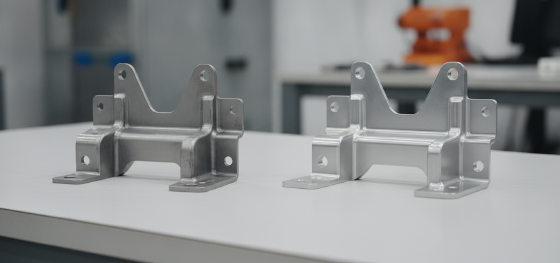
When is stamping more cost-effective than standard laser and brake bending?
Stamping becomes the most economical choice once production volumes exceed five hundred units, as the extremely low per-part price quickly absorbs the upfront die costs.
Comparing sheet metal stamping to traditional manual fabrications highlights a profound shift in production economics. For low volumes, relying on manual laser slicing and brake forming is the standard sheet metal fabrication process, offering maximum flexibility with zero die costs. However, once you scale, manual run-time costs will slowly drain your budget.
| Production Variable | Matched Die Stamping | Traditional Fabrications |
|---|---|---|
| Tooling Expense (NRE) | High (Custom steel dies) | Zero (Software-driven setup) |
| Per-Piece Part Price | Extremely Low (Pennies at volume) | High (Heavy manual labor) |
| Cycle Time per Feature | Milliseconds | Minutes |
| Dimensional Consistency | Excellent (Near zero drift) | Moderate (Subject to operator drift) |
By investing in custom dies, you eliminate the slow, labor-intensive sheet metal fabrication process steps, delivering ready-to-assemble stampings in days. This transition completely protects your margins as your product achieves commercial success in the market.
Rapid Tooling for Stamping Dies
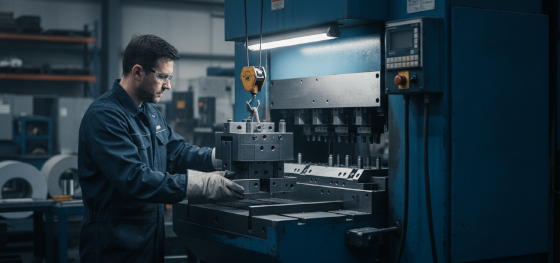
Can stamping tooling be adapted for low-volume prototyping runs?
Yes, we utilize modular die bases and softer steel alloys to create rapid mold setups, lowering upfront NRE costs by up to fifty percent.
Traditional progressive dies require months of intensive CNC machining and optical grinding, making them impractical for fast-paced development cycles. To bridge this gap, our engineering team implements rapid tooling strategies that utilize pre-machined master mold bases.
By only machining the custom active inserts rather than a complete die set, we dramatically compress your lead times. This allows you to test functional, stamped metal prototypes using production-grade materials before finalizing your design. It delivers the speed of rapid prototyping with the physical characteristics of mass production.
Cost-Effective Stamping Production at JUCHENG
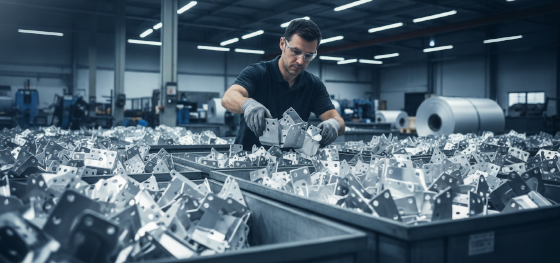
How does JUCHENG deliver cost-effective stamping services?
We run high-speed mechanical press lines with custom-tailored die inserts, matching tool geometry to your selected material class to prevent stamping failures.
Why struggle with slow delivery times? Our automated sheet metal stamping press lines are fully integrated into our digital network, allowing us to move from computer drawings to high-speed blanking runs in record time. We manage the entire tooling and press operations in-house.
We process a wide range of metal sheets to support your specific application, including lightweight aluminum, high-yield stainless steel, and easily formable carbon steel. Our technical queue provides a 24-hour free DFM analysis to evaluate your CAD models, checking punch parameters and strain limits before we cut steel. Supported by our no MOQ policy and rapid delivery guarantee, we provide agile support for your prototyping runs and volume production demands.
FAQ: Critical Questions About Sheet Metal Stamping
How do you control metallurgical wrinkling during a deep stamping strike?
We prevent wrinkling by adjusting our blank-holding forces on the press. Utilizing custom spring pressure or hydraulic blank-holding systems maintains uniform tension on the sheet flange, allowing the metal to slide smoothly into the die cavity without buckling.
What are the main causes of punch slippage and premature tool wear?
Tool wear is typically caused by insufficient lubrication, running hard alloys without proper surface coatings, or using improper clearance gaps between punch and die. We resolve this by running automated spray systems and applying premium physical vapor deposition (PVD) coatings to our tool steel punch heads.
Is aluminum stamping more difficult than steel stamping?
Aluminum possesses lower ductility and a higher risk of outer-edge cracking compared to soft low-carbon steel. To stamp aluminum successfully, we use larger bend radii, customize our die clearances, and apply highly polished draw rings to prevent material buildup on the tooling surfaces.
How does JUCHENG avoid edge burrs and shearing defects during high-speed stamping runs?
We manage burrs by implementing precise, material-specific punch clearances on our press lines. Our toolmakers perform automated sharpening cycles on all tool steel punches, maintaining clean, localized shear stresses that keep the cut edges completely smooth.

