


When you see a bright blue or gold screw in a surgical kit, your first instinct might be to think it is painted. It isn't. If you scratch it, the color doesn't chip off like paint. This is the magic of anodized titanium. Unlike aluminum anodizing, which opens up pores in the metal to accept colored dyes, titanium anodizing involves no pigments, no dyes, and no harsh chemicals. It is a manipulation of physics itself.
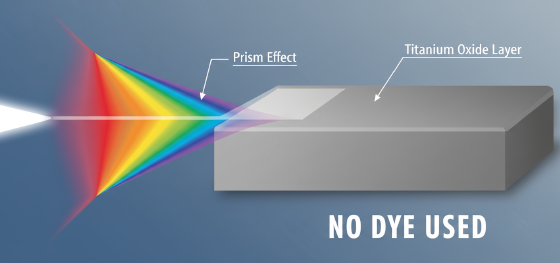
This unique surface treatment is critical for the medical and aerospace industries, not just for aesthetics, but for functionality and safety. At Jucheng Precision, we integrate this process directly into our titanium cnc machining workflow, delivering parts that are not only dimensionally perfect but also finished to strict AMS and medical standards.
Whether you need Type 2 for wear resistance or Type 3 for color coding, understanding the science behind the spectrum will help you specify the right finish for your product.
The Science: Magic of Interference
Type 2 vs Type 3: Grey vs Rainbow
Medical Color Coding: A Surgeon's Friend
Anti-Galling: Lubricity without Grease
The Process: Voltage Controls Color
JUCHENG's Capability: The Art of Racking
The Science: Magic of Interference
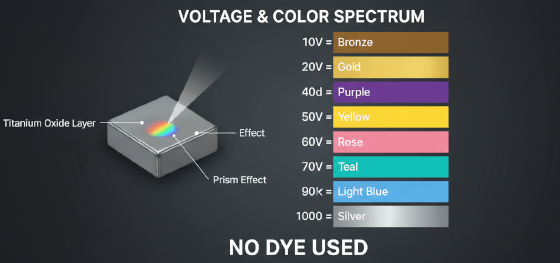
How can a metal change color without dye? The answer lies in "Thin Film Interference," the same phenomenon that creates rainbow colors in soap bubbles or oil slicks on water.
By applying an electric current to the titanium part in an electrolyte bath, we force an oxide layer ($TiO_2$) to grow on the surface. This layer is transparent. However, depending on its thickness (which we control with voltage), it refracts light. Part of the light reflects off the top of the oxide layer, and part of it travels through and reflects off the base metal. When these light waves recombine, certain wavelengths cancel out while others are amplified. Your eye perceives this as color. It is pure structural color, making it biocompatible and impossible to peel off.
Type 2 vs Type 3: Grey vs Rainbow
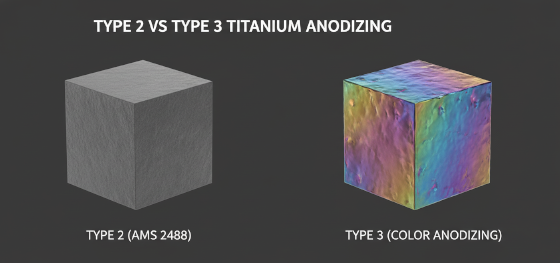
In the aerospace and medical worlds, we generally categorize anodized titanium into two distinct types based on the AMS 2488 standard.
Type 2 (Dark Grey): This process uses higher voltages and specialized electrolytes to build a thick, hard, and porous oxide layer. It is not decorative. Its primary purpose is to increase wear resistance and prevent seizing. It typically has a matte, dark grey appearance.
Type 3 (Color): This is the decorative or identification finish. The oxide layer is much thinner. By varying the voltage from roughly 10V to 100V, we can achieve a spectrum ranging from bronze (low voltage) to blue, yellow, pink, and finally green (high voltage).
Medical Color Coding: A Surgeon's Friend
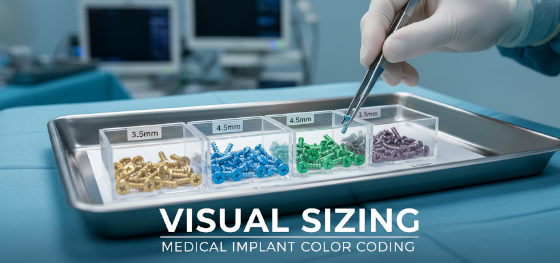
Why do medical companies care so much about Type 3 color anodizing? Imagine a trauma surgery. The surgeon has seconds to choose the correct bone screw.
A 3.5mm screw looks almost identical to a 4.0mm screw under bright operating theater lights. A mix-up could crack a patient's bone or fail to hold a fracture. By anodizing all 3.5mm screws Blue and all 4.0mm screws Green, the manufacturer eliminates human error. This "Visual Sizing" is a mandatory safety feature for many orthopaedic and dental implant systems. Because no dyes are used, the parts remain 100% sterile and non-toxic inside the human body.
Anti-Galling: Lubricity without Grease

Titanium has one major weakness: it has a high coefficient of friction against itself. If you force a raw titanium bolt into a titanium nut, they will often "gall" or cold-weld together, seizing permanently.
Anodizing solves this. The oxide layer created (especially Type 2) acts as a hard ceramic-like shell. It separates the base metals and provides a "dry lubrication" effect. This is essential for aerospace fasteners and adjustable medical implants where parts must slide or thread smoothly without lubricants, which are often banned in vacuum or sterile environments.
The Process: Voltage Controls Color
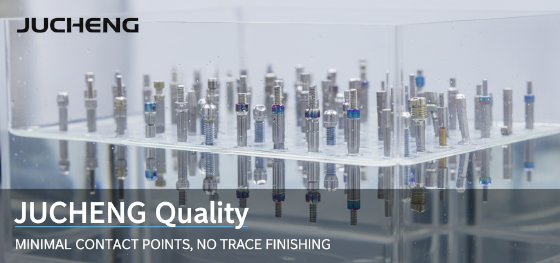
The beauty of this process lies in its precision. Unlike painting, where you might have batch-to-batch variation, voltage control is absolute.
If we set the power supply to exactly 25.0 Volts, the titanium will grow an oxide layer of a specific nanometer thickness, resulting in a specific shade of Blue—every single time.
• 10-15V: Bronze / Brown
• 25-30V: Blue
• 45-50V: Yellow / Gold
• 65-70V: Pink / Purple
• 90-100V: Green / Teal
At Jucheng Precision, we use digital power supplies to ensure that the gold screw you order today matches the gold screw you ordered three years ago perfectly.
JUCHENG's Capability: The Art of Racking
The most difficult part of anodizing isn't the chemistry; it's the "Racking." To pass electricity into the part, you must physically touch it with a titanium fixture. Where you touch it, the anodizing won't form (a contact mark).
If the contact point is on a visible surface or a critical thread, the part is scrapped. Jucheng's engineers design custom racking fixtures that hold the part internally or on non-critical waste tabs that are removed later. We ensure 100% coverage on the surfaces that matter. From CNC machining to final color finishing, we handle the entire chain in-house, ensuring your titanium parts arrive ready for the operating room or the launch pad.

