


Walk into any aerospace hangar, and you will be surrounded by two metals: Aluminum and Titanium. They are the twin pillars of modern flight. Both are silver, both are non-magnetic, and both are revered for being "lightweight." But peering under the skin of a jet fighter reveals a strict segregation. The fuselage skin is aluminum; the engine exhaust cones are titanium.

Why? The battle of titanium vs aluminum is not a contest of good versus bad. It is a contest of specific physics. Aluminum is the king of low-cost light-weighting, while titanium is the master of high-stress survival.
At Jucheng Precision, we often see designs where engineers over-spec titanium when aluminum would suffice, wasting budget. Conversely, we see aluminum specified in high-heat zones where it will inevitably fail. This guide breaks down the physical, thermal, and economic boundaries between these two aerospace giants.
The Weight Champion: Aluminum
Strength-to-Weight: The Titan
The Heat Limit: Where Aluminum Fails
Machinability and Cost Gap
Fatigue Life: The Infinite Cycles
JUCHENG's Verdict: The Decision Matrix
The Weight Champion: Aluminum

Let's clear up a massive misconception immediately: Titanium is NOT lighter than Aluminum. In fact, it is significantly heavier.
Aluminum (6061/7075): Density is ~2.7 g/cm³.
Titanium (Ti-6Al-4V): Density is ~4.43 g/cm³.
Physics doesn't lie. If you machine two identical chess pieces, one from aluminum and one from titanium, the titanium piece will weigh roughly 60% more. Therefore, if volume is your primary constraint (e.g., you have a fixed-size housing for a drone), Aluminum is the undisputed winner for weight reduction. It allows you to build bulky, stiff structures that float on water.
Strength-to-Weight: The Titan
So, why do we use titanium if it's heavier? Because it is exponentially stronger.
A high-end aluminum alloy like 7075-T6 has a yield strength of about 503 MPa. Titanium Grade 5 hits 900-1100 MPa. Titanium is practically twice as strong. This brings us to the "Strength-to-Weight Ratio." Even though titanium is heavier per cubic centimeter, you need less of it to hold the same load.
For a landing gear strut, an aluminum version would need to be massively thick to prevent buckling. A titanium version can be a slender, elegant tube. In space-constrained applications, titanium wins because it packs more strength into a smaller package.
The Heat Limit: Where Aluminum Fails

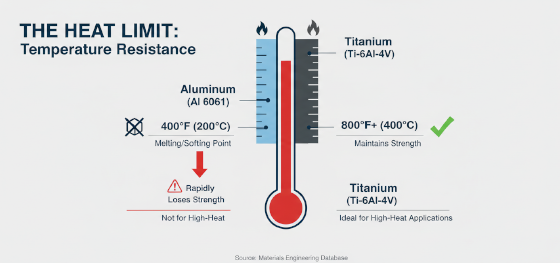
This is the dealbreaker. The temperature capability is usually the deciding factor in the titanium vs aluminum debate.
Aluminum has a relatively low melting point (~660°C), but it starts to lose its structural integrity much earlier. At just 150°C (300°F), aluminum alloys begin to soften and weaken drastically. They anneal themselves.
Titanium, on the other hand, maintains its strength well up to 400°C (750°F) or higher depending on the alloy. This is why you will never see aluminum inside the hot section of a jet engine or near a racing exhaust manifold. It would warp or melt. Titanium thrives in this "Warm Zone" where aluminum fails but heavy steel is not yet required.
Machinability and Cost Gap
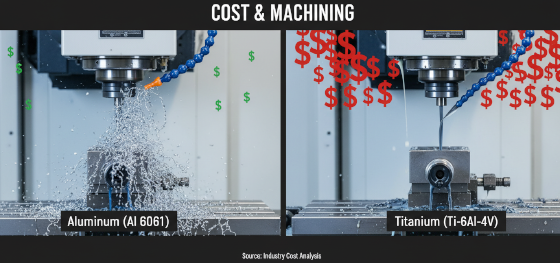
For the procurement manager, the difference is painful. Aluminum is the most abundant metal in the earth's crust; Titanium is difficult to refine.
Material Cost: Titanium costs 7x to 10x more than Aluminum per kilogram.
Machining Cost: Aluminum is "Free Machining." We can run our CNC machines at 12,000 RPM, removing material rapidly with minimal tool wear. Titanium requires slow speeds, specialized cooling, and expensive tooling to prevent work hardening.
When we provide quotes for titanium cnc machining versus aluminum machining, the price difference can be stark. If your part does not need the heat resistance or extreme strength of titanium, staying with aluminum is the single best way to reduce project costs.
Fatigue Life: The Infinite Cycles
There is one final hidden property: Fatigue Limit.
Aluminum does not have a distinct fatigue limit. This means that no matter how small the stress, if you cycle aluminum enough millions of times (bend it back and forth), it will eventually crack and fail. It has a finite lifespan.
Titanium (like steel) has a true endurance limit. If the stress is kept below a certain threshold, the part can theoretically cycle infinitely without failing. This makes titanium the superior choice for dynamic parts like springs, helicopter rotor hubs, and medical implants that must survive millions of heartbeats or rotations.
JUCHENG's Verdict: The Decision Matrix
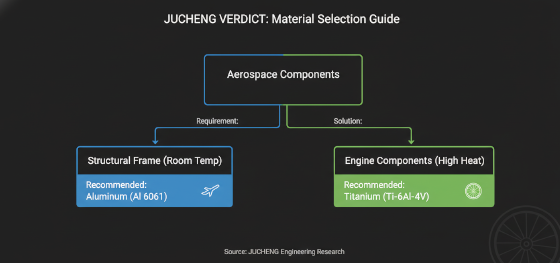
Making the right call requires looking at the environment your part will live in.
Stick to Aluminum if:
• The operating temperature is below 150°C.
• You need maximum weight savings for a given volume (bulk).
• Cost is a primary concern.
• You want to anodize the part in bright colors for aesthetics.
Upgrade to Titanium if:
• The part faces temperatures between 150°C and 450°C.
• You need high strength in a thin, compact space.
• The part will be exposed to saltwater or harsh chemicals.
• The part undergoes cyclic loading (fatigue).
Jucheng Precision is equipped to handle both. We have high-speed spindles dedicated to aluminum and high-torque machines dedicated to titanium. Send us your requirements, and we will help you manufacture the perfect balance of performance and price.

