


They are both silver. They are both corrosion-resistant. They are both used in the most demanding engineering environments on Earth. Yet, the choice between Titanium and Stainless Steel is often a battle between physics and economics.
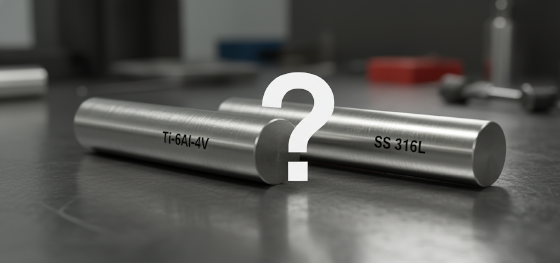
If you are building a Formula 1 suspension arm, you choose Titanium because every gram saved translates to speed. If you are building a food processing tank, you choose Stainless Steel because it offers hygiene at a fraction of the price. The debate of titanium vs stainless steel is not about which metal is "better" in absolute terms; it is about which metal is efficient for your specific constraints.
At Jucheng Precision, we machine tons of both materials. We see the invoices, and we see the tool wear. This guide provides an unfiltered look at the trade-offs, helping you decide if the "Titanium Premium" is worth paying.
content:
The Weight Factor: The 45% Rule
Strength-to-Weight: The Real Metric
Corrosion: Good vs Perfect
Thermal Conductivity and Machining
Cost Analysis: The 5x Multiplier
JUCHENG's Verdict: Budget vs Performance
The Weight Factor: The 45% Rule
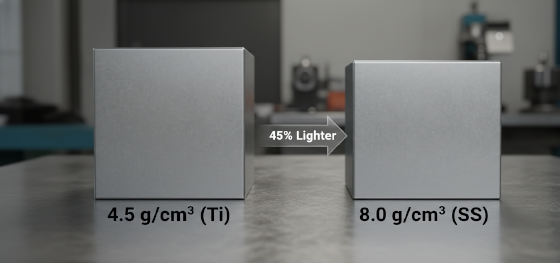
The most immediate difference between these two metals is density. This is usually the primary driver for switching to titanium.
Stainless Steel (304/316): Density is approximately 8.0 g/cm³.
Titanium (Ti-6Al-4V): Density is approximately 4.43 g/cm³.
Titanium is roughly 45% lighter than steel. For a static part like a table leg, this is irrelevant. But for a moving part—like a connecting rod in an engine or a robotic arm—that weight reduction drastically reduces inertia. In aerospace, where every kilogram of payload costs thousands of dollars in fuel over a plane's lifetime, titanium's low density pays for itself.
Strength-to-Weight: The Real Metric
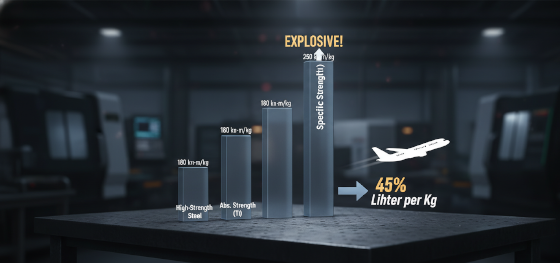
There is a common misconception that titanium is "stronger" than steel. This is not always true. High-strength martensitic stainless steels (like 17-4 PH) can achieve yield strengths comparable to or even higher than Titanium Grade 5.
However, steel achieves this strength while being heavy. Titanium achieves it while being light. This is why we measure Strength-to-Weight Ratio (Specific Strength). In this metric, titanium is unmatched. It provides the structural integrity of steel at nearly half the weight. This allows engineers to design thinner, lighter structures without compromising safety factors.
Corrosion: Good vs Perfect
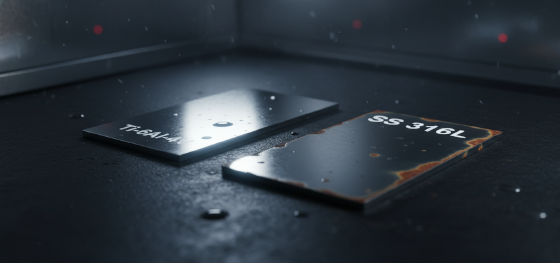
Both metals rely on an oxide film to protect them from rust, but the quality of that protection differs.
Stainless Steel (316L): It is excellent for general use. However, in warm saltwater or environments with low oxygen circulation (crevices), the passive layer can break down, leading to pitting or crevice corrosion.
Titanium: It is virtually immune to seawater, chlorine, and most acids. Its oxide film regenerates instantly. In a titanium vs stainless steel salt spray test, titanium will remain pristine indefinitely, while stainless steel will eventually show signs of attack. For subsea or offshore applications, titanium is the "install and forget" solution.
Thermal Conductivity and Machining
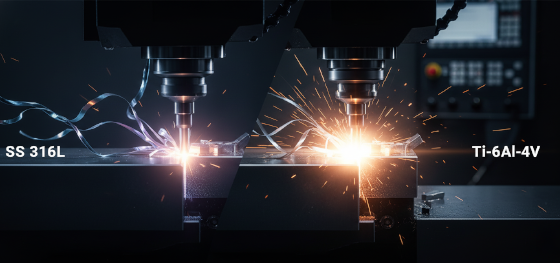
This is where the manufacturing cost enters the equation. The physical properties of these metals dictate how easy—or hard—they are to cut.
Stainless steel is a relatively poor conductor of heat, but Titanium is significantly worse. During CNC machining, stainless steel chips will carry away about 50% of the heat. Titanium chips carry away almost none.
This means that in titanium cnc machining, the heat concentrates at the tool tip, causing rapid failure if not cooled aggressively. Additionally, titanium has a lower modulus of elasticity (it is springy). It tends to deflect away from the cutter, causing chatter and tolerance issues, whereas steel is rigid. Machining titanium requires slower speeds, more expensive tooling, and more rigid setups than steel.
Cost Analysis: The 5x Multiplier
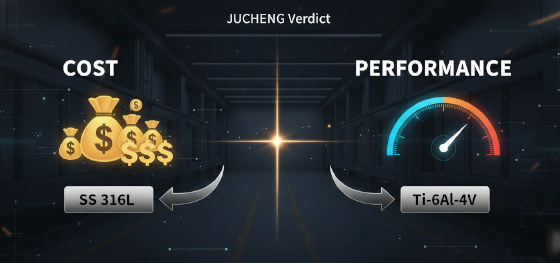
Let's be honest about the budget. Titanium is a premium material.
Raw Material: Titanium Grade 5 bars can cost 5 to 10 times more per kilogram than Stainless Steel 304.
Machining Time: Because we must run the machines slower to protect the tools, the "cycle time" for a titanium part is typically double that of a steel part.
When you combine expensive stock with slow machine time and high tooling consumption, the final part price for titanium can be 5x to 10x higher than its stainless steel counterpart. This is why you rarely see titanium bolts on a standard office chair.
JUCHENG's Verdict: Budget vs Performance
So, which metal wins? It depends on what you are optimizing for.
Choose Stainless Steel if:
• Weight is not a critical constraint.
• The budget is tight.
• The environment is standard (food, medical tools, indoor structures).
• You need magnetic properties (some 400 series steels).
Choose Titanium if:
• The part flies, races, or enters the human body (implants).
• Weight reduction is worth paying a premium.
• The environment involves extreme salt, chlorine, or chemicals.
At Jucheng Precision, we offer expert DFM (Design for Manufacturing) reviews for both materials. If your design specifies Titanium but doesn't strictly need it, we might suggest switching to 17-4 PH Stainless to save you money. Conversely, if you need the ultimate performance, we have the 5-axis capabilities to machine Ti-6Al-4V to perfection. Upload your CAD file today for a comparative quote.

