


Machining titanium is not about luck; it is about physics. If you treat titanium like aluminum and try to run it at 10,000 RPM, you will not just break a tool. You will likely weld the cutter to the part, destroy the spindle, or in the worst-case scenario, start a Class D metal fire.
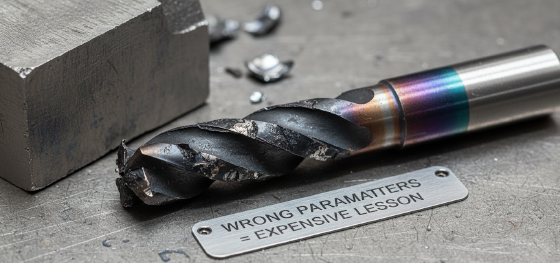
The phrase Titanium Machining Speeds and Feeds strikes fear into the hearts of inexperienced operators. Titanium is unique because it combines low thermal conductivity with high chemical reactivity and a tendency to work-harden instantly. Success requires a complete inversion of standard machining logic: you must slow down the rotation, but you must be aggressive with the feed.
At Jucheng Precision, our titanium cnc machining process is built on decades of data. We don't guess. We calculate. This guide reveals the technical parameters we use to keep tools cool and parts precise, helping you understand why we are the trusted partner for difficult aerospace and medical alloys.
The Thermal Trap: Why Speed Kills
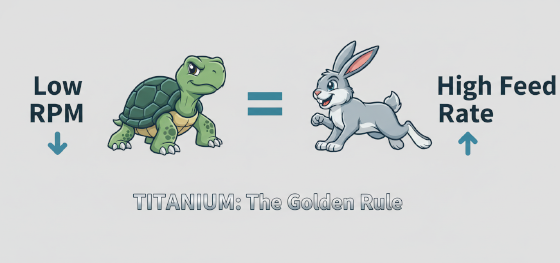
The Golden Rule: Low Speed, High Feed
Starting Numbers: SFM Guidelines
Chip Thinning and Dynamic Milling
Coolant: Volume, Pressure, and Safety
JUCHENG's Engineering Edge
The Thermal Trap: Why Speed Kills
To optimize speeds and feeds, you must first understand where the heat goes. In steel machining, about 50% of the heat goes into the chip. In aluminum, it is nearly 80%. This means the chip acts as a heat sink, carrying thermal energy away from the tool.
Titanium is different. It is a thermal insulator. It refuses to absorb heat, and it refuses to let the heat transfer into the chip. Consequently, nearly 80% to 90% of the heat generated by friction concentrates directly on the cutting edge of the tool. If you run high Surface Feet per Minute (SFM), the temperature at the tool tip will skyrocket past 1000°C in milliseconds. At this temperature, the titanium chemically reacts with the tool material, leading to rapid crater wear and catastrophic failure. Therefore, the first rule is: Speed Kills. You must reduce your RPM to keep the thermal load manageable.
The Golden Rule: Low Speed, High Feed
While we must lower the RPM (Speed), we absolutely cannot lower the Chip Load (Feed). This seems counter-intuitive to new machinists who want to "baby" the cut, but light cuts are fatal in titanium.
Titanium is prone to work hardening. If the tool rubs against the surface before cutting, the friction instantly hardens the material skin. If your feed rate is too low, the cutting edge just rubs, creating a hardened layer that destroys the tool on the next rotation. We follow the "Feed or Flee" principle. We ensure the specific Chip Load Per Tooth (IPT) is high enough to force the cutter to bite deep into the bulk material, underneath the hardened skin. You must be cutting, or you must be retracted. Never dwell.
Starting Numbers: SFM Guidelines
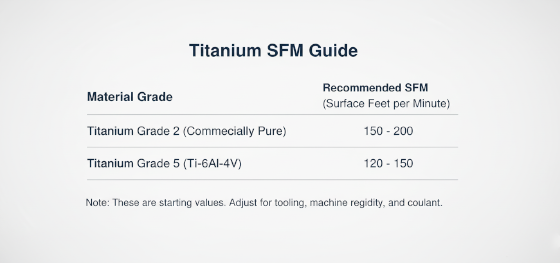
While every setup is different, having a reliable baseline is crucial. At Jucheng Precision, we categorize our starting parameters based on the alloy grade, as Grade 5 is significantly harder than Grade 2.
For Grade 2 (Commercially Pure): We typically start around 150 to 200 SFM (45-60 m/min). Because it is softer, the risk is gumminess rather than abrasion.
For Grade 5 (Ti-6Al-4V): We drop the speed to 120 to 160 SFM (35-50 m/min). The heat generation here is intense.
These are conservative starting points for uncoated carbide. With advanced AlTiN coatings and rigid setups, we can push these numbers higher, but we always prioritize process security over raw speed to ensure consistent titanium cnc machining quality.
Chip Thinning and Dynamic Milling
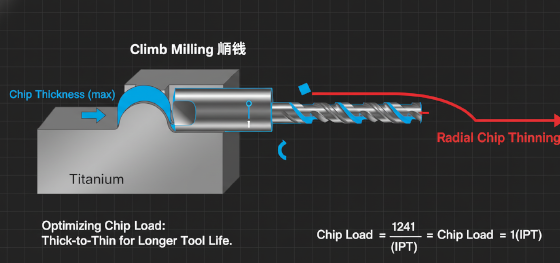
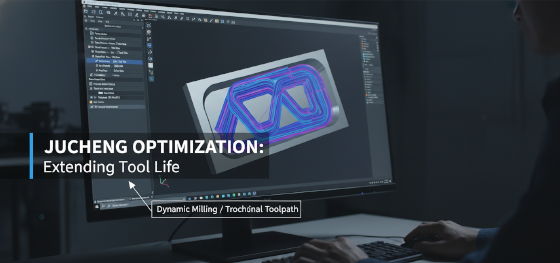
Modern CAM software has revolutionized titanium machining through a technique called Dynamic Milling (or Trochoidal Milling). In traditional milling, the tool engages the material at 50% or 100% width, creating a massive arc of contact that traps heat.
We utilize a low Radial Depth of Cut (RDOC)—typically 10% to 15% of the cutter diameter—combined with extremely high Axial Depth of Cut (ADOC). This reduces the arc of contact. The tool is only cutting for a brief moment and then spends the rest of the rotation spinning in cool air (or coolant). This intermittent cutting action allows the flute to cool down before it re-enters the material. Because the chip becomes thinner at this low engagement (Radial Chip Thinning), we can drastically increase the feed rate to maintain the correct chip thickness, often running 3x to 5x faster than traditional methods.
Coolant: Volume, Pressure, and Safety
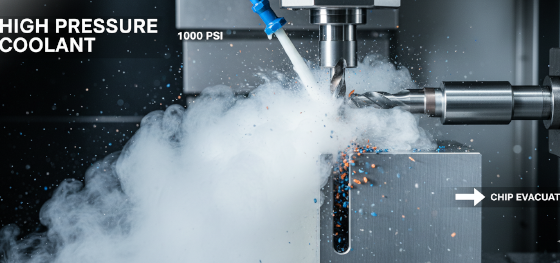
We cannot stress this enough: High-Pressure Coolant is mandatory. A trickle of coolant is useless; it will just boil off before it hits the cutting zone, causing thermal shock (rapid heating and cooling) that cracks the carbide.
Jucheng uses 1000 PSI (70 bar) through-spindle coolant systems. This high-pressure blast penetrates the heat barrier created by the spinning tool, delivering cooling directly to the shear zone. Crucially, it also blasts the chips away. If titanium chips are re-cut, they can work-harden and break the tool instantly. Furthermore, wet machining is a critical safety protocol. Titanium dust is highly flammable. Keeping the process flooded prevents sparks from igniting a Class D fire in the machine enclosure.
JUCHENG's Engineering Edge
Knowing the numbers is one thing; applying them to complex geometries is another. At Jucheng Precision, our engineers don't just input standard speeds and feeds. We optimize every tool path.
We simulate the machining process to detect areas of excessive heat buildup or tool deflection. We use variable helix end mills to dampen vibration (chatter), which is the enemy of surface finish in titanium. When you send us a CAD file, you are getting the benefit of optimized physics, ensuring your parts are machined efficiently, safely, and to the tightest tolerances possible.

