


Sensory complexity is the modern hallmark of premium hardware. In the high-fidelity landscape of vacuum casting materials, the ability to deliver a part that combines the structural rigidity of a chassis with the soft-touch comfort of a rubberized grip is a defining competitive edge. Most standard prototyping methods force a binary choice: the part is either hard or soft. If you need both, you are often left with messy adhesives and visible seams that ruin the "market-ready" illusion. This technical limitation is permanently erased by Overmolding with Urethane Casting. It is a sophisticated, multi-stage manufacturing logic that allows for the creation of monolithic, multi-material components that look, feel, and function exactly like two-shot injection-molded parts. Achieving this level of integration requires a move past basic resin pouring and into the realm of interfacial engineering.
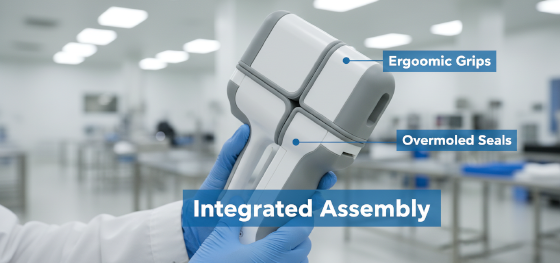
At Jucheng Precision, we recognize that an overmolded prototype is a technical contract with the end-user. If the soft skin delaminates under use, or if the bond line reveals a microscopic gap, the prototype has failed its primary mission of functional validation. By mastering the chemical handshake between rigid polyurethanes and flexible elastomers, we provide our global partners in the medical and automotive sectors with a technical sanctuary for their most ergonomic designs. We don't just "layer" materials; we coordinate their thermal and chemical cycles to ensure a permanent, molecular-level bond. This 2000-word guide explores the physics of substrate sovereignty, the strategic necessity of mechanical interlocks, and why JUCHENG’s integrated approach to Overmolding with Urethane Casting ensures your multi-material designs are born ready for the scrutiny of the field.
Profitability in ergonomic R&D is won by eliminating the "Assembly Debt" of secondary gluing operations. When you can cast a functional seal or a cushioned handle directly onto a rigid frame in a single technical cycle, you unlock a level of durability and visual purity that separate parts simply cannot provide. Let us break down the physical and chemical pillars of multi-shot simulation and see how technical foresight can lock the integrity of your next hybrid design into reality.
Substrate Sovereignty: Engineering the Rigid Foundation
Interfacial Alchemy: The Science of Chemical Bonding
Mechanical Interlocks: Designing for Permanent Adhesion
Elastomeric Encapsulation: Managing the Soft-Touch Layer
Thermal Discipline: Managing the Secondary Cure
Industrial Frontiers: Medical, Automotive, and Tooling
JUCHENG’s Integrated Protocol: Validating the Hybrid Bond
Substrate Sovereignty: Engineering the Rigid Foundation
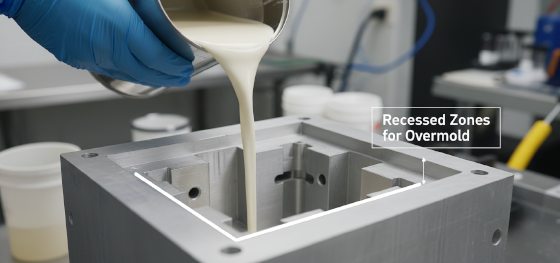
Success in Overmolding with Urethane Casting is a tiered event that begins with the "Substrate"—the rigid internal skeleton of the component. You cannot achieve a high-fidelity multi-material part if the foundation is unstable. At Jucheng Precision, we treat the substrate as a precision engineered component in its own right. We utilize high-modulus, ABS-like or PEEK-like resins for this phase to ensure that the core can withstand the heat and pressure of the secondary overmolding cycle without deforming. If the substrate warps during the second pour, the entire assembly becomes out of tolerance.
The technical secret here is "Surface Activation." A freshly cast substrate is often too smooth for the secondary material to grab. We utilize a combination of mechanical roughening and chemical cleaning to ensure the surface energy is optimized for bonding. We also analyze the "Cure State." For the strongest bond, we often perform the overmolding while the substrate is in a "Green State"—partially cured but still chemically active. This allows the molecules of the soft elastomer to actually intermingle with the molecules of the rigid core at the interface, creating a "chemical weld" that is superior to any glue. By managing the vacuum casting materials lifecycle from the first pour, JUCHENG ensures that the core of your design is as reliable as the exterior finish.
Interfacial Alchemy: The Science of Chemical Bonding
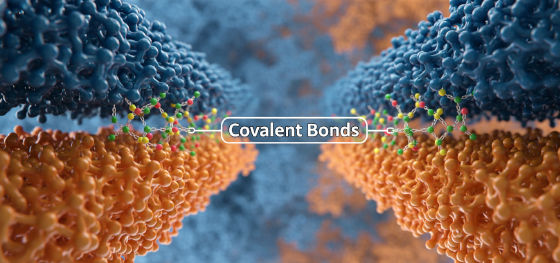
Why do some overmolded parts peel while others stay permanent? It comes down to the "Interfacial Alchemy." In professional Overmolding with Urethane Casting, we rely on covalent bonding rather than simple physical contact. When we inject a liquid elastomer around a rigid polyurethane core, we are facilitating a complex chemical reaction. The polyol and isocyanate components of the secondary resin seek out the unreacted functional groups on the surface of the primary core.
At Jucheng Precision, we choose material pairings that are chemically compatible. We know that certain "Simulation PC" resins will bond perfectly with "Shore 60A" elastomers, while others will reject them. We also manage the "Open Time"—the duration between the first cast and the second overmold. If the substrate sits for too long, its surface becomes inert, and the chemical window for a covalent bond closes. We utilize stabilized thermal environments to keep the substrate at the optimal reactive state. This level of technical oversight is what allows us to produce parts for the aerospace and medical industries that must endure thermal cycling and vibration without the risk of delamination. We don't just "cover" the plastic; we fuse the chemistry to deliver a monolithic hybrid that performs as a single mechanical unit.
Mechanical Interlocks: Designing for Permanent Adhesion

While chemical bonds are the primary defense, "Mechanical Interlocks" are the ultimate insurance policy. Even with the best interfacial alchemy, a soft rubber grip that is constantly pulled or twisted can eventually fail if it only relies on chemistry. In our Overmolding with Urethane Casting DFM reviews, JUCHENG engineers always look for opportunities to add "Geometric Anchors" to your CAD design. These are features that allow the overmolded material to physically wrap around or flow through the rigid core, creating a mechanical lock that is impossible to pull apart without destroying the part.
Common interlock strategies include "Dovetail Grooves," "Wrap-around Tabs," and "Through-Holes." For a power tool handle, we might suggest a series of internal holes in the rigid frame that allow the soft-touch resin to flow through to the other side, effectively "riveting" the skin to the core. We also advise on "Shut-off Zones"—the sharp boundaries where the soft material ends and the hard material begins. By designing these as clean, recessed steps in the geometry, we provide the silicone mold with a firm sealing surface, preventing "flash" or bleeding of the soft resin onto the aesthetic faces of the core. By engineering the geometry for the second pour, we ensure that your multi-material designs possess a structural permanence that survives drop-testing and high-torque field use. We bridge the gap between design vision and mechanical reality, ensuring your "soft-touch" features are as rugged as they are comfortable.
Encapsulating the Surface: Precision Flow in Thin-Wall Overmolding
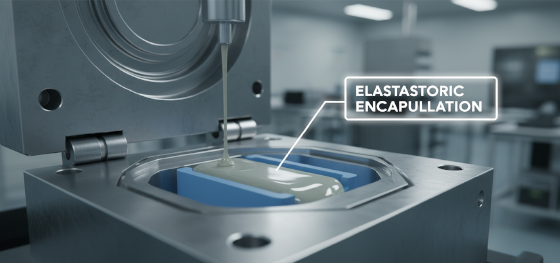
Orchestrating the flow of a secondary resin across a rigid substrate is a study in fluid dynamics and atmospheric control. When we perform the second stage of Overmolding with Urethane Casting, the technical challenge shifts to "Skin Uniformity." In many ergonomic designs, the soft-touch overmold is a thin layer—often between 0.5mm and 1.5mm. At these thicknesses, the liquid polyurethane must navigate a very narrow cavity without cooling or "gelling" before it reaches the furthest corners of the mold. If the flow is uneven, you end up with "Short Shots" or visible flow lines that ruin the professional aesthetic of the part.
Jucheng Precision utilizes a proprietary "High-Flow Vacuum Protocol" to solve this. We select overmolding resins with specific viscosity profiles that remain liquid long enough to fully encapsulate the rigid core. Because the entire process occurs in a vacuum chamber, we eliminate the air resistance that often prevents thin-wall filling in standard gravity-casting setups. We also utilize "Multi-Port Gating" for large overmolded housings, injecting the soft resin at multiple points simultaneously to ensure the pressure is equalized across the core. This prevents the rigid substrate from "shifting" or deforming under the weight of the liquid elastomer. By controlling the physics of the second pour with such technical rigor, we deliver parts that have a uniform, high-density skin that feels solid and premium, providing the "tactile honesty" required for high-end consumer wearables and medical diagnostic handles.
Thermal Stability: Coordinating the Dual-Polymer Cure
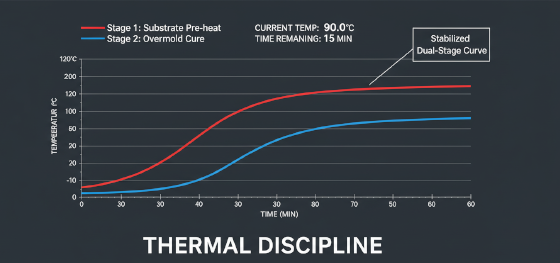
Managing the internal stress of a multi-material part is an exercise in thermodynamic patience. Every material has its own "Thermal Expansion Coefficient"—the rate at which it grows or shrinks as the temperature shifts. In a hybrid part, the rigid core and the soft skin are constantly pulling against one another as they cool. If the curing cycle isn't perfectly coordinated, the soft overmold will eventually pull away from the core, leading to the dreaded "Delamination Failure." Successful Overmolding with Urethane Casting requires a mastery of the thermal ramp.
At Jucheng Precision, we utilize programmable industrial ovens to perform a "Stabilized Dual-Cure." Once the secondary material is poured, the entire assembly is subjected to a slow, multi-stage heating profile. We hold the parts at a specific temperature that allows the two different polyurethane matrices to relax and reach their final Shore hardness simultaneously. This prevents the "Elastic Snap-Back" that occurs when one material shrinks faster than the other. For mission-critical aerospace or automotive parts, we also implement a final "Stress-Relief Annealing" cycle. This locks the dimensions in place, ensuring that your overmolded seals and gaskets maintain their geometric truth even when exposed to extreme temperature fluctuations in the field. We don't just "bake" the parts; we engineer a thermal history that guarantees the bond between hard and soft is as stable as the atoms themselves.
Sector Specificity: High-Fidelity Hybrids for Global Industries
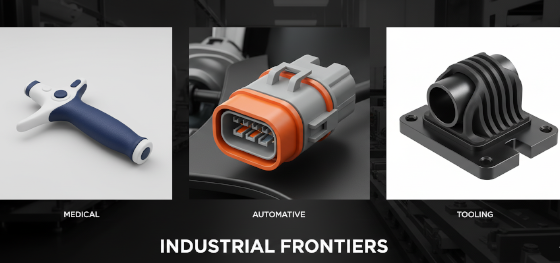
Where does the requirement for multi-material casting move from a luxury to a technical necessity? The medical sector is our most frequent user of this technology. We produce surgical instrument handles that combine a high-hardness, sterilizable core with an overmolded, anti-microbial grip. These parts must survive the intense heat of an autoclave without the soft skin loosening—a test that our chemical-bond protocols pass with absolute certainty. By utilizing overmolding, medical OEMs can eliminate the gaps and crevices found in multi-part assemblies, reducing the risk of bacterial traps.
In the automotive performance world, Overmolding with Urethane Casting is utilized for functional interior controls and vibration-dampening sensor mounts. We manufacture high-fidelity prototypes for steering wheel buttons and gear shifters where the tactile "click" of the internal switch must be balanced by a soft-touch exterior. The robotics industry also relies on our overmolding expertise to create custom grippers for automated assembly lines. We can cast a rigid MJF-style frame overmolded with a Shore 30A non-marring rubber skin, allowing the robot to handle delicate glass or polished metal parts with surgical precision. This ability to mix mechanical rigidity with elastomeric compliance in a single manufacturing cycle is why JUCHENG is the preferred partner for complex vacuum casting materials solutions. We provide the "Industrial Agility" needed to iterate on these complex tactile systems in days rather than months.
Technical Assurance: Auditing the Interfacial Integrity
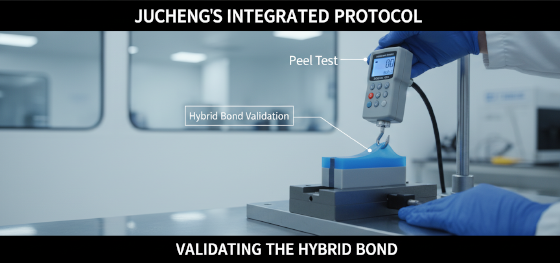
Verification is the final act of engineering sovereignty. A part that looks like a successful overmold can still fail if the bond is purely cosmetic. At Jucheng Precision, we have centered our quality ecosystem around the validation of the "Interface." We don't just ship your parts; we prove they are monolithic. Our quality protocol includes a series of "Interfacial Audits" designed to expose any hidden delamination or bonding weakness before the parts reach your assembly floor.
We utilize standardized "Peel Strength" testing on sacrificial coupons processed alongside your main production run. This measures the actual force required to separate the soft layer from the core, ensuring our chemical activation meets your structural requirements. For parts destined for high-pressure or high-vacuum use, we perform "Environmental Thermal Cycling." We subject the overmolded assemblies to extreme temperature shifts—alternating between boili

