


An idea in your head is perfect. It has no flaws. A 3D model on your screen is also perfect. It has no manufacturing defects. But between this world of perfection and the real world of physical products, there is a dangerous chasm.
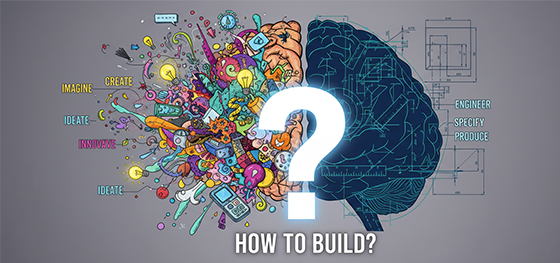
Many great ideas die in this chasm. They fail the harsh tests of reality. The snap-fit that worked in the CAD model breaks in real life. The material that felt good in a simulation feels cheap in a customer's hand.
So, what is rapid tooling? It is not just a piece of metal. It is a bridge. It is a strategic tool designed to carry your idea safely across this chasm, from the fantasy of a prototype to the reality of a manufacturable product.
content:
Answering the First Question: What is a Prototype?
Defining Rapid Tooling: The Bridge
Benefit 1: Speaking the Language of Real Materials
Benefit 2: Answering the Question of Scale
Your Partner for Crossing the Chasm
Answering the First Question: What is a Prototype?
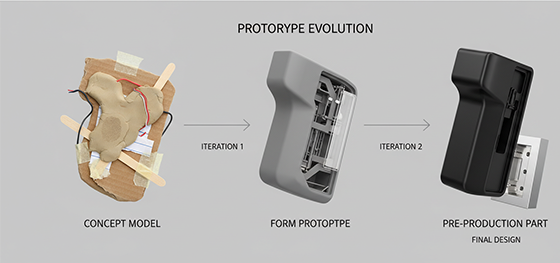
To understand rapid tooling, you must first understand the different levels of a "prototype."
The first level is a "looks-like" prototype. This is often a 3D print. Its job is to validate the shape, size, and ergonomics of your design. It answers the question: "Does my idea look right?"
The second level is a "works-like" prototype. This might be a rough assembly of CNC parts and electronics. Its job is to validate the core function. It answers the question: "Does my idea work?"
But there is a third, critical level. The "pre-production" prototype. This prototype must look, feel, and work exactly like the final product. It must be made from the real production material and with the real production process. It answers the most important question: "Can I actually manufacture and sell this idea?"
Defining Rapid Tooling: The Bridge
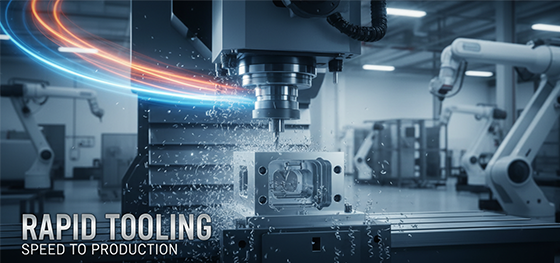
This is where Rapid Tooling comes in. It is the fastest and most cost-effective way to create these critical pre-production prototypes.
The "tooling" part refers to an injection mold. But unlike a mass-production mold made of hardened steel that takes months to build, a rapid tool is typically made from a softer material, like aluminum.
The "rapid" part refers to how this tool is made. We use high-speed CNC machines to carve the mold directly from a block of aluminum. This allows us to create a functional injection mold in as little as 7 days.
This tool is then used in a standard injection molding machine to produce your parts. The result is not a simulation. It is a real, molded part.
Benefit 1: Speaking the Language of Real Materials
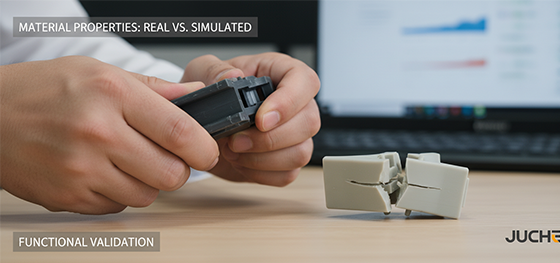
The first huge benefit of this approach is material reality.
3D printing materials are amazing, but they are simulants. A 3D printed part that is "ABS-like" is not the same as a part molded from real ABS pellets. It does not have the same strength, the same flexibility, or the same surface texture.
Rapid tooling allows you to make your parts in the exact, final, production-grade plastic. Real ABS. Real Polycarbonate. Real glass-filled Nylon.
This is a game-changer. It allows you to perform real, meaningful functional tests. Will your snap-fit break after 100 cycles? Will your part deform under heat? With a part from a rapid tool, the data you get is real data you can trust.
Benefit 2: Answering the Question of Scale

The second benefit is answering the question of scale. 3D printing is great for making 5 or 10 parts. But what if you need 500 parts for a beta test with real customers? Or 2,000 parts for your first production run?
3D printing at this volume is incredibly slow and expensive. The cost per part never goes down.
Rapid tooling is the perfect solution for this "low-volume" stage. While there is an upfront tooling cost, the price per part is extremely low. This makes it economically feasible to produce hundreds or even thousands of parts.
It allows you to get your product into the hands of real users. You can gather market feedback and validate your idea before you make the huge investment in a mass-production steel mold. It is the ultimate risk-reduction strategy.
Your Partner for Crossing the Chasm
So, what is rapid tooling? It is the technology that bridges the dangerous gap between a simple prototype and full-scale production.
It is a philosophy that allows you to test, learn, and iterate with real materials, at a realistic scale, and at an affordable cost.
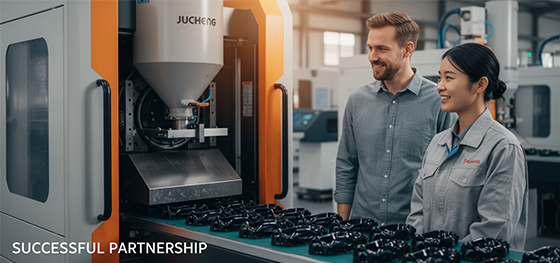
Choosing a partner for this critical stage is essential. At JUCHENG, we are experts in building these bridges. We have the in-house CNC capabilities to create your tool quickly. We have the injection molding expertise to produce your parts perfectly.
We are here to be your guide on the most important part of your product's journey: the journey from a great idea to a real, successful product.

