


Determining the correct inner corner dimensions during the layout phase is vital to maintaining structural durability. Selecting a proper minimum bend radius sheet metal prevents deep cosmetic splits, eliminates structural fractures, and ensures long-term fatigue resistance on your assemblies. To achieve repeatable, high-precision folds on the shop floor, designers must understand the mechanical strain limits of their chosen alloys while avoiding extreme tensile stress on the outer surface of the fold.

Forcing a soft sheet into an impossibly sharp bend is one of the most common design errors in hardware development. When the inner radius is set too tight, the metal on the outer edge stretches past its physical ultimate strength, leading to visible cracks and structural failures. Proactively aligning your bending geometry with material-specific elongation limits keeps your production simple and highly cost-effective.
Let's examine the physical failures caused by over-bending, establish a practical thickness-to-radius rule of thumb for common alloys, and review our reference charts to select the optimal parameters for your next custom project.
content:
What Happens If You Bend Too Sharp?
The General Rule of Thumb: Thickness vs. Bend Radius
Minimum Bend Radius Reference Chart
Precision Bending Capabilities at JUCHENG
FAQ: Critical Questions About Minimum Bend Radius Sheet Metal
What Happens If You Bend Too Sharp?

What metallurgical failures occur when sheet metal is bent below its minimum radius limit?
Bending metal below its limit forces the outer fibers past their plastic limits, causing micro-cracking, severe wall thinning, and complete structural splitting along the fold line.
During a standard press fold, the metal behaves as a elastic-plastic medium. As the top punch descends, the inner surface is compressed while the outer fibers undergo extreme tensile stress. If your design specifies an inner bend radius that is too small, the localized stretching exceeds the material's elongation limits.
This excessive stretching initiates micro-cracking on the outer surface of the fold. Over time, these micro-cracks propagate under mechanical vibration or thermal cycles, leading to complete joint failure. This issue is highly critical in load-bearing structural brackets and medical enclosures where sudden fractures can compromise entire assemblies.
The General Rule of Thumb: Thickness vs. Bend Radius

What is the standard engineering ratio between material thickness and inner radius?
The basic rule of thumb is to maintain an inner bend radius equal to at least 1.0 times the material thickness for soft ductile metals, scaling higher for harder tempers.
To avoid structural degradation on the shop floor, we use a general rule of thumb for minimum bend radius sheet metal that scales directly with the stock thickness. Different metals possess different levels of metallurgical ductility, meaning they stretch at different rates under force. Forcing hard tempers into tight die openings without adjusting your radius guidelines leads to high scrap rates.
For instance, soft annealed aluminum or low-carbon cold-rolled steel can handle a tight inner radius without splitting. However, precipitation-hardened alloys or high-strength stainless steel grades work-harden rapidly, requiring a bend radius of at least 1.5 to 3.0 times the thickness. Proper orientation relative to the rolling grain direction is also critical; bending parallel to the grain requires a much larger radius than bending across it.
Minimum Bend Radius Reference Chart
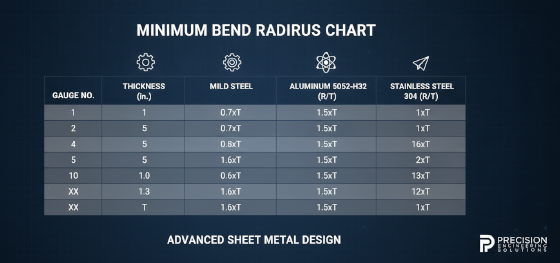
What are the specific inner radius limits for aluminum, steel, and stainless steel?
The limits range from 0.8 times the thickness for carbon steel up to 2.0 times or more for hard aluminum and stainless steel tempers.
To prevent unexpected cracking during production, designers must reference precise thickness-to-radius ratios for their selected materials. Using incorrect CAD offsets can cause parts to stretch out of tolerance, ruining your assembly clearances. Here is a direct reference guide for standard commercial gauges:
| Material Class | Thickness Range | Minimum Inner Radius (R) | Springback Characteristics |
|---|---|---|---|
| Aluminum (e.g., 5052-H32) | 1.0 mm - 3.0 mm | 1.0 x Material Thickness | Low (predictable forming, stable angles) |
| Stainless Steel (e.g., SUS304) | 1.0 mm - 3.0 mm | 1.5 x Material Thickness | High (demands springback over-bending) |
| Carbon Steel (e.g., SPCC) | 1.0 mm - 4.0 mm | 0.8 x Material Thickness | Minimal (excellent ductility, very consistent) |
Precision Bending Capabilities at JUCHENG

How does JUCHENG guarantee crack-free bends on high-precision assemblies?
We operate high-performance CNC press brakes equipped with an extensive inventory of hardened punches and V-dies, matching tool geometry to your selected alloy.
Integrating these physical limits into your active sheet metal design cycle is the single most effective way to eliminate production defects. JUCHENG integrates these advanced geometric and material validations into our digital manufacturing network, ensuring that your CAD files translate into fully finished, durable assemblies with extreme dimensional precision.
We process a wide range of raw sheets, including lightweight aluminum, high-yield stainless steel, and easily formable carbon steel. Our technical department provides a 24-hour free DFM analysis to check your CAD models, checking tolerances and tool clearances before production. Supported by our no MOQ policy and rapid delivery guarantee, we manage your project from initial flat pattern cutting to final packaging and assembly.
FAQ: Critical Questions About Minimum Bend Radius Sheet Metal

What causes cracking on the outer radius of hard aluminum 6061-T6?
Aluminum 6061-T6 is precipitation-hardened, making it highly strong but significantly less ductile than annealed alloys. Bending 6061-T6 with a tight radius will instantly cause severe cracking. We prevent this by utilizing a much larger minimum radius (at least 3.0 to 4.5 times the thickness), or by heat-treating the bend zone to locally soften the metal before forming.
Why must a press brake operator change the V-die opening for thicker sheets?
The V-die opening directly dictates the inner bend radius and the force required to fold. Utilizing a V-die that is too small for a thick sheet dramatically concentrates the bending force, causing extreme localized thinning, outer-edge splitting, and potentially damaging the press brake tools under excessive tonnage.
How does the rolling grain direction of a sheet affect the bend limit?
During manufacturing at the mill, metal sheets develop a continuous rolling grain. Bending parallel to this grain concentrates tensile stress along the boundary lines, causing the metal to tear easily. We prevent this during our nesting phase by orienting all major bend lines perpendicular or diagonal to the grain.
How does JUCHENG prevent cracking when the minimum bend radius sheet metal limit is tight?
Our technical department reviews your CAD designs during our complimentary DFM stage. If your application demands a tight radius that risks material tearing, we suggest ductile alloy substitutes (such as 5052-H32 over 6061-T6), or design specialized relief cuts to isolate the bending stress completely, delivering clean, crack-free enclosures.

