


In product development, there are two great leaps. The first is from an idea to a physical prototype. The second, and far more dangerous, is from that single prototype to the first ten thousand production parts.

This second leap is a chasm of risk. Committing to a $100,000 steel production mold is a bet-the-company decision. What if there is a hidden design flaw? What if the market feedback is not what you expected?
You need a bridge. A way to cross this chasm safely, quickly, and affordably. That bridge is Rapid Tooling. It is not just a faster way to make a mold. It is a strategic process that accelerates your journey to market while dramatically reducing your risk.
content:
How Rapid Tooling Works
Mold Materials (Aluminum vs. Soft Steel)
The Injection Molding Connection
Cost Analysis
Manufacturing Comparison
Quality & Tolerances
Surface Finishes
Industries & Applications
How Rapid Tooling Works

So, What is rapid tooling? At its core, it is the use of fast and agile manufacturing techniques to create an injection mold cavity in days, not months. There are a few methods, but the most common and effective is "Direct Tooling."
Direct Tooling means we take a solid block of metal and use a high-speed CNC machine to directly carve out the core and cavity of your mold. The process is entirely digital, moving straight from your 3D CAD file to the machine. There are no intermediate steps. This is what makes it so incredibly fast. To learn more about this, read our deep dive into What is rapid tooling.
Mold Materials (Aluminum vs. Soft Steel)

The secret to the speed of Direct Tooling is the choice of material. Instead of the hardened tool steel (like H13) used for mass production molds, rapid tooling uses softer, more easily machinable metals.
The two main choices are high-grade Aluminum tooling (often 7075 alloy) and pre-hardened "soft" steels like P20. Aluminum is the king of speed. It can be machined up to three times faster than steel. It also has excellent thermal conductivity, which means it cools down faster between cycles, leading to a shorter part production time. P20 steel is harder and more durable than aluminum, offering a longer tool life, but it takes longer to machine.
The Injection Molding Connection

This is the most important concept to understand. A rapid tool is not a different kind of process. It is a tool that is used in the standard injection molding process.
The parts you get from Rapid tooling for injection molding are not "like" production parts. They ARE production parts. They are made on the same machines, using the same process, and most importantly, from the same real, production-grade plastic pellets (like ABS, PC, or Nylon). This is a huge advantage. It allows you to perform true functional and material testing that is impossible with a 3D printed part. This is what makes it the perfect "Bridge Tooling Service" to get your product to market while you wait for a high-volume steel tool to be made.
Cost Analysis
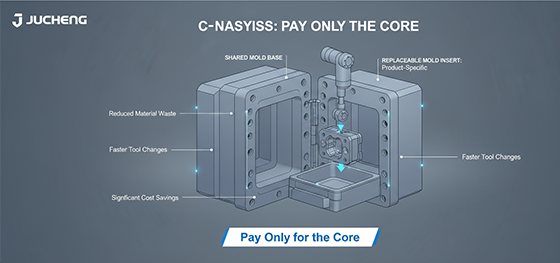
The Rapid tooling cost is dramatically lower than a traditional production tool. There are a few reasons for this.
First, as we discussed, the raw material (aluminum or P20 steel) is cheaper and much faster to machine than hardened tool steel. Less machine time directly equals lower cost.
Second, at JUCHENG, we use a "shared mold base" or Master Unit Die (MUD) system. The large, expensive outer frame of the mold is a standardized, reusable component. Your rapid tool is just the custom core and cavity inserts that fit inside this master frame. You are only paying for the small part that is unique to your design. This dramatically reduces the cost.
Manufacturing Comparison
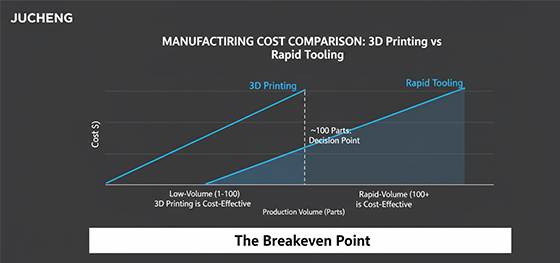
So, when should you choose Rapid tooling vs 3D printing? It is a question of quantity and material reality.
For quantities under 50 to 100 parts, 3D printing is almost always the faster and cheaper option. There is no tooling cost.
However, once your quantity needs grow beyond 100 parts, the economics shift dramatically. The per-part cost of 3D printing remains high, while the per-part cost of molding from a rapid tool becomes very low. The breakeven point is typically around 100 pieces.
More importantly, if you need to test your part in the actual, final production plastic (like a real ABS or a glass-filled Nylon), rapid tooling is your only option. 3D printed materials are just simulants.
Quality & Tolerances

What kind of quality can you expect? The Rapid tooling tolerances are very impressive. Because we are using CNC machines to create the tool, the resulting parts can be very precise.
A typical tolerance for a part made from a rapid tool is around +/- 0.1mm, with even tighter tolerances possible on critical features. This is significantly more accurate and repeatable than 3D printing. The main variable is the material shrinkage, which our engineers will account for during the tool design. At JUCHENG, we verify these tolerances on the First Article (T1) samples using our in-house CMM machines.
Surface Finishes

The Rapid tooling surface treatment capabilities are excellent, but have one key limitation to understand. The final part's finish is a replica of the mold's finish.
We can easily achieve a variety of matte and textured finishes, like SPI C-grade (stone polish) or a VDI 3400 spark erosion texture. We can also achieve a good semi-gloss SPI B-grade finish.
However, achieving a true, flawless mirror polish (SPI A-grade) on an aluminum tool is very difficult and often not recommended. Aluminum is a softer metal and cannot hold a perfect diamond polish as well as hardened steel. For most applications, a semi-gloss or matte texture is the best and most cost-effective choice for rapid tooling.
Industries & Applications
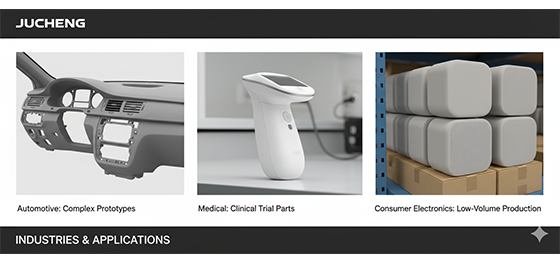
The Rapid tooling industry applications are vast. It is the perfect solution for any project that needs to move from prototype to low-volume production quickly and with minimal risk.
In the Automotive industry, we use it to create dashboard components and interior trim for pre-production test vehicles. In Medical, it is used for the housings of handheld devices that are needed for clinical trials.
But its greatest impact is for Startups and Consumer Electronics. For a Kickstarter project, rapid tooling is the perfect way to produce the first 1,000 units for your backers, validating the market before you invest in expensive production tooling.
Rapid tooling is the ultimate risk-reduction strategy. It is the bridge that allows you to walk, not leap, from a single prototype to a successful product launch. At JUCHENG, with our promise of T1 samples in as fast as 7 days, we are your expert partner in building that bridge.

