


Snapping a beautifully designed prototype in half with your bare hands is a humbling experience. Last month, a client handed me a 3D printed drone chassis mechanism they intended to push into immediate field testing. Applying just a few pounds of lateral torsion, the plastic emitted a sickening crack, splitting perfectly along its microscopic Z-axis layer lines. Hardware startups hemorrhage venture capital when they confuse visual form-fit models with true kinetic survivability. Bridging the treacherous gap between desktop prototyping and mass manufacturing demands absolute metallurgical and chemical awareness.

Evaluating Rapid Tooling vs 3D Printing dictates the financial velocity of your entire product launch. 3D printing magically builds complex geometries from nothing, demanding absolutely zero upfront tooling capital but suffering from crippling anisotropic weakness and agonizingly slow cycle times at scale. Rapid tooling forces you to purchase a dedicated, CNC-machined aluminum mold cavity, but rewards that investment by shooting hundreds of identical, incredibly strong injection-molded parts per hour using genuine engineering resins.
Mastering this specific manufacturing break-even point prevents catastrophic supply chain paralysis. Procurement managers must brutally calculate non-recurring engineering (NRE) amortization, part lifecycles, and the absolute limits of mechanical shear stress. Surviving the [2026] global hardware market relies entirely on transitioning from additive to subtractive-molding technologies at the exact mathematical sweet spot.
content:
How Do Mechanics of 3D Printing and Rapid Tooling Differ?
When Should You Rely Exclusively on 3D Printing?
When MUST You Pivot to Aluminum Rapid Tooling?
Does Anisotropic Weakness Destroy 3D Printed Prototypes?
What Are the True NRE Break-Even Costs for Both?
How Does Jucheng Merge Both Technologies in Shenzhen?
What Are the Most Critical Prototype Scaling FAQs?
How Do Mechanics of 3D Printing and Rapid Tooling Differ?
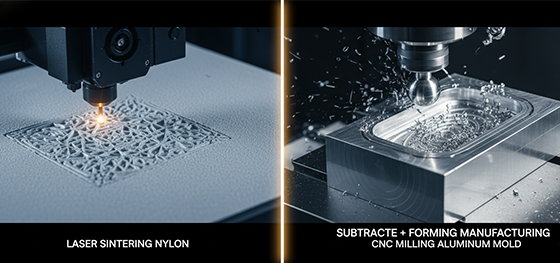
Do both processes utilize the exact same raw plastic materials? Absolutely not. 3D printing requires highly modified, easily meltable filaments or UV-cured resins, whereas rapid tooling uses genuine, mass-production thermoplastic pellets injected under massive hydraulic pressure.
Additive manufacturing builds volumetric objects by stacking thousands of microscopic 2D cross-sections. Whether a laser is curing liquid resin (SLA) or a heated nozzle is extruding plastic spaghetti (FDM), the machine operates completely tool-free. You simply upload a digital CAD file, and the machine deposits material precisely where needed. This process ignores traditional manufacturing constraints, easily generating impossible internal voids and deeply undercut geometries.
Rapid tooling entirely abandons the additive philosophy. Machinists use high-speed 5-axis CNC mills to violently carve a negative cavity out of solid 7075 aluminum blocks. Once this soft mold is loaded into an injection press, 700-degree molten plastic blasts into the void at supersonic speeds. The aluminum instantly chills the polymer, allowing the machine to eject a fully solid, net-shape component every thirty seconds.
When Should You Rely Exclusively on 3D Printing?
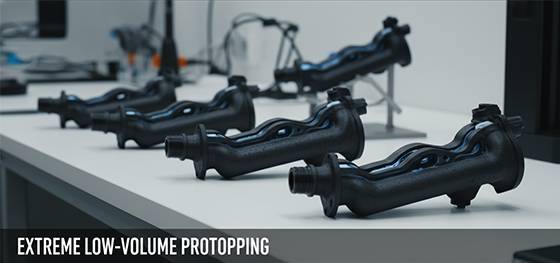
Is additive manufacturing still relevant once you need more than ten parts? Yes, but strictly for highly complex, low-volume components requiring radical geometric freedom or massive mass customization that steel dies cannot physically release.
Specify 3D printing exclusively during the violent, early-stage iterative design loop. When mechanical engineers need to test five slightly different variations of a sensor housing mounting clip on the same afternoon, burning $15,000 on five distinct aluminum molds is financial suicide. A multi-jet fusion (MJF) printer can output all five variations simultaneously overnight for under a hundred dollars.
Furthermore, medical and aerospace sectors aggressively leverage 3D printing for patient-specific implants or generative-design drone brackets featuring organic, lattice-like skeletal structures. These bizarre, webbed geometries physically trap themselves inside traditional two-part molds. Additive manufacturing remains the undisputed king of complex, tool-less fabrication.
When MUST You Pivot to Aluminum Rapid Tooling?

Can a fleet of 3D printers economically produce 5,000 automotive enclosures? Never. The agonizingly slow laser traversal times instantly choke your supply chain, demanding an immediate pivot to high-speed rapid injection molding.
Bridge production demands actual material verification. If your final product requires UL-rated flame-retardant Polycarbonate (PC) or highly abrasive 30% glass-filled Nylon, 3D printed substitutes will fail UL certification testing. Rapid tooling allows you to inject the exact same production-grade resin pellets you will eventually use in your massive H13 steel mass-production dies. The molded parts act, feel, and fail exactly like the final product.
You must invest in rapid aluminum molds the moment your market test volume crosses the 200-unit threshold. While printing 200 units might take a week of continuous machine time and cost $30 per part, an aluminum tool can shoot those 200 units in two hours, dropping the raw unit cost to mere pennies. Velocity completely destroys additive limits at scale.
Does Anisotropic Weakness Destroy 3D Printed Prototypes?

Are 3D printed parts actually weaker than injection-molded parts? Catastrophically so in specific stress planes. Additive parts exhibit severe anisotropic weakness, meaning their tensile strength degrades massively when pulled apart along the Z-axis layer lines.
When an FDM printer extrudes hot plastic onto a cooler layer beneath it, the molecular cross-linking is mathematically incomplete. The resulting component behaves exactly like a stack of glued wooden planks; it handles downward compression brilliantly but splinters instantly when subjected to sheer torsion. Attempting to deploy a printed plastic gear in a high-torque robotic drivetrain guarantees immediate, violent teeth shearing.
Rapid tooling eradicates this fatal structural flaw. Because high-pressure injection forces completely molten plastic into a sealed void, the polymer chains entangle seamlessly in every direction. The resulting component becomes completely isotropic. It absorbs kinetic shock, withstands extreme drop testing, and resists chemical fatigue uniformly across its entire geometry.
| Manufacturing Metric | Industrial 3D Printing | Aluminum Rapid Tooling | Engineering & Cost Impact |
|---|---|---|---|
| Upfront NRE Capital | Zero ($0.00) | Moderate ($2,000 - $8,000) | 3D printing saves aggressive startup budgets |
| Per-Unit Part Cost | High ($10 to $100+) | Extremely Low ($0.50 - $3.00) | Molding dominates volumes over 500 units |
| Material Strength | Anisotropic (Layer weakness) | Isotropic (Solid density) | Rapid tooling survives brutal drop tests |
| Geometric Freedom | Infinite (No draft needed) | Restricted (Requires draft angles) | Molding punishes unverified CAD blueprints |
What Are the True NRE Break-Even Costs for Both?

How do you mathematically decide when to cut an aluminum mold? You must plot the exact volume curve where the agonizingly high variable cost of 3D printing intersects and surpasses the fixed NRE tooling fee.
Assume a complex drone housing costs $40 to 3D print. Generating 50 units costs $2,000 total. Cutting a rapid aluminum mold for that exact same housing demands a $3,500 NRE tooling fee, but drops the injection-molded unit price to $2.00. Making those same 50 units via rapid tooling incinerates $3,600. Printing wins the micro-batch battle flawlessly.
However, a bridge production run of 500 units brutally violently reverses this dynamic. Printing 500 parts generates a massive $20,000 invoice. Injecting 500 parts, including the entire $3,500 tooling cost, totals merely $4,500. Procurement managers must aggressively forecast their exact pilot-launch requirements to prevent incinerating venture capital on inefficient scaling pathways.
How Does Jucheng Merge Both Technologies in Shenzhen?

Can a single facility provide seamless scaling from additive validation directly to subtractive bridge tooling? Yes. Operating within the Shenzhen precision manufacturing hub, Jucheng deploys massive MJF print farms directly alongside our CNC-machined MUD (Master Unit Die) injection presses.
Navigating [2026] hardware procurement demands eradicating disconnected vendor handoffs. We execute your initial five beta prototypes using industrial 3D printing overnight. Once your engineering team verifies the physical geometry, we immediately transition the CAD file to our 5-axis mills to carve a soft aluminum cavity, utilizing standard MUD frames to slash your NRE costs by 40%.
Our senior engineers intervene brutally during the CAD transition phase. 3D prints forgive undercuts and zero-degree walls; injection molds do not. Backed by rigorous ISO9001:2015 protocols, our Free DFM reviews aggressively add required draft angles and identify gate freeze risks before we cut aluminum. We dictate your scalability without MOQ restrictions.
What Are the Most Critical Prototype Scaling FAQs?

Resolving hardcore mechanical limitations prevents devastating assembly line bottlenecks when transitioning from printer beds to hydraulic clamping presses.
How long does an aluminum rapid tool typically last?
Aluminum cavities generally survive between 2,000 to 10,000 injection shots depending entirely on the aggressiveness of the plastic. Shooting soft ABS extends the mold life beautifully. Injecting 30% glass-filled Nylon acts like pressurized sandpaper, rapidly eroding the delicate parting lines and generating severe plastic flash within a few thousand cycles.
Can I add metal threaded inserts into 3D printed parts?
Yes, but the mechanical grip is highly vulnerable. Technicians must use specialized ultrasonic welders or heated soldering irons to melt brass inserts into the printed plastic. However, due to the anisotropic nature of the print, applying heavy torque to the bolt often shears the insert entirely out of the layer lines. Injection molding allows over-molding, fusing the plastic permanently around the brass insert during the liquid phase for infinite pull-out strength.
Do I need to redesign my 3D printed part for rapid tooling?
Absolutely. Additive manufacturing spoiled you with geometric freedom. To survive an injection mold, you must mathematically redesign the CAD file to include 1-to-3 degree draft angles on all vertical walls, maintain absolute uniform wall thickness to prevent deep sink marks, and eliminate internal voids that a steel core pin cannot physically reach.

