


Designing high-strength structures for warehouse siding, protective roofs, or heavy-duty industrial enclosures requires a deep understanding of geometric and structural efficiency. Evaluating the total cost of corrugated sheet metal represents the most critical step in custom sheet metal fabrication, directly determining whether your architectural or engineering project remains highly profitable or exceeds your targeted budget. This specialized waved profiling process introduces structural ridges that dramatically increase stiffness, allowing you to use thinner, more economical materials.
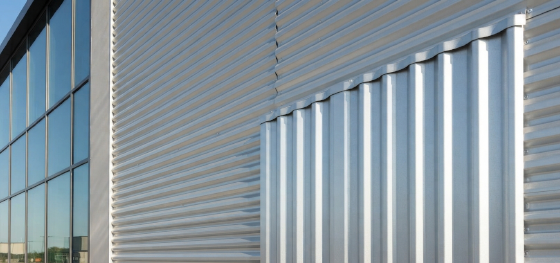
Suffer from heavy, over-engineered enclosures that require thick, expensive plates to handle wind loads or physical impacts? Standard flat panels require high material thicknesses to prevent buckling, which drives up raw material costs and global shipping weight. Transitioning to a corrugated, waved geometry completely eliminates these weight and cost bottlenecks, delivering a rigid structural shield at a fraction of the raw material expense.
Let's explore how waved profiling increases bending strength without adding raw plate thickness, analyze the cost differences between high-speed automated roll forming and flexible press brake bending, and review how to scale custom waved panels economically.
How Corrugation Increases Strength Without Adding Thickness

How does the mechanical waving of steel plates dramatically increase structural stiffness?
Corrugation increases the sheet's second moment of area (moment of inertia) along the wave direction, allowing a thin, lightweight sheet to handle high bending loads without flexing.
When evaluating the cost of corrugated sheet metal, designers must analyze the physical geometry. Standard flat carbon steel requires high thickness to handle high bending stress. However, by running flat sheets through corrugated forming dies to create wave-like profiles (such as sinusoidal or trapezoidal patterns), we increase the section modulus of the sheet.
This geometric change allows a thin 0.8mm corrugated sheet to handle the same bending load as a flat 2.5mm plate, saving up to sixty percent of the raw material weight. This substantial material reduction directly slashes your raw material bills for large projects, making it highly economical to use galvanized or pre-painted galvanized steel and aluminum without paying the high weight premiums of flat plates.
Roll Forming vs. Press Brake Bending for Corrugation
What is the cost difference between high-volume roll forming and low-volume press brake forming?
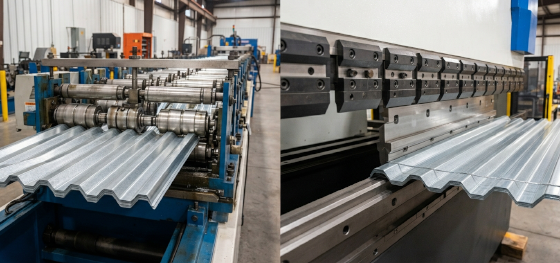
Roll forming is highly cost-effective for massive continuous runs but carries a high upfront mold charge, while press brake bending is perfect for custom prototyping and low volumes with zero tooling setup fees.
To minimize your manufacturing budget, selecting the correct forming method is critical. Automated roll forming is the industry standard for mass-producing corrugated sheets. It feeds flat coils through a series of progressive rollers that bend the metal continuously. While roll forming delivers an exceptionally low unit price, it requires an expensive, custom tooling setup (NRE) for each wave profile, making it highly impractical for short runs.
Conversely, for custom prototyping and low-volume architectural projects, we utilize a programmable press brake. This process folds the waves individually using standard V-dies. While press brake forming has a higher cycle time per sheet, it completely eliminates the upfront mold charges, providing a highly flexible and cost-effective method for short-run custom profiles. Here is a direct comparison:
| Forming Variable | Automated Roll Forming | Programmable Press Brake Bending |
|---|---|---|
| Upfront Setup Cost (NRE) | High (Requires custom rollers, 5,000+ USD) | Zero (Utilizes standard universal V-dies) |
| Bending Speed per Wave | Extremely Fast (Continuous roll feed) | Slow (Requires individual physical strikes) |
| Profile Customization | Restricted (Locked to specific roller shapes) | Excellent (Unlimited wave pitch adjustments) |
| Best Target Volume | 10,000+ meters (High-volume continuous runs) | 1 to 1,000 units (Prototyping & small batches) |
Custom Corrugated Panels Delivered Globally by Jucheng Precision

How does Jucheng Precision minimize the overall price of custom corrugated metal panels?
We operate high-power fiber lasers, high-capacity turret presses, and automated powder coating lines, bypassing fragmented supplier markups.
Why pay premium prices for scattered processing? At Jucheng Precision, we manage cutting, bending, and finishing under one roof, keeping your overall sheet metal fabrication cost remarkably low. Our advanced press brakes and high-speed turret presses execute complex, multi-bend sequences in a single setup, ensuring that your parts are cut, formed, and finished with extreme consistency.
We process a wide range of materials, including lightweight aluminum, high-yield stainless steel, and easily formable carbon steel during high-precision sheet metal fabrication cycles. Our technical department provides a 24-hour free DFM analysis to check your CAD models, checking tolerances and material limits before production. Supported by our no MOQ policy and rapid delivery guarantee, we manage your project from initial flat pattern cutting to final, high-durability packaging and assembly.
FAQ: Critical Questions About Cost of Corrugated Sheet Metal

Our engineering team has compiled professional solutions to the most common quality and cost challenges faced during corrugated fabrication runs:
Is corrugated metal cheaper than standard flat sheet metal?
Raw corrugated sheets are slightly more expensive than bare flat sheets due to the processing fee of wave profiling. However, because corrugation allows you to reduce the material thickness by up to sixty percent while maintaining the same structural strength, the overall cost of corrugated sheet metal for a large-scale project is often significantly cheaper, as it slashes the total raw material weight required.Does Jucheng Precision charge extra tooling fees for custom corrugated bending?
No, we maintain an extensive in-house library of standard, high-grade punches and V-die sets for various thicknesses and radii. If your designs utilize standard industrial dimensions, we can process your custom corrugated panels immediately, allowing you to bypass any custom tooling or NRE mold expenses completely.How do you calculate the actual covered area versus the raw flat sheet area due to overlapping wave ridges?
Because corrugated panels must overlap by at least one wave ridge to ensure water and dustproof seals, the net covered area is always less than the raw flat sheet area. Designers must factor in a "yield loss" of typically 10% to 15% when purchasing material, ensuring that you order enough raw sheets to cover your target surface dimensions.How does Jucheng Precision prevent surface scratching and paint peeling on pre-painted corrugated panels?
We protect the soft coatings of pre-painted or galvanized sheets by executing CNC bending with specialized urethane die inserts or applying high-density protective vinyl masking films. This prevents direct metal-on-metal friction between the steel tooling and the sheet, delivering clean, scratch-free decorative panels ready for immediate final assembly.

