


Sourcing precision metal components without a transparent pricing roadmap is a major risk for product developers and procurement managers. Calculating the precise sheet metal cost of custom components is a critical milestone in custom sheet metal fabrication, directly determining whether your hardware launch remains highly profitable or stalls under heavy debt. This specialized manufacturing discipline relies on balancing raw plate prices, machine run times, and post-processing steps to deliver robust, high-yield enclosures.

Traditional fabricators often hide their pricing calculations inside bulk quotes, leaving you vulnerable to unexpected NRE tooling expenses and high scrap charges. If your design features non-standard bending angles or inefficient nesting paths, you will end up paying for raw metal that is thrown straight into the scrap bin. Demystifying these cost drivers allows you to design parts that are inherently optimized for high-speed, cost-effective production.
Let's explore the general market rates for raw plates, analyze the three major segments that dictate your processing bills, and review the hidden costs of low nesting yields on the shop floor.
How Much Does Sheet Metal Cost? A Market Overview

What is the standard price range for raw sheet metal materials?
Raw plate prices are highly dependent on global commodity markets, ranging from 1.00 USD per kilogram for standard hot-rolled carbon steel to over 4.50 USD per kilogram for aerospace aluminum.
Evaluating the general market sheet metal cost reveals distinct pricing tiers across different metal groups. Raw metal is purchased by weight and is heavily influenced by the London Metal Exchange (LME) price indexes. Designers must choose their materials carefully, as premium alloys can easily double your initial material budget.
For standard structural frames, low-carbon steel is the most economical choices. Upgrading to corrosion-resistant galvanized plates adds a slight premium, while choosing premium SUS304 or SUS316 stainless steel brings a much higher material cost. Lightweight aluminum represents the highest raw cost tier among standard metals, but its exceptionally low density can reduce final shipping and transit expenses.
The 3 Major Cost Drivers: Raw Material, Machine Time, and Post-Processing

What are the primary factors that determine the overall price of a custom part?
The final price is determined by raw material weight, CNC machine processing time, and secondary post-treatments like painting or plating.
To optimize manufacturing budgets, designers must understand the three major cost segments of custom fabrication. Standard laser cutting and press brake bending costs are highly dependent on machine setup and processing run times. If your part features complex, tight-tolerance geometries, it will drive up the hourly processing rate.
The first driver is raw material, representing the weight of the flat blank. The second driver is machine processing time, which includes the laser cutting length and the number of physical folds on press brakes. The final driver is secondary finishing, such as powder coating or chemical passivation, which adds a protective surface barrier but requires manual handling. Here is a breakdown of these cost drivers:
| Cost Category | Key Sub-Drivers | Average Cost Impact | Design Optimization Strategy |
|---|---|---|---|
| Raw Material | Alloy grade, sheet gauge, nested scrap weight | 35% to 50% | Nest parts tightly, use standard thicknesses |
| CNC Processing | Laser cutting path, number of bends, setup times | 30% to 45% | Standardize bend radii, simplify cut profiles |
| Post-Processing | Powder coating, plating, manual assembly | 15% to 25% | Specify local standard finishes, avoid masking |
The Hidden Cost of Scrap and Low Yield Rates
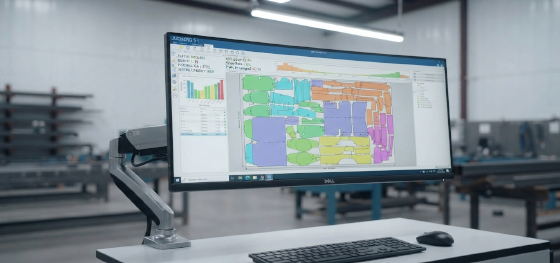
Why does low nesting efficiency dramatically inflate your custom part pricing?
Because the raw material is purchased by the sheet, any unused skeleton metal is billed directly to your project as scrap waste.
Every advanced sheet metal fabrication cycle contains hidden cost leaks that designers rarely identify. When a flat pattern features irregular, protruding flanges, it cannot be packed tightly during the laser nesting phase. This poor nesting efficiency leaves large areas of un-cut skeleton metal, forcing you to pay for raw material that is immediately thrown away.
To maximize material yield, our engineers check your designs for optimal nesting boundaries. We recommend designing parts that can share cut lines or nesting smaller bracket components inside the hollow cutouts of larger chassis. This proactive nesting optimization ensures that you get maximum parts per sheet, driving down the wasted material bill of your order.
Get Factory-Direct Pricing from Jucheng Precision
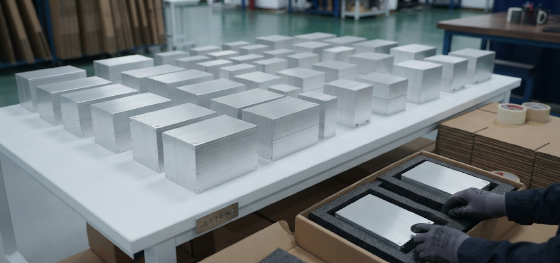
How does Jucheng Precision minimize fabrication expenses on custom hardware orders?
We eliminate middle-man markups by managing cutting, bending, and finishing in-house, utilizing an extensive inventory of standard press tools to bypass mold fees.
Integrating precise cost-saving parameters into your early design cycles is the single most effective way to protect your budget. Jucheng Precision bridges the gap between rapid prototyping and volume production, keeping your overall sheet metal fabrication cost remarkably low. We operate an IATF 16949 and ISO 13485 certified environment, running advanced fiber lasers and high-tonnage brakes with extreme repeatability.
We stock a wide selection of raw sheet metals, including lightweight aluminum, high-yield stainless steel, and easily formable carbon steel. Our technical department provides a 24-hour free DFM analysis to evaluate your CAD models, checking tolerances and material limits before production. Supported by our no MOQ policy and rapid delivery guarantee, we manage your project from initial flat pattern cutting to final, high-durability surface powder coating.
FAQ: Critical Questions About Sheet Metal Cost
Our engineering team has compiled professional solutions to the most common budgeting challenges faced during product development:
Why is sheet metal so expensive right now?
Global commodity prices fluctuate due to energy costs and shipping bottlenecks. Sourcing directly from an integrated, high-capacity manufacturer like Jucheng Precision helps bypass distributor markups and protects your project from localized supply chain volatility.Does volume significantly affect the final sheet metal cost?
Yes, heavily. While prototyping runs require manual setups that increase the per-part cost, scaling to volume allows us to amortize these setup fees. For extreme high-volume production, we utilize automated progressive dies to stamp out thousands of parts per hour, reducing your unit cost to pennies.How do you protect high-precision parts from scratching during finishing?
We protect raw panels during press operations by utilizing specialized polyurethane die liners or applying protective vinyl masking films. This prevents direct metal-on-metal friction, delivering clean, scratch-free brackets ready for immediate final assembly.How does Jucheng Precision prevent thickness variations in custom orders?
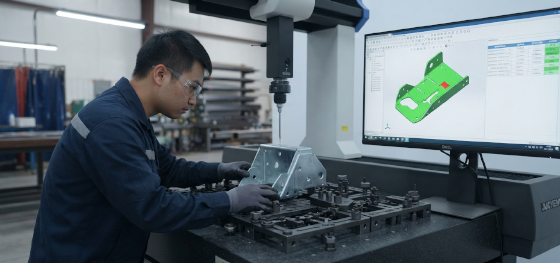
We continuously calibrate our fiber lasers and CNC press brake back gauges to compensate for minor thickness variations in raw steel sheets. Our team utilizes advanced 3D unfolding software to calculate exact material elongation parameters, and conducts full coordinate measuring machine (CMM) dimensional checks on completed assemblies before final packaging.

