


Structuring custom hardware profiles to bypass fabrication defects requires more than just standard CAD drafting. Adhering to proven sheet metal design guidelines ensures that your flat patterns fold seamlessly on high-speed press brakes, keeping your manufacturing costs low and preventing physical material failures. To achieve high repeatability on the assembly floor, designers must understand the physical stress boundaries of metal deformation while keeping a uniform wall thickness across all folded flanges.
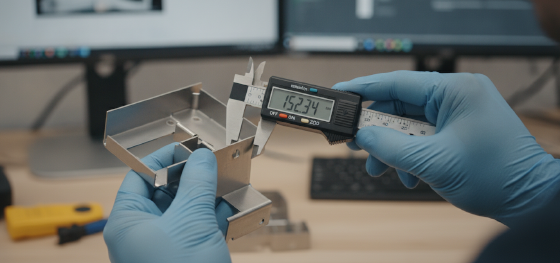
For many product developers, overlooking these fundamental manufacturing limits leads to severe delays and costly engineering changes. Brackets modeled with impossibly sharp inner corners or mounting holes placed directly on bend lines will warp, tear, and fail during press operations. Proactively optimizing your CAD designs against physical tooling limits is the best way to secure your production schedule.
Let's examine the most critical mechanical rules for sheet metal engineering, explore how to design the perfect bend with accurate springback compensation, and review how to manage holes, slots, and flat patterns to maximize material utilization.
content:
Maintain Uniform Wall Thickness
Designing the Perfect Bend
Managing Holes, Slots, and Edges
Get Expert DFM Support from JUCHENG
FAQ: Critical Questions About Sheet Metal Design Guidelines
Maintain Uniform Wall Thickness

Why is maintaining a uniform thickness across all folded flanges critical?
Uniform wall thickness prevents localized material stretching and stress concentrations during bending, ensuring consistent springback and high dimensional precision.
Maintaining a uniform wall thickness is a fundamental rule in sheet metal engineering. Unlike molded plastics or cast metals, sheet metal parts are manufactured from raw, flat plate stock of a single, continuous thickness. If your 3D CAD design incorporates varying thicknesses in a single component, it becomes physically impossible to fabricate from a single sheet, requiring slow, multi-part welding or CNC milling.
Additionally, transitions between thick and thin sections can cause severe material twisting under press brakes. Using a single thickness across the entire flat layout ensures that the material deforms predictably, keeping your manufacturing simple and highly cost-effective. We recommend sticking to standard industrial gauge thicknesses to reduce raw stock costs.
Designing the Perfect Bend

What factors must be calculated to design a reliable, crack-free bend?
We must specify an inner bend radius equal to or greater than the material thickness, and calculate the exact K-factor to compensate for outer fiber stretching.
Under standard sheet metal design guidelines, attempting to fold metal with a sharp inner corner is one of the most common causes of metallurgical failures. Bending metal past its physical elongation limits forces the outer fibers to experience extreme tensile stress, causing micro-cracking and material splitting. To prevent tearing, always maintain a minimum bend radius that corresponds to the specific ductility of your alloy.
Managing material elongation also requires an accurate K-factor. The K-factor represents the shifting of the neutral axis relative to the overall material thickness during deformation. Harder metals like stainless steel stretch differently than softer aluminum plates, requiring distinct K-factor values to unfold 3D models into accurate flat patterns. We pre-calculate these variables to compensate for springback, ensuring consistent fold angles across production runs.
| Material Grade | Recommended K-Factor | Recommended Minimum Radius | Bending Characteristics |
|---|---|---|---|
| Aluminum (e.g., 5052-H32) | 0.40 - 0.43 | 1.0 x Material Thickness | Highly formable, low springback, easy to fold |
| Stainless Steel (e.g., SUS304) | 0.44 - 0.46 | 1.5 x Material Thickness | Work-hardens rapidly, high springback, requires high tonnage |
| Carbon Steel (e.g., SPCC) | 0.41 - 0.45 | 0.8 x Material Thickness | Excellent ductility, predictable deformation, cost-effective |
Managing Holes, Slots, and Edges

How do you prevent mounting holes and slots from deforming during bending?
Keep all hole edges at a minimum distance of twice the material thickness plus the bend radius away from the fold line to prevent stretching.
Placing holes too close to a fold line exposes the hollow cavity to intense tensile stresses during bending. As the metal stretches around the die, the hole is pulled out of shape, deforming into an elliptical, egg-like profile that prevents mounting bolts from passing through. To prevent this, always maintain a strict hole-to-edge distance of at least two times the thickness plus the inner bend radius.
Similarly, managing exposed outer edges is critical to operator safety and part rigidity. When designing folded safety hems (such as a closed hem to hide sharp edges), always ensure the hem height is at least four times the material thickness. This allows our press brake tools to clamp and flatten the hem cleanly without buckling the main panel surface, ensuring a smooth, rigid finish.
Get Expert DFM Support from JUCHENG

How does JUCHENG help engineers optimize their custom designs for high-precision manufacturing?
We analyze your 3D CAD files utilizing advanced DFM software, verifying flat patterns, bend interferences, and material limits before production.
Integrating complete manufacturing rules into your early Sheet metal design cycles is the most effective way to eliminate costly errors. JUCHENG integrates these strict geometric checks into our digital manufacturing network, allowing us to transition your drawings into fully finished, durable hardware with extreme dimensional consistency.
We process a wide range of raw sheets, including lightweight aluminum, high-yield stainless steel, and easily formable carbon steel. Our technical department provides a 24-hour free DFM analysis to check your CAD models, checking tolerances and tool clearances before production. Supported by our no MOQ policy and rapid delivery guarantee, we manage your project from initial flat pattern cutting to final packaging and assembly.
FAQ: Critical Questions About Sheet Metal Design Guidelines

What is the minimum recommended flange length for press brake bending?
The minimum flange length must be wide enough to span across the chosen V-die opening during the descent. If a flange is too short, it will slide straight into the die instead of bending. As a general manufacturing rule, the minimum flange length should be at least four times the material thickness to ensure stable, accurate bends.
How do you prevent tearing at the base of a bent flange?
Tearing occurs when a bend is executed close to an existing straight edge, forcing the adjacent flat metal to stretch. To prevent tearing, we recommend designing specialized bend relief cuts (such as small rectangular slots) at the corner intersections of the fold, isolating the bending stress completely from the flat surface.
Can different metal sheets be folded utilizing the exact same press brake dies?
While the same machine can fold various metals, different alloys require custom die openings and punch radii. Soft aluminum requires larger punch radii to prevent outer-edge cracking, while hard stainless steel demands higher tonnages and smaller die clearances to manage its high yield strength, requiring different tooling setups.
How does JUCHENG help engineers implement these sheet metal design guidelines?
Our technical department analyzes your CAD models during our complimentary DFM stage. If your enclosure design features holes that are too close to a fold, or flanges that are too short to bend safely, we suggest clear modifications to keep your parts functional, highly manufacturable, and cost-effective.

