


Designing sleek lateral USB ports on the side of your hardware enclosure looks fantastic until you receive the official factory tooling quote. Standard heavy-duty steel molds open strictly in one vertical direction, ripping apart to release the hot metal. Adding deep lateral grooves physically locks the solidified component permanently inside the steel cavity. Resolving die casting undercuts forces manufacturers to build massive, highly complex moving steel mechanisms that violently drive your initial production costs into the stratosphere.

Procurement teams frequently battle engineering departments over these expensive aesthetic choices. Paying an extra twenty thousand dollars just to cast a side-facing mounting bracket ruins your commercial profit margins. Executing a rigorous die casting design guide audits these specific geometric traps before you sign any manufacturing contracts. Jucheng Precision aggressively challenges these costly features, finding smarter ways to achieve the exact same functionality without breaking your tooling budget.
Balancing complex geometry against brutal mechanical reality dictates your ultimate unit price. Let's dissect how sliding steel blocks extract these stubborn shapes, why maintaining moving tooling causes massive factory headaches, and exactly when secondary milling becomes your ultimate financial savior.
content:
Geometric Traps: Why Do Parts Get Stuck?
Hydraulic Sliders: Forcing Lateral Extractions
Tooling Debt: The Hidden Cost of Moving Parts
Redesign Strategies: Erasing Lateral Features
Jucheng Precision: Smarter Hardware Tooling
FAQ: Honest Answers About CNC Alternatives
Geometric Traps: Why Do Parts Get Stuck?

What physical barrier prevents complex hardware from dropping safely out of the press?
Any protruding lip, recessed side cavity, or lateral channel that obstructs the straight vertical pulling path acts as a mechanical anchor, physically fusing the frozen metal to the tool.
Visualizing the mold separating requires imagining two giant blocks pulling apart. If your design features a deep indent on the side wall, the steel core forming that indent must physically get out of the way before the vertical block lifts.
Engineers transitioning from 3D printing constantly overlook this limitation. Additive manufacturing builds parts layer by layer, allowing infinite geometric freedom. Pushing boiling liquid metal into a rigid steel cavity violently enforces the laws of extraction physics.
Hydraulic Sliders: Forcing Lateral Extractions

How do heavy foundries successfully extract enclosures featuring mandatory lateral holes?
Toolmakers integrate specialized hydraulic side-action sliders that drive heavy steel pins horizontally into the cavity before injection, then rapidly pull them outward before the main vertical blocks separate.
Building these moving mechanisms requires extreme precision engineering. The sliding block must withstand hundreds of tons of violent injection pressure without shifting backward. If the slider moves even a fraction of a millimeter during the pour, heavy metal flash will violently spit out of the seam.
Coring out lateral features creates highly visible cosmetic scars. Every time a moving slider intersects with the primary mold wall, it leaves a distinct parting line on the exterior of your hardware, requiring aggressive secondary polishing to erase.
Tooling Debt: The Hidden Cost of Moving Parts
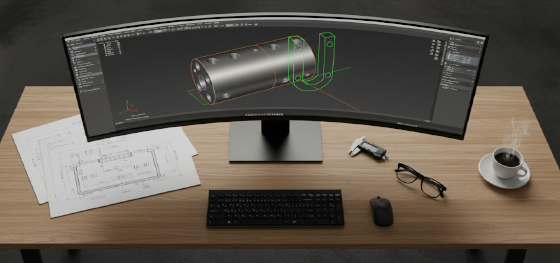
Why do hardware startups desperately avoid installing moving blocks inside their tooling?
Adding complex pneumatic or hydraulic tracks drastically inflates the initial NRE tooling invoice while simultaneously introducing massive failure points that demand constant factory maintenance.
Moving parts wear out aggressively inside hot environments. Liquid aluminum inevitably seeps into the microscopic gaps around the sliding tracks, slowly grinding the mechanism to a complete halt. Fixing a jammed slider shuts down your entire commercial assembly line instantly.
Procurement directors must calculate this severe maintenance liability. Opting for simple, straight-pull molds guarantees absolute factory uptime, pumping out millions of parts continuously without suffering from jammed internal gears.
Redesign Strategies: Erasing Lateral Features

How do senior designers alter their blueprints to completely avoid expensive side-actions?
By extending the closed lateral hole entirely to the top edge of the part, transforming the trapped circle into an open, U-shaped vertical slot that ejects effortlessly.
Shifting problematic features directly onto the primary parting line represents another brilliant engineering hack. If the side hole sits exactly where the two massive steel halves meet, each half can form part of the hole, completely neutralizing the extraction trap.
Running your CAD files through comprehensive design for die casting (DFM) protocols reveals these cost-saving opportunities immediately. Smart hardware teams actively sacrifice minor aesthetic preferences to secure brutally efficient, highly profitable manufacturing runs.
Jucheng Precision: Smarter Hardware Tooling

Why must hardware founders rely on agile contract manufacturers for mold design?
Low-tier brokers simply build exactly what you draw, happily charging you massive premiums for unnecessary sliders; premium facilities actively challenge your blueprint to slash your NRE expenses.
Operating our heavy manufacturing hub, Jucheng Precision routinely offers a hybrid commercial approach. Instead of building a twenty-thousand-dollar sliding mechanism for a tiny side hole, we pour a solid block and simply drill the hole later using our massive in-house CNC machining fleet.
Stop bleeding capital on over-engineered tooling. Send your complex assemblies to our senior design team today. We meticulously analyze your geometric traps, provide ruthless mathematical alternatives, and deliver flawless metallic enclosures.
FAQ: Honest Answers About CNC Alternatives
Does CNC milling a side hole cost more than building a hydraulic slider?
For massive million-unit runs, a durable slider eventually pays for itself. However, for low to medium volumes, utilizing secondary subtractive milling remains vastly cheaper than buying complex moving steel.
Can I cast lateral screw threads directly into the side of my enclosure?
Absolutely not. Threads fundamentally lock into the surrounding metal matrix. You must cast a smooth core hole using a slider, then manually tap the threads afterward, or simply CNC the entire feature.
Why do snap-fit clips work in plastic injection but fail in metallurgy?
Plastics bend and flex significantly during ejection, allowing them to temporarily pop out of minor undercut traps. Rigid industrial alloys refuse to bend; they will violently tear the steel tool apart instead.
Will the factory warn me before building an insanely expensive mold?
Professional facilities halt everything. We refuse to cut heavy H13 tool steel until our clients thoroughly review our DFM report highlighting every single geometric trap and its associated financial penalty.

