


Transitioning your hardware components from low-volume fabrication to automated, high-velocity mass production is a massive economic milestone. Implementing correct sheet metal stamping design guidelines ensures that your complex profiles can be manufactured repeatably with minimal tool wear, while matching your features to the automated sequence of high-speed progressive dies. For hardware engineers, this specialized tooling discipline is the key to driving per-piece part prices down to pennies on millions of units.

Suffer from premature die chipping, high reject rates, or extreme burrs along cut edges during stamping trials? When part geometries are modeled without accounting for metallurgical shear zones, blanking clearances, or punch stresses, it leads to massive tool repair costs and delayed launches. Proactively optimizing your CAD designs to match high-pressure die mechanics is the best way to secure your production margins.
Let's examine the economic thresholds for transitioning from standard bending to hard tooling, review standard design guidelines for blanking, piercing, and coining operations, and explore how our agile rapid tooling solutions protect your budget.
content:
Bending vs. Stamping: When to Switch to Hard Tooling
Designing for Blanking, Piercing, and Coining
Rapid Tooling Services for Stamping Dies at JUCHENG
FAQ: Critical Questions About Sheet Metal Stamping Design
Bending vs. Stamping: When to Switch to Hard Tooling

What production volume justifies the upfront capital expense of stamping dies?
Stamping becomes the most economical choice when volumes exceed 5,000 units, as the extremely low per-part price quickly absorbs the initial NRE tooling costs.
Understanding the economic transition from standard fabrication to hard stamping is critical to managing your capital investment. For low-volume prototyping and pilot runs, laser cutting and press brake folding are highly cost-effective because they require zero custom tooling. However, these manual processes are slow, resulting in a high per-piece part price.
As your production volumes scale past thousands of units, transitioning to progressive dies becomes necessary to drop unit prices. Although designing custom steel dies carries a high upfront tooling cost, the automated mechanical press lines can stamp out hundreds of complete parts per minute. This extreme speed reduces labor and machine run times, protecting your profit margins at scale.
Designing for Blanking, Piercing, and Coining
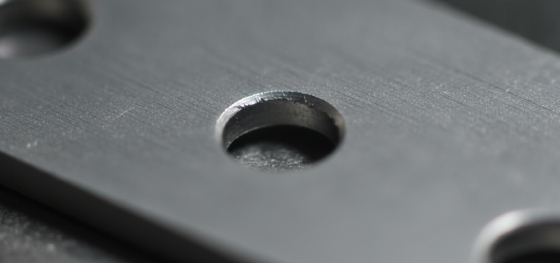
What are the essential design rules for shearing and forming operations on stamping presses?
We recommend maintaining minimum hole diameters equal to sheet thickness, specifying corner radii over 0.5 times the thickness, and avoiding long narrow slots.
When optimizing sheet metal stamping design parameters, designers must focus heavily on the localized shear and flow limits of the material. During blanking (cutting the flat profile) and piercing (punching holes), sharp corners on the punch are highly prone to edge chipping. To prolong tool life, always specify outer and inner corner radii of at least 0.5 times the material thickness.
Similarly, avoid designing long, thin cantilevers or narrow slots. The corresponding punches on the die will be extremely thin and fragile, causing them to break under high stamping pressures. For high-density circular grids, maintain a minimum spacing of 1.5 times the thickness between holes. When crisp edges or high local stiffness are required, we execute cold coining, compressing both sides of the sheet to flatten burrs and increase local strength.
Rapid Tooling Services for Stamping Dies at JUCHENG
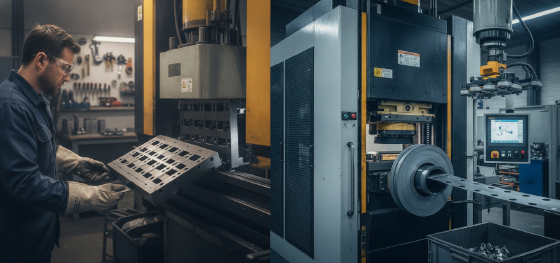
How does JUCHENG lower the cost and lead time of custom stamping dies?
We utilize modular die bases and pre-machined master plates, only machining the custom active inserts to lower NRE tooling costs by up to fifty percent.
Integrating these hard-tooling clearances into your early sheet metal design cycle is the single most effective way to eliminate production defects. JUCHENG integrates these advanced geometric and material validations into our digital manufacturing network, ensuring that your CAD files translate into fully finished, durable assemblies with extreme dimensional precision.
We process a wide range of raw sheets, including lightweight aluminum, high-yield stainless steel, and easily formable carbon steel. Our technical department provides a 24-hour free DFM analysis to check your CAD models, checking tolerances and tool clearances before production. Supported by our no MOQ policy and rapid delivery guarantee, we manage your project from initial flat pattern cutting to final packaging and assembly.
FAQ: Critical Questions About Sheet Metal Stamping Design

What is the minimum diameter for pierced holes in hard alloys?
As a general stamping rule, the minimum diameter of any pierced hole should not be less than the material thickness (d ≥ t). Forcing a punch with a diameter smaller than the sheet thickness concentrates extreme shear stress on the tip, causing rapid tool wear, bending, or complete punch fracture.
How do you control high springback in stamped high-strength steels?
We address springback by over-bending the flanges in the die stations by calculated angles, or incorporating localized coining steps around the bend lines. Compressing the metal past its elastic limit locally stress-relieves the material, locking the flange into its exact target angle after the punch retracts.
Why is the grain direction of raw metal coils important for progressive dies?
Raw metal coils develop a continuous grain direction during processing at the rolling mill. If a major bend in your part is executed parallel to this grain, the outer fibers will stretch and split easily. During our nesting stage, we align the parts at angles to ensure all major folds are executed perpendicular or diagonal to the grain.
How does JUCHENG support custom sheet metal stamping design projects?
Our technical department reviews your CAD designs during our complimentary DFM stage. If your part features slots that are too narrow, or holes placed too close to a flange, we suggest clear modifications like widening slots or adjusting hole locations, delivering safe, highly manufacturable, and cost-effective stamped parts.

