


Designing custom metal parts usually starts with a simple worry: will these pieces actually fit together on the assembly line? Sourcing teams often copy tight CNC limits onto their casting drawings, completely ignoring how hot metal contracts during cooling. Comparing die casting vs cnc tolerances directly resolves this expensive over-engineering mistake. Your choice between these two metalworking paths determines your final mold life and whether your parts end up in the scrap bin.

Buying expensive steel tooling based on unverified drawings is a dangerous trap. Startups often waste valuable capital demanding microscopic limits on simple cover walls, while mature companies waste time on slow cutting paths when they should be mass-producing. Deciding between die casting vs cnc machining keeps your early-stage cash flow completely secure.
Balancing development speed with easy assembly is the key to winning in hardware. Let's compare standard casting limits to raw milling accuracy, analyze why liquid metal changes size, and explore how secondary milling fixes your dimensions cheaply.
content:
Subtractive Accuracy: Inside the Milling Bay
Formative Realities: Thermal Limits on Liquid Metal
Hybrid Tolerances: Perfecting Raw Castings with Selective Milling
Quality Checks: Verifying Microns on the Shop Floor
FAQ: Honest Answers About Measurement and Shrinkage
Subtractive Accuracy: Inside the Milling Bay

Shaving metal block by block using computer-guided spindles ensures absolute dimensional control. Solid raw aluminum remains completely cold and stable during these high-speed cutting runs, completely bypassing thermal contraction variables.
Standard milling machines routinely hold these tight limits down to five microns. Sourcing components like high-precision bearing seats or medical optics demands this exact level of geometric certainty.
This advanced subtractive method is why direct cutting remains the absolute industry standard for tight die casting vs cnc tolerances. You get flawless, repeatable accuracy across every single part without causing structural warping.
Molten Metal Realities: Why Liquid Freezes Unevenly

Liquid metal contracts violently as it chills inside steel molds. This natural thermodynamic movement makes achieving absolute microscopic precision physically impossible directly out of the machine.
Standard injection molding delivers excellent baseline dimensional accuracy for general housing walls. Zinc and magnesium alloys flow beautifully, but they still shrink by fractions of a millimeter as they freeze.
Forcing your designs below these natural as-cast limits causes massive scrap rates. You end up paying huge factory premiums because the operators must constantly halt production to adjust pressures or rebuild worn-out sliding pins.
Hybrid Tolerances: Perfecting Raw Castings with Selective Milling
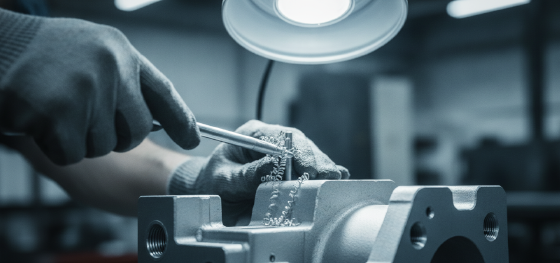
Combining both technologies under one roof is the ultimate industry secret to saving money at scale. We cast the overall complex shape cheaply and then use our 5-axis mills strictly on the critical mating faces.
Running precise cnc machining die cast parts allows you to master die casting vs cnc tolerances. We leave a microscopic layer of extra metal on the sealing faces, ensuring the cutters have enough material to shave flat.
Securing this hybrid tolerance balance gives you the best of both worlds. You get the extreme speed of high-pressure metal injection alongside the microscopic limits required for watertight O-ring grooves.
Quality Checks: Verifying Microns on the Shop Floor

| Dimensional Requirement | As-Cast Metallurgy Performance | Secondary CNC Milling Performance |
|---|---|---|
| Linear Dimensions | +/- 0.15mm (As-cast zinc) | +/- 0.005mm (5-axis CNC) |
| Flatness Limits | +/- 0.20mm (As-cast aluminum) | +/- 0.010mm (5-axis CNC) |
| Internal Threads | Not recommended (Shrinkage ruins pitch) | Excellent (Microscopic tap control) |
Comparing raw numbers from different suppliers requires a highly standardized diagnostic baseline. Sourcing your components based on realistic die casting vs cnc tolerances protects your margins from unexpected factory rework fees.
Operating our own highly flexible, fully audited facility ensures your final parts match your blueprints. Send your complex CAD files to our technical team today for a comprehensive, manual DFM flow analysis and secure a highly optimized dual-quote.
FAQ: Honest Answers About Measurement and Shrinkage
Does heavy mechanical polishing alter the final geometric measurements?
Tumbling and vibratory finishes physically scrub microscopic layers off the exterior skin, slightly altering your raw limits. We calculate this fractional material loss during the initial tool design phase to keep critical dimensions perfect.
Can I run zinc and aluminum through the exact same steel mold?
No. Because different metals shrink and contract at completely different rates, pouring aluminum into a mold designed for zinc will result in parts that fail to meet your dimensional tolerances.
Do you charge extra fees for mandatory Material Test Reports?
Providing complete chemical certifications (CoA) and RoHS compliance certificates with every single delivery is our standard practice, included entirely free of charge.
Why do some plated parts develop tiny bumps months after production?
Subsurface porosity causes this massive failure. Acidic plating chemicals become trapped in microscopic holes during manufacturing, slowly outgassing over time and pushing the chrome layer upward into a blister.

