


Pouring hot liquid metal into steel molds is incredibly cheap, but those raw parts rarely fit together perfectly on the assembly line. Shaking from high-speed motors and daily chemical washdowns demands absolute physical flatness that raw casting cannot deliver. Specifying custom cnc machining die cast parts bridges this massive precision gap, turning rough raw shells into airtight commercial hardware.

Rushing into final product assembly with unmachined metal covers is a massive financial risk. Startups often waste valuable capital forcing mismatched parts together, completely ignoring the basic physics of die casting vs cnc machining capabilities. Operating our own integrated manufacturing facility allows our engineering team to handle both processes seamlessly under one roof.
Balancing raw metal injection speeds with microscopic cutting accuracy determines your ultimate profit margins. Let's look at why cast metal needs help from a drill bit, how to plan for extra material on your CAD files, and why using a single supplier prevents expensive scrap.
content:
Flat Faces and Tapped Holes: Why Casting Needs Help
Planning the Blueprint: Leaving Extra Metal
Turnkey Coordination: Erasing Supply Chain Friction
FAQ: Honest Answers About Tools and Tolerances
Flat Faces and Tapped Holes: Why Casting Needs Help
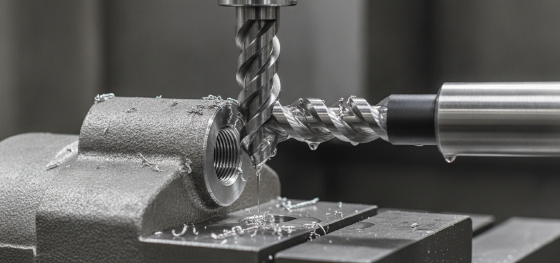
Why do raw metal castings require secondary subtractive milling?
Because the high shrinkage rate of cooling metal distorts delicate features like screw threads and O-ring grooves, requiring precise cutting to achieve watertight seals.
Standard injection molds cannot cast microscopic internal threads reliably. The liquid metal contracts as it freezes, warping the tiny pitches and making it impossible to drive a screw in safely without stripping the surrounding alloy.
Doing some basic cnc machining die cast parts work solves this assembly bottleneck. We cast the part as a solid cylinder first, then use our high-speed drill presses to cut perfect, tight threads that survive high torque.
Planning the Blueprint: Leaving Extra Metal

How much excess material should engineers design on their raw casting drawings?
Industry experts recommend leaving exactly 0.5mm to 1.5mm of sacrificial metal, providing enough depth for the cutter to grab cleanly.
Designing your parts with a precise die casting machining allowance is a non-negotiable step before cutting steel molds. If your CAD file is too tight, the spinning cutter will simply graze the surface, destroying your expensive tools.
Cutting too deep is equally dangerous. Shaving off too much metal penetrates the dense outer skin, exposing a porous internal core that causes your cnc machining die cast parts to leak under pressure.
Turnkey Coordination: Erasing Supply Chain Friction

Why does shipping raw metal castings to a separate machine shop ruin your budget?
Because separate factories will constantly blame each other for dimensional errors, leaving you to absorb the massive financial costs of scrapped batches.
Sourcing raw components from unverified brokers is a massive, dangerous risk. If the machine shop cuts into a hidden air void, they will claim the casting was dirty, while the foundry will blame the CNC setup.
Consolidating your entire hardware pipeline inside the JC Rapid facility eliminates this finger-pointing completely. We cast the raw metal and immediately load the parts into our own CNC bay to ensure a perfect cnc machining die cast parts execution.
FAQ: Honest Answers About Tools and Tolerances

Does secondary machining increase the tooling cost?
No. Machining is a subtractive process done post-casting, meaning it requires zero expensive mold modifications and has no impact on your NRE budget.
Can I anodize a part after it has been machined?
Yes, but keep in mind that machined areas will look brilliantly shiny and colored, while raw cast areas will look dull gray due to high silicon levels.
Do you provide the Material Test Reports with every shipment?
Providing complete chemical certifications (CoA) and RoHS compliance certificates with every single delivery is our standard practice, included entirely free of charge.
How fast can your engineers deliver a fully finished part?
Depending on the specific alloy and geometric complexity, our high-precision machining bays routinely deliver fully finished, machined castings globally in as little as 5 days.

