


Manufacturing for the healthcare sector is a discipline defined by a reverence for human life. In the vast landscape of CNC machining industry applications, no other field carries the same weight of responsibility as the production of surgical tools and permanent implants. A single microscopic burr or a trace of chemical contamination can transform a life-saving device into a hazardous object. This is the extreme reality of Medical CNC Machining. It is a world where "close enough" does not exist, and where the manufacturing process must be as clean, precise, and documented as the surgery itself.
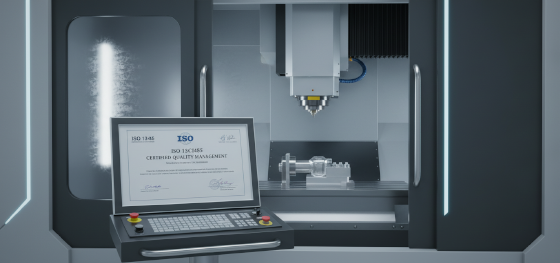
At Jucheng Precision, we have evolved beyond the role of a standard machine shop to become a certified partner in the medical supply chain. We understand that medical device engineers are not just looking for a vendor who can follow a blueprint; they are looking for a facility that understands the nuances of biocompatibility and the rigors of ISO 13485 compliance. Operating from our specialized micro-machining and 5-axis centers, we provide a validated technical path to realize the most complex orthopedic and diagnostic components. This guide explores the foundational requirements of medical manufacturing and why JUCHENG remains the trusted choice for global medical innovation.
Trust is built on documentation and zero-defect consistency. Whether you are building a revolutionary spinal fusion system or a high-volume set of dental abutments, your partner must respect the physics of the material and the laws of the regulator. Let us examine the technical pillars that define professional medical fabrication.
content:
The Unique Demands of Medical Machining
Strategic Materials: Biocompatibility and Strength
Critical Processes: Mastering 5-Axis and Swiss Turning
JUCHENG's ISO 13485 Pillar: Validated Excellence
JUCHENG's Quality Edge in Healthcare
The Unique Demands of Medical Machining
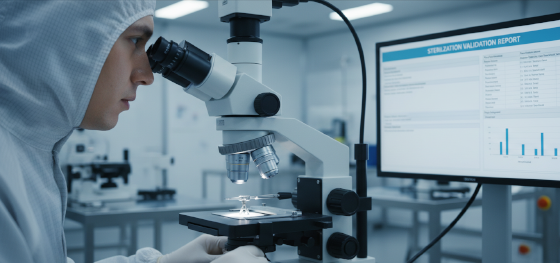
A medical part is a high-stakes component that must survive three distinct environments: the CNC machine, the sterilization chamber, and the human body. This triple-threat requirement creates a set of demands that are unique to Medical CNC Machining. The first is Biocompatibility. The material must be chemically inert, ensuring it does not trigger an inflammatory response or leach toxic ions into the bloodstream. This means our facility must maintain extreme cleanliness to prevent any cross-contamination from non-medical alloys like leaded brass or low-grade steel.
The second demand is Sterilization Survivability. Every reusable medical tool is subjected to repeated cycles of high-pressure steam (autoclaving), gamma radiation, or aggressive chemical washes. A part that looks perfect on day one but warps after ten sterilization cycles is a catastrophic failure. Jucheng Precision accounts for this by utilizing thermal stabilization and stress-relief protocols during the machining phase. Finally, there is Traceability. In the medical world, a part without a documented history does not exist. We maintain a "Golden Thread" of data for every component, linking the finished device to the specific heat number of the raw resin or metal billet. This level of technical oversight is what defines a true medical partner within the broader field of CNC machining industry applications.
Strategic Materials: Biocompatibility and Strength
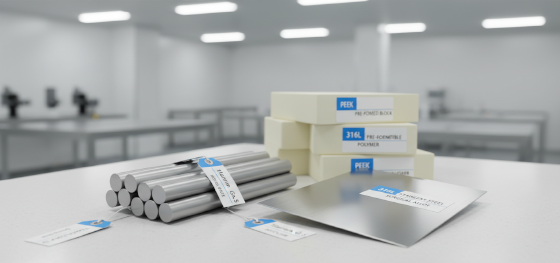
Material selection in healthcare is a balance between mechanical performance and biological acceptance. For permanent implants, Titanium is the undisputed king. We primarily machine Grade 5 (Ti-6Al-4V) and the even purer Grade 23 (ELI) for bone plates, screws, and dental implants. Titanium's unique ability for osseointegration—where natural bone bonds directly to the metal—makes it indispensable. We also process high-purity 316L Stainless Steel for surgical instruments like forceps and clamps, where corrosion resistance in saline environments is the priority.
In the realm of advanced polymers, JUCHENG is an expert in Machining Medical Grade PEEK and Radel. These high-performance plastics are favored for spinal fusion cages and reusable handles because they offer a modulus of elasticity similar to human bone and can survive hundreds of autoclave cycles without degradation. Machining these materials requires specialized sharp-edge tooling and oil-free cooling strategies to prevent the material from absorbing contaminants. By mastering this diverse palette of biocompatible materials, we ensure that your medical device is structurally sound and safe for its intended surgical mission.
Critical Processes: Mastering 5-Axis and Swiss Turning
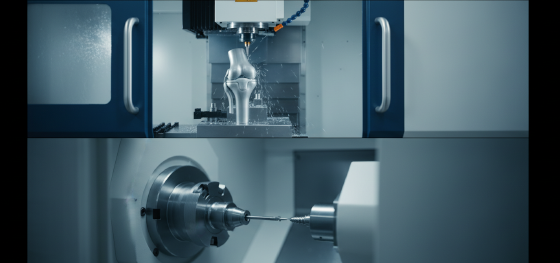
The geometry of the human body is organic and complex, which means medical parts rarely feature simple flat planes. To replicate these shapes, Jucheng Precision utilizes simultaneous 5-axis CNC milling. This technology allows our cutters to reach into deep, undercut features on orthopedic implants in a single setup. By eliminating multiple re-clamping operations, we maintain absolute concentricity and location accuracy between features, which is vital for parts like artificial hip joints or complex robotic surgical arms.
For the micro-world of medical manufacturing, our Swiss CNC turning centers are the workhorses. We produce miniature surgical probes, high-frequency connectors, and tiny dental screws with diameters as small as 0.5mm. These machines utilize a sliding headstock and guide bushing to support the material within millimeters of the cut, ensuring that long, thin parts do not deflect or vibrate. Following the machining, we apply specialized deburring and electropolishing techniques. In Medical CNC Machining, deburring is not just a cosmetic step—it is a safety mandate. Any loose metallic shard can detach inside a patient, leading to severe inflammation. Our microscopic deburring process ensures every edge is rounded and every surface is molecularly smooth.
JUCHENG's ISO 13485 Pillar: Validated Excellence
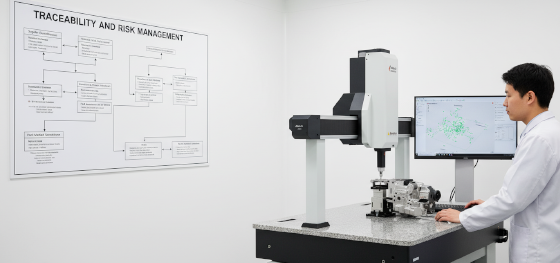
The single most important technical specification in our facility is not a dimension on a print—it is our ISO 13485:2016 certification. This international standard is the hallmark of a world-class medical device manufacturer. For our clients, this certification is more than a piece of paper; it is a guarantee of a risk-based manufacturing culture. It means that every new part undergoes a PFMEA (Process Failure Mode and Effects Analysis) to identify and mitigate potential quality risks before the first chip is ever cut.
ISO 13485 demands absolute process validation. When we program a validated cycle for a bone plate, every part in that batch—and every future batch—will be identical. We implement a rigorous calibration schedule for our high-precision CMMs and video measuring systems, ensuring our data is objective and unassailable. This commitment to the regulatory landscape of Medical CNC Machining provides our partners with the "Peace of Mind" needed for FDA and CE MDR submissions. We provide the comprehensive documentation packages, from mill test reports to final inspection logs, that allow your products to clear the highest regulatory hurdles without delay.
JUCHENG's Quality Edge in Healthcare
Choosing a partner for healthcare components is a decision of technical liability. Most shops can make a "good" part; JUCHENG provides a "validated" solution. Our facility is designed for the high-purity, high-complexity demands of the 21st-century medical device market. We bridge the gap between initial rapid prototyping and full-scale ISO-validated production. Our engineers speak the language of surgeons and clinicians, translating complex anatomical requirements into stable, manufacturable CNC tool paths.
From orthopedic surgery to diagnostic instrumentation and dental implants, our expertise in Medical CNC Machining ensures your innovation reaches the clinic safely. We don't just cut metal and plastic; we manufacture trust. Our integrated approach—combining 5-axis precision, exotic material mastery, and a zero-defect mindset—makes Jucheng Precision the premier choice for CNC machining industry applications in the medical sector. Contact our engineering team today for a comprehensive DFM review and see how our certified manufacturing protocols can stabilize and elevate your next medical breakthrough.

