


Mechanical friction represents the silent adversary of long-term hardware reliability. In the high-stakes sectors of industrial robotics, automotive drivetrains, and aerospace fasteners, choosing a material that "grinds to a halt" is a failure that can trigger million-dollar recalls. When your project demands the high wear resistance of a self-lubricating polymer combined with the structural stiffness to replace metal, nylon injection molding becomes the mandatory engineering choice. Polyamide (PA), commonly known as Nylon, is a semi-crystalline thermoplastic characterized by its exceptional toughness and low coefficient of friction. Jucheng Precision operates as a high-fidelity manufacturing partner, navigating the unique thermodynamic challenges of Injection molding materials to deliver parts that serve as the structural engine of your design. However, mastering Nylon requires more than just high pressure; it requires a surgical management of moisture absorption and abrasive fiber control to ensure your hardware remains dimensionally sovereign in the field.
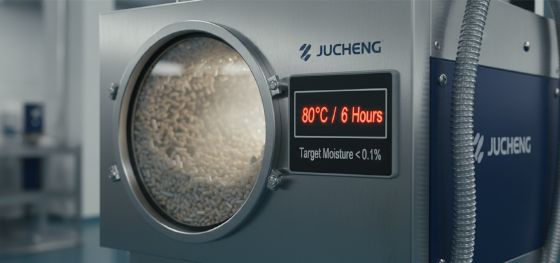
Molecular "thirst" dictates the success of every Nylon production run. Polyamides are inherently hygroscopic—they possess a chemical craving for atmospheric water molecules. Attempting to process "wet" Nylon leads to hydrolysis, a catastrophic chemical reaction that breaks the polymer chains and results in parts with the structural integrity of wet cardboard. Jucheng Precision eliminates this "Hydrolytic Crisis" by enforcing a strict "Desiccant Shield" protocol—drying every gram of Nylon resin in advanced dehumidifying hoppers until the moisture content is below 0.1% before the first shot is fired. This guide deconstructs the mechanical divide between PA6 and PA66, the abrasive realities of glass-fiber reinforcement, and the mandatory tooling standards required to survive the "Glass-Fiber Grinding" of high-volume manufacturing.
The Polyamide Standoff: PA6 vs. PA66 Property Matrix
Hygroscopic Forensics: Managing Moisture and Dimensional Drift
Abrasive Sovereignty: The Power and Penalty of Glass-Fiber
Tooling Rigor: Why H13 Steel is Mandatory for Nylon
JUCHENG Protocol: Zero-Defect Polyamide Execution
The Polyamide Standoff: PA6 vs. PA66 Property Matrix
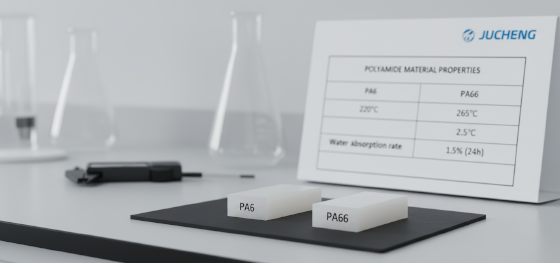
Selecting the correct Nylon grade requires a cold-blooded analysis of thermal limits versus impact requirements. While the "Nylon" label is used broadly, the mechanical reality shifts dramatically between Nylon 6 (PA6) and Nylon 66 (PA66). PA66 is the "High-Performance" sibling, offering a higher melting point and superior stiffness, making it the go-to for under-the-hood automotive parts. PA6, conversely, offers better impact resistance and easier processability due to its lower melt viscosity. To assist in early-stage design, Jucheng Precision provides the following comparative matrix:
| Mechanical Property | Nylon 6 (PA6) | Nylon 66 (PA66) |
|---|---|---|
| Melting Point (°C) | 220°C | 265°C |
| Tensile Modulus (MPa) | 2,300 - 2,800 | 2,900 - 3,400 |
| Moisture Absorption (%) | 9.0% (Saturation) | 8.5% (Saturation) |
| Molding Shrinkage Rate | 0.7% - 1.5% | 0.8% - 1.8% |
Observing the data reveals that PA66 is the superior choice for high-heat environments where rigidity is the primary mandate. However, if your design features aggressive snap-fits that require more ductility, Jucheng Precision often directs engineers toward PA6. We don't just "fill molds"; we map the resin chemistry to your specific mechanical load case, ensuring your nylon injection molding project achieves the optimal balance of toughness and longevity.
Hygroscopic Forensics: Managing Moisture and Dimensional Drift
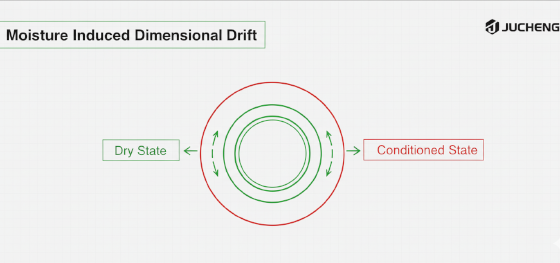
Dimensional sovereignty in Nylon is a moving target. Because Polyamides are hygroscopic, they act like a mechanical sponge. After leaving the mold, a Nylon part will gradually absorb moisture from the air until it reaches "Equilibrium Content." This absorption causes the part to physically grow—often expanding by 0.5% to 0.8% in volume. For high-precision bearing seats or interlocking gear sets, this "Nylon Swell" can lead to binding or catastrophic failure. Jucheng Precision manages this through "Conditioning." For safety-critical hardware, we submerge parts in warm water baths post-molding to reach equilibrium state immediately. This ensures that the dimensions we measure in the QC lab are the final dimensions the user will experience in the field. We don't just provide a part that fits on day one; we provide the manufacturing intelligence to ensure it fits on day one thousand.
Abrasive Sovereignty: The Power and Penalty of Glass-Fiber
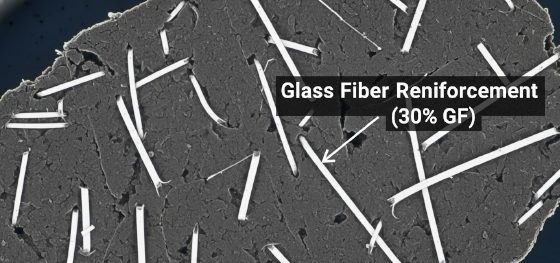
Structural replacement of metal often necessitates "Glass-Fiber" (GF) reinforcement. By infusing the Nylon matrix with 15% to 50% microscopic glass shards, engineers can triple the material’s tensile strength and dramatically increase its heat deflection temperature. However, this mechanical power comes with a severe manufacturing "Abrasion Tax." Glass-filled Nylon is essentially a high-velocity abrasive sludge that acts like sandpaper on the tool steel. If you run GF-Nylon in a standard soft steel mold (like P20), the sharp fibers will "wash out" the gates and erode the parting lines within a few thousand shots, leading to Injection molding flash and dimensional drift. Jucheng Precision eliminates this "Tooling Decay" by utilizing only hardened H13 tool steel for all glass-filled projects. We understand that structural durability in the part requires uncompromising durability in the mold.
Tooling Rigor: Why H13 Steel is Mandatory for Nylon
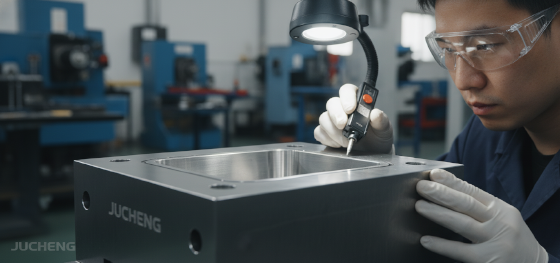
Tooling longevity is a byproduct of material hardness. When executing nylon injection molding for structural components, the mold must be harder than the abrasive forces acting upon it. Standard P20 steel (30 HRC) is a "soft target" for glass fibers. At Jucheng Precision, we utilize H13 tool steel, which is heat-treated to 48-52 HRC. This high-hardness barrier resists the "Grinding Effect" of the resin flow front, ensuring that your mold maintains its razor-sharp parting lines and tight tolerances through 100,000+ cycles. Furthermore, we apply specialized PVD (Physical Vapor Deposition) coatings to gates and high-wear zones to provide an extra layer of "Armor." We prioritize "Zero-Maintenance Production," ensuring your project doesn't suffer from the quality degradation and expensive mold rework that plagues cheaper, unhardened tooling.
JUCHENG Protocol: Zero-Defect Polyamide Execution
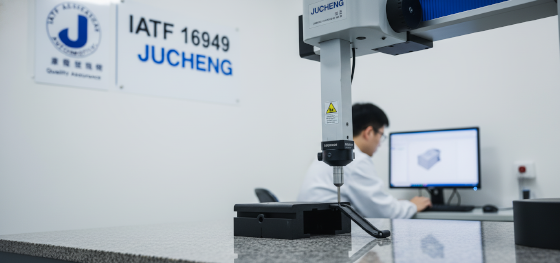
Manufacturing excellence at Jucheng Precision is built on the foundation of scientific process control. We don't just "mold plastic"; we manage a thermodynamic event. Our facility, housing over 150 CNC machines and elite injection bays, is optimized for the high-viscosity and high-shrinkage challenges of Injection molding materials. When you upload a CAD file to our facility, our veteran engineers perform a comprehensive "Moisture and Shrinkage Audit." We suggest wall-thickness optimizations to prevent "Sink Marks" in thick Nylon sections and propose gate locations that randomize fiber orientation to minimize warping. We provide full material lot traceability and CMM dimensional reports for every batch, ensuring your hardware journey is lean, predictable, and market-ready. Stop compromising your high-wear designs with inaccurate mockups or soft tooling. Leverage our decade of Polyamide mastery to validate rapidly and launch profitably. Contact our engineering team today for a free DFM review and see how we can turn your digital intent into a self-lubricating, indestructible reality.

