


Your startup is ready to launch its first product. You need 500 units for your first batch. 3D printing is too slow and the price per part is too high. A full production steel mold is financially out of the question. What do you do?

This is the classic startup dilemma. You are trapped in the valley between a single prototype and mass production. Understanding the Rapid tooling cost is the key to escaping this trap.
It is a unique economic model, perfectly suited for this stage of a product's life. It is about making a smart, manageable investment to get your product to market. This guide will break down that model for you.
content:
Dissecting the Mold Cost
Unpacking Your Part Price
Calculating Your Breakeven Point
Investing Smarter with No MOQ
Dissecting the Mold Cost

The first part of any Rapid tooling cost is the mold itself. But this is where the "rapid" philosophy already saves you a huge amount of money compared to traditional tooling.
The first saving comes from the material. A rapid tool is made from a softer material, like Aluminum or P20 steel. This material is cheaper to buy and much faster to CNC machine. Less machine time directly equals a lower mold cost.
The second, and even bigger, saving comes from a smart system called a shared mold base, or MUD (Master Unit Die) system. The large, heavy, and expensive outer frame of the mold is a standardized, reusable component that we own.
Your rapid tool is just the small, custom-machined core and cavity inserts that fit inside our master frame. You are only paying for the small pieces that are unique to your design. This is a huge cost saving. It can reduce your upfront tooling investment by 30% to 50% or more.
Unpacking Your Part Price
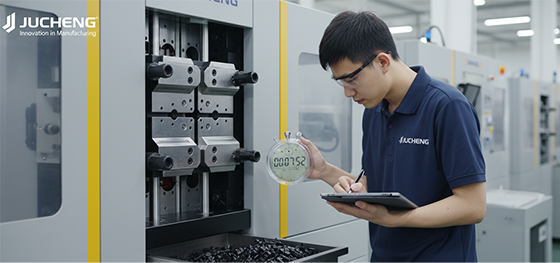
Once the mold is made, the second part of the cost is the price per part. For Rapid Tooling, this price is a little higher than mass-production, but much lower than 3D printing.
Like any molding process, the price is based on the material cost and the machine time (cycle time). Because a rapid tool is often a simpler, single-cavity tool, the process might require more manual oversight than a fully automated production tool. This can make the piece price slightly higher.
However, if we are using an aluminum tool, its excellent heat dissipation can lead to faster cooling times. This shorter cycle time can help to lower the part price, offsetting some of the other costs.
The key takeaway is this: you are paying a very low tooling cost, and in return, you get a very reasonable part price that makes low-volume production economically viable.
Calculating Your Breakeven Point

So, when does it make sense to invest in a rapid tool? This is a "breakeven" calculation against your other main option: 3D printing.
3D printing has a tooling cost of zero. But the price per part is high and does not go down with quantity. Let's say it is $40 per part.
Rapid tooling has an upfront tooling cost. Let's say it is $3,000. But the part price is much lower, maybe $10.
For 50 parts: 3D printing costs $2,000. Rapid tooling costs $3,000 + (50 x $10) = $3,500. 3D printing is cheaper.
For 200 parts: 3D printing costs $8,000. Rapid tooling costs $3,000 + (200 x $10) = $5,000. Rapid tooling is now much cheaper.
The breakeven point is around 100 parts. If your production needs are higher than this, investing in a rapid tool is the smarter financial decision.
Investing Smarter with No MOQ

The Rapid tooling cost model is designed for flexibility. It is about providing an affordable path to market for new products.
A key part of this philosophy is the business model of your manufacturing partner. Many large manufacturers have a high Minimum Order Quantity (MOQ). They are not interested in a project for just 500 parts.
At JUCHENG, we have a "No MOQ" policy. We are built to support you, whether you need 50 parts or 5,000 parts. We understand the journey of a startup. We know that your first order might be small.
Our entire pricing structure and business model is designed to support this low-volume, high-mix world. We offer cost-effective rapid tooling solutions that make your first production run possible. We are not just a supplier; we are an investment partner in your product's launch.

