


Is a tighter tolerance always a better tolerance? For an engineer, this can feel like a trick question. We are trained to pursue the highest possible precision.

But in the world of manufacturing, every zero after the decimal point comes with a cost. A significant cost. The art of smart product development is not about achieving perfection everywhere. It is about achieving the right level of precision, in the right places, for the right price.
This is the philosophy behind Rapid tooling tolerances. It is a pragmatic approach to precision. This guide will explain what level of accuracy you can realistically expect from a rapid tool, and why it is the perfect choice for the job it is designed to do.
content:
The Goal: 'Fit for Purpose,' Not 'Perfect'
Understanding the Numbers: A Typical Specification
Why It's Not the Same as a Steel Tool
Our Commitment: Verification with Data
The Goal: 'Fit for Purpose,' Not 'Perfect'
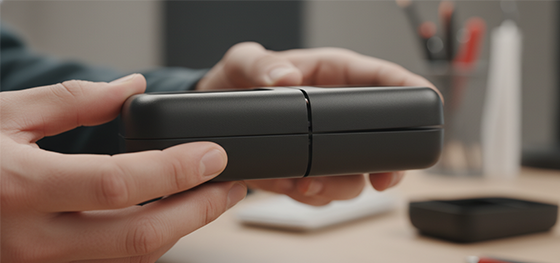
The primary goal of Rapid Tooling is to bridge the gap between a prototype and production. It is a tool for validation.
Does your two-part enclosure fit together with a clean, even seam? Will your PCB mount correctly on the internal bosses? Will the buttons function without sticking? These are the questions a rapid tool is designed to answer.
To answer these questions, you do not need the insane precision of a final production tool that costs $100,000. You need a tolerance that is "fit for purpose." You need the part to be accurate enough to perform a real-world assembly and function test. This is exactly what rapid tooling delivers.
Understanding the Numbers: A Typical Specification
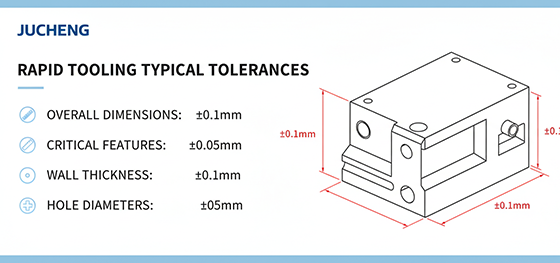
So, what are the actual numbers? What are typical Rapid tooling tolerances?
While it can vary based on the part's size and complexity, a good general specification for a part molded from an aluminum rapid tool is a machining tolerance of around +/- 0.1mm (or 0.005 inches).
For smaller, critical features within the part, such as the distance between two mounting holes, it is often possible to hold an even tighter tolerance, perhaps down to +/- 0.05mm.
It is important to remember that this is the tolerance of the mold itself. The final plastic part will also have a tolerance based on the material's specific shrinkage rate. A good manufacturer will scientifically account for this shrinkage when they design the tool.
Why It's Not the Same as a Steel Tool

Why can't a rapid tool hold the exact same tolerances as a full production steel tool? The reason comes down to the material properties of the tool itself.
Aluminum is much softer than hardened steel. Over many thousands of injection cycles, the abrasion from the flowing plastic can cause microscopic wear on the mold, especially at sharp corners or gates.
Aluminum also has a higher rate of thermal expansion. As the mold heats up and cools down with each cycle, it expands and contracts more than a steel tool would. This can lead to very slight variations in part dimensions.
A good manufacturer understands these limitations. We design our rapid tools with smart cooling channels and use carefully controlled processes to minimize these effects. This is how we can still achieve very impressive and highly functional tolerances from a softer tool.
Our Commitment: Verification with Data

Making a promise about a tolerance is easy. Proving it is what matters. This is where a professional partner's commitment to quality becomes clear.
At JUCHENG, our process does not end when the part comes out of the machine. The first parts made from any new tool, known as T1 samples, go directly to our quality assurance lab.
Here, our QA engineers use high-precision CMMs (Coordinate Measuring Machines) to perform a full dimensional inspection. We measure all the critical dimensions you specified on your drawing and compare them to the actual results.
We then provide you with a comprehensive First Article Inspection Report. This document is your data-driven proof that the Rapid tooling tolerances have been met. It is your confidence that the parts you are receiving are accurate and ready for your critical validation tests. This is our commitment to being your trusted partner in precision.

