


Physical realization remains the ultimate judge of autonomous innovation. In the hyper-accelerated landscape of 2026, the transition from a digital CAD render to a walking, talking Alpha build is the most dangerous window for hardware startups. For innovators developing the next generation of service robots, the primary adversary is not the code—it is the "Hardware Blackout." If your first physical units take three months to manufacture, your venture capital runway evaporates, and your market data arrives too late. Navigating this requirement for extreme iteration speed and exhibition-grade aesthetics requires the strategic deployment of Service robot prototyping. Jucheng Precision operates as a high-fidelity hardware sanctuary in the Shenzhen precision manufacturing hub, providing the multi-process depth needed to transform a complex Bill of Materials (BOM) into a cohesive machine in days. We don't just "print parts"; we engineer a persuasive physical reality that allows your startup to secure project funding, pass early ergonomic audits, and confidently scale into high-volume production.
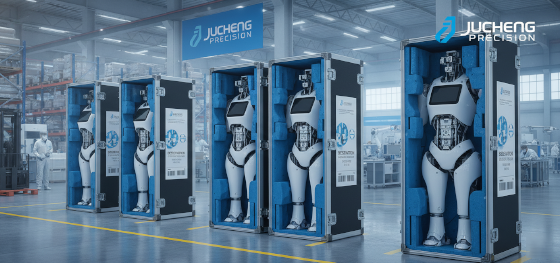
Establishing a resilient robotics roadmap demands the absolute rejection of "low-fidelity" validation. Amateurs often spend forty percent of their seed funding managing fragmented vendors who provide rough 3D prints that snap under motor torque or unpainted shells that look like science experiments. Jucheng Precision eliminates this "Operational Friction" by acting as your single-source hardware architect. Whether you need an optically clear sensor window or a load-bearing aluminum joint linkage, our facility provides the material science and metrological rigor required for 2026 market entry. This guide deconstructs the necessity of the "CES-Ready" visual model, the physics of functional structural testing, and why JUCHENG’s "BOM Orchestration" is the mandatory foundation for anyone developing Service robot prototyping projects for global deployment.
Trade Show Realism: Using SLA and Vacuum Casting for demos
Functional Survival: Testing drivetrains with CNC and MJF
JUCHENG Protocol: Orchestrating the entire multi-process BOM
FAQ
Trade Show Realism: Using SLA and Vacuum Casting for demos
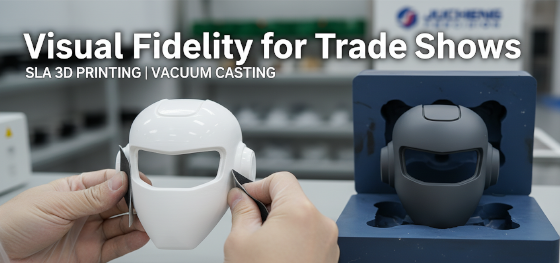
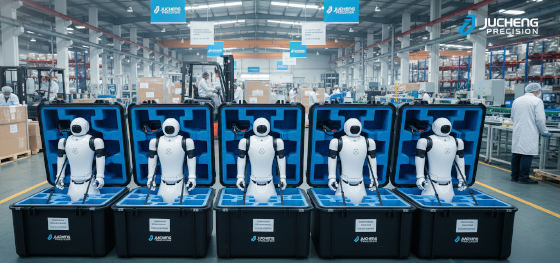
Visual authority dictates the success of a project's first capital raise. When engineering Service robot prototyping for high-stakes trade shows like CES or hospital procurement fairs, the robot must look and feel like a shipping product. Jucheng Precision utilize high-resolution Stereolithography (SLA) to print initial masters with sub-micron surface energy. These masters are hand-polished by our master model makers and used to create flexible silicone molds for polyurethane vacuum casting. This technology allows us to deliver batches of 10 to 20 identical enclosures that possess the exact color depth and VDI texture intended for the final production run. Our in-house cleanroom finishing department applies automotive-grade 2K paints and high-gloss UV coatings, ensuring that when your investors touch the bot, they register the soul of a high-end consumer electronic device, effectively eradicating the "prototype doubt" that kills hardware ventures.
Functional Survival: Testing drivetrains with CNC and MJF
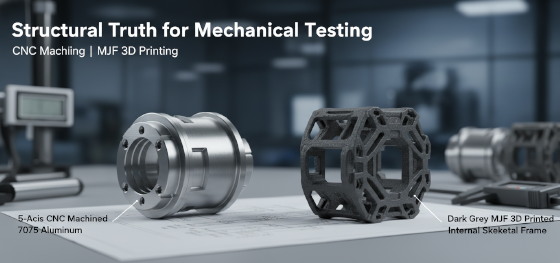
Mechanical truth is only found in real metals and high-modulus polymers. An autonomous robot that cannot navigate a carpeted office because its motor mounts flex or its drive hubs vibrate is a failure that provides zero data for your software team. For the structural linkages and high-torque movement centers of your Service robot prototyping, Jucheng Precision utilizes 5-axis CNC machining. We carve actuator housings and wheel brackets from solid blocks of 7075-T6 aluminum to ensure zero-backlash movement. For the internalorganizing frames, we deploy Multi Jet Fusion (MJF) 3D printing with Carbon-Fiber reinforced Nylon. This "Structural Skeletons" approach provides the necessary flexural modulus to withstand motor stall torque and rough handling during field trials. We don't just provide "mockups"; we deliver mechanical assets that are certified for survival in high-G dynamic testing, ensuring your Alpha fleet is functional, not just visible.
JUCHENG Protocol: Orchestrating the entire multi-process BOM
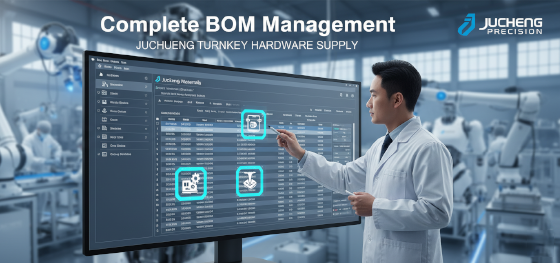
Manufacturing excellence at Jucheng Precision is built on the foundation of the "Single-Source" mandate for autonomous hardware. We recognize that a service robot is a hybrid puzzle where a 1mm mismatch between a CNC joint and a cast resin cover halts the entire assembly. When you upload your complete robot CAD assembly to our facility, our veteran engineers perform a comprehensive "BOM Integration Audit." We route each component to the optimal process—sheet metal for the chassis, 5-axis CNC for the gears, and RIM for the oversized covers—ensuring that every part mates perfectly when it arrives at your lab. We provide full material lot traceability and CMM dimensional inspection reports for every Service robot prototyping batch, providing the "Paper Trail of Quality" required for eventual ISO 13485 or IATF 16949 compliance. Stop gambling your iteration cycle on fragmented vendors. Leverage our decade of multi-process mastery to validate rapidly, scale responsibly, and maintain a zero-inventory balance sheet.
FAQ
Q: How fast can JUCHENG deliver an exhibition-ready robot?
A: Utilizing our integrated facility, we typically deliver complete, painted, and assembled Service robot prototyping kits in 10 to 14 business days from CAD approval.
Q: Can JUCHENG handle robot sensor window machining for prototypes?
A: Yes. We provide 5-axis machining and vapor polishing for PC and PMMA windows, achieving 92% light transmission for LiDAR and vision sensor testing.
Q: Do you offer **Overmolded robot bumpers** for Alpha units?
A: Absolutely. We utilize polyurethane overmolding to bond soft Shore 40A elastomers directly onto your robot's rigid skeleton, providing permanent impact protection for field testing.
Q: What documentation is provided for medical-bot prototypes?
A: Every medical batch is accompanied by full material certificates (USP Class VI) and dimensional CMM reports, ensuring your hardware meets clinical trial standards.

