


Boardroom stakes escalate the moment a physical manifestation of a design is placed on the table. For industrial designers and project managers, the aesthetic integrity of a prototype is not a luxury; it is the primary vehicle for securing executive buy-in and investor confidence. Digital renderings, regardless of their ray-tracing quality, fail to communicate the tactile weight, specular reflection, and organic "soul" of a real-world object. When a project demands "showroom-ready" fidelity—surfaces that rival the gloss of a smartphone or the texture of a luxury vehicle dashboard—engineers bypass additive methods in favor of Visual Prototypes Vacuum Casting. This specialized branch of vacuum casting prototyping focuses on eradicating the "uncanny valley" of manufacturing artifacts. It transforms raw CAD data into a physical clone that is indistinguishable from a mass-produced unit coming off a high-pressure injection press. Jucheng Precision treats every visual model as a masterpiece of molecular mimicry, ensuring that your stakeholders see the final product's intent, not the limitations of a prototype lab.
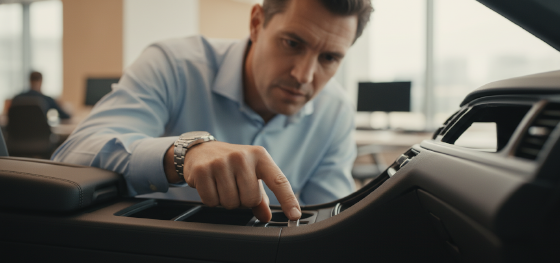
Tactile feedback remains the ultimate judge of consumer perceived value. If a prototype feels "plasticky," possesses visible layer lines, or exhibits inconsistent coloring, the human brain subconsciously registers it as an inferior experiment. Achieving retail-level gravitas requires a surgical approach to surface energy, light behavior, and chemical stability. Unlike 3D printing, which "builds" a surface through stepped layers, vacuum casting "replicates" a surface through liquid conformity. This distinction is the bedrock of premium hardware development. This guide dissects the chemistry of pigment integration, the physics of VDI texture transfer, and the manual craftsmanship required to deliver visual prototypes that dominate trade show floors and global marketing photography.
Boardroom Stakes: Why Visual Fidelity Dictates Funding
Physics of Specularity: Eradicating the Staircase Effect
Texture Sovereignty: Mastering VDI and Mold-Tech Standards
Color Science: In-Mold Pigmentation vs Topical Painting
JUCHENG Excellence: Engineering the Showroom Finish
Boardroom Stakes: Why Visual Fidelity Dictates Funding
Stakeholder psychology is often more influenced by a part's finish than its internal mechanics. During critical design reviews, a rough-textured or poorly colored prototype signals a lack of project maturity. Visual Prototypes Vacuum Casting eliminates this risk by providing a "Golden Sample" that behaves visually like a finished product. At Jucheng Precision, we understand that for consumer electronics and medical devices, the exterior housing must communicate reliability and premium quality. Using 3D prints for these sessions is often a liability; the porous surface absorbs fingerprints and scatters light in a way that looks "unfinished." Casting allows for the production of 20 to 50 identical units, each possessing the exact weight and surface energy of the intended mass-production material. This consistency ensures that every investor or board member holds the same high-quality vision in their hands, removing visual doubt from the financial equation.
Physics of Specularity: Eradicating the Staircase Effect

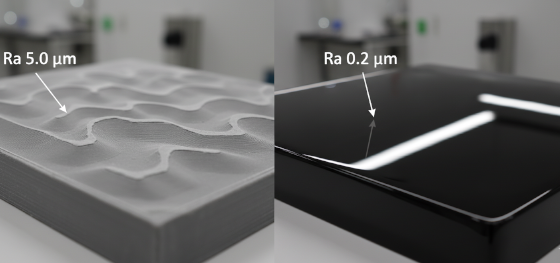
Specular reflection is the unforgiving critic of any prototype surface. Additive manufacturing, by its very nature, creates a "Staircase Effect" where curves are approximated by stacked layers. Even with high-resolution SLA printing at 50-micron layers, these steps create microscopic diffraction noise that dulls the gloss of a part. Sanding these parts manually to achieve a high-gloss finish often results in "wavy" surfaces that distort light reflections—a phenomenon known as "Orange Peel." Visual Prototypes Vacuum Casting bypasses this by utilizing a different physical logic. We invest dozens of hours in hand-polishing a single CNC-machined master pattern to an SPI A2 mirror finish. Because the silicone mold is a liquid during formation, it wets the surface of the master at an atomic level, capturing its perfect flatness. Every subsequent polyurethane part pulled from that mold inherits that crystalline specularity. For automotive light guides or high-end cosmetic enclosures, this means the light flows across the surface without distortion, providing a level of visual authority that 3D prints simply cannot fathom.
Texture Sovereignty: Mastering VDI and Mold-Tech Standards

Surface grain defines the tactile language of a brand. Whether it is a rugged VDI 3400 spark-erosion texture for a power tool or a subtle Mold-Tech leather grain for a car's interior door handle, the texture must be uniform and crisp. Replicating these industrial standards is the hallmark of professional vacuum casting prototyping. Layer-based resins lack the chemical density to hold these micro-geometric features, and sanding them off ruins the intent. Jucheng Precision technicians apply these textures directly to the master pattern using chemical etching or bead-blasting protocols. The flexible RTV silicone tool then acts as a high-fidelity transfer medium. Because the mold can stretch during demolding, we can capture "undercut textures" and deep grains that would normally require expensive mechanical lifters in a steel mold. The result is a prototype that doesn't just look like the final product; it mirrors its exact tactile DNA, allowing your ergonomic team to conduct valid "grip tests" and "scratch-resistance audits" before committing to a $30,000 production tool.
Color Science: In-Mold Pigmentation vs Topical Painting
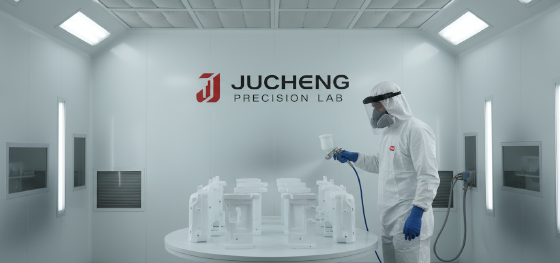
Chromatic accuracy is non-negotiable for brand-sensitive hardware. Prototyping shops often resort to topical spray painting to match colors, which adds an uncontrolled layer of thickness (often 25-50 microns) that can interfere with the fit of a complex multi-part assembly. Furthermore, painted parts are prone to chipping, revealing an unsightly white or grey resin beneath. Visual Prototypes Vacuum Casting utilizes "In-Mold Pigmentation." At Jucheng Precision, we mix high-intensity liquid dyes directly into the polyurethane resin components before they enter the vacuum chamber. We calibrate these colors in dedicated light boxes against Pantone or RAL standards. This ensures the color is "baked-in" through the entire cross-section of the part. If a visual prototype is dropped or scratched during a trade show, the color remains consistent, maintaining the illusion of a solid-molded production part. For specialized finishes like metallic frosts or soft-touch rubberized skins, we apply automotive-grade 2K coatings in our dust-free spray booths, delivering a depth of color and surface durability that makes the prototype ready for high-definition product photography.
JUCHENG Excellence: Engineering the Showroom Finish
Manufacturing mastery at Jucheng Precision culminates in our integrated finishing laboratory. We recognize that the final five percent of effort dictates ninety percent of a stakeholder's perception. Beyond the basic pour, we offer high-value post-processing including silk-screening for interface labels, pad-printing for corporate logos, and precision laser-etching for permanent regulatory markings. For optical applications, we utilize specialized UV-stabilized resins that possess a refractive index matching Polycarbonate or PMMA. These clear parts are degassed under extreme vacuum to ensure zero micro-bubbles, achieving ninety percent light transmission for high-fidelity lens prototypes. When you leverage our facility for your vacuum casting prototyping, you aren't just buying a model; you are securing a competitive edge. We deliver visual prototypes that are so dimensionally accurate and cosmetically flawless that they serve as the "Golden Samples" for your mass-production supply chain to follow. Stop compromising your brand's vision with crude experiments. Experience the uncompromising surface realism of industrial polyurethane replication. Contact our engineering team today for an itemized quote and see how JUCHENG turns CAD files into showroom reality.

