


Demanding microscopic perfection across an entire raw metal casting guarantees financial ruin. Hardware engineers accustomed to precise subtractive milling often blindly copy those exact same dimensional requirements onto their injection blueprints. Forcing molten metal to freeze within fractions of a millimeter requires aggressive tooling maintenance and incredibly slow machine cycles. Establishing a ruthless die casting design guide upfront separates critical sealing faces from standard cosmetic walls. Balancing these geometric demands prevents your procurement team from overpaying for completely unnecessary precision.

Liquid alloys violently shrink and warp as they chill inside heavy steel molds. Specifying ultra-tight die casting tolerances across every single feature forces the factory to constantly halt production and adjust the hydraulic pressure. Smart hardware founders understand that raw injection provides fantastic baseline accuracy but requires strategic mechanical intervention to achieve absolute perfection.
Navigating these physical limits dictates your ultimate assembly success. Let's dissect the thermodynamic variables causing geometric drift, compare standard commercial guidelines, and understand exactly when secondary milling becomes mathematically mandatory.
content:
Thermodynamic Variables: Why Do Dimensions Drift?
Understanding Linear and Flatness Deviations
NADCA Standards: Balancing Cost and Precision
Secondary CNC: Achieving Microscopic Perfection
JC Rapid Hub: Validating Flawless Dimensions
FAQ: Honest Answers About Measurement and Warpage
Thermodynamic Variables: Why Do Dimensions Drift?
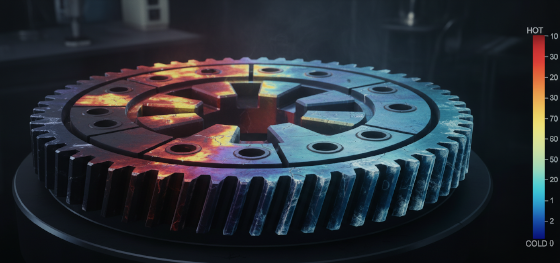
What physical forces cause raw metal components to change size unexpectedly?
Boiling metal aggressively contracts during the cooling phase; if the internal factory water lines fail to extract heat uniformly, the resulting part twists and deviates from the original CAD file.
Tooling wear introduces another massive variable into your supply chain. Scraping hot aluminum against H13 tool steel millions of times slowly erodes the cavity surface, microscopically altering the final product footprint over long production runs.
Operating advanced turnkey manufacturing facilities requires obsessive temperature monitoring. Technicians constantly calibrate the hydraulic injection velocity and ambient mold heat to minimize this natural metallurgical drift.
Understanding Linear and Flatness Deviations
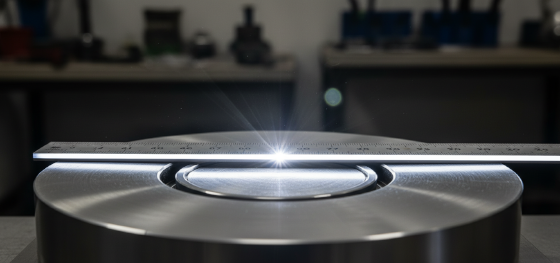
Why do massive metal panels struggle to remain perfectly flat after ejection?
Ejector pins pushing forcefully against hot, semi-solid metal naturally introduce minor bowing and warping, making absolute flatness incredibly difficult to achieve without secondary flattening operations.
Linear dimensions stretch and shrink depending on their distance from the primary injection gate. Features located deep inside the mold cavity experience slightly different thermal realities than features sitting right next to the hot molten source.
Concentricity matters heavily when designing overlapping cylindrical features. Ensuring two cast holes perfectly align requires utilizing single, solid steel core pins rather than relying on two separate moving mold halves meeting perfectly in the middle.
NADCA Standards: Balancing Cost and Precision

How do procurement directors evaluate realistic commercial manufacturing limits?
Relying on established nadca die casting tolerances provides a globally recognized baseline, separating standard commercial expectations from extremely expensive, high-precision aerospace requirements.
Standard class guidelines allow factories to run machines faster and accept minor dimensional variations, drastically driving down your unit piece price. Precision class guidelines force foundries to slow down, tighten their thermal controls, and replace mold components much more frequently.
Pushing every feature into the precision class destroys your tooling amortization strategy. Smart engineers map standard limits to general chassis walls and strictly reserve precision callouts for vital interlocking gears and sensor mounts.
Secondary CNC: Achieving Microscopic Perfection
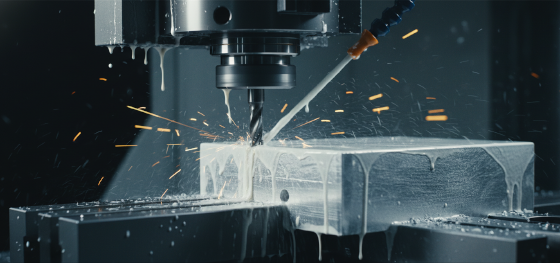
When should hardware teams abandon raw casting limits and deploy subtractive milling?
Reviewing die casting vs machining tolerances proves that raw metallurgy simply cannot achieve the absolute zero-gap perfection required for waterproof O-ring grooves or critical threaded holes.
Sending raw hardware directly into a 5-axis milling bay acts as the ultimate dimensional safety net. Forward-thinking engineers intentionally leave a tiny layer of sacrificial metal on the CAD file specifically for the cutting tools to shave off later.
Stop paying exorbitant fees for impossible metallurgical expectations. JC Rapid pairs massive injection presses directly alongside advanced cutting centers to shave away excess metal perfectly, securing flawless physical fitment at unbeatable commercial speeds.
JC Rapid Hub: Validating Flawless Dimensions
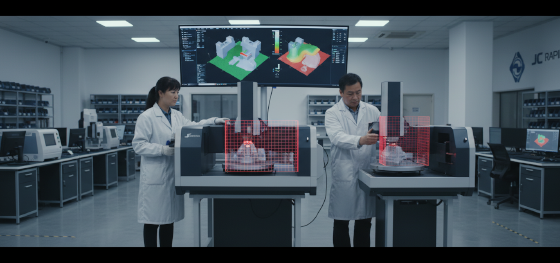
Why must you partner with a factory that utilizes optical laser scanners?
Traditional hand calipers cannot accurately measure complex, sweeping organic curves; laser mapping compares the physical part directly against your original 3D CAD model instantly.
Blindly trusting a low-tier broker guarantees mismatched assemblies will arrive at your loading dock. We deploy strict coordinate measuring machines (CMM) to verify every single critical sealing face before authorizing global shipments.
Submit your complex hardware assemblies to our engineering department today for a rigorous DFM audit. We map the thermodynamic drift, recommend optimal baseline dimensions, and execute flawless secondary milling.
FAQ: Honest Answers About Measurement and Warpage

Can heavy vibratory tumbling alter the final geometric measurements?
Yes, aggressive ceramic media physically removes microscopic layers of material from the exterior skin. Engineers must calculate this slight volumetric reduction before finalizing the blueprint.
Do different metal alloys require completely different precision brackets?
Absolutely. Zinc flows incredibly well and shrinks minimally, allowing for phenomenal as-cast accuracy. Aluminum fights back aggressively, generally requiring slightly wider dimensional allowances.
Why do moving side-action sliders reduce overall dimensional accuracy?
Moving steel blocks inherently possess tiny mechanical clearances to allow sliding. These microscopic gaps introduce slight geometric shifts that solid, non-moving mold halves simply do not experience.
Will applying thick electrostatic powder coating ruin my precise screw holes?
Heavy polymer baking adds significant thickness. Technicians proactively mask critical threaded cavities and precise mating surfaces beforehand to guarantee your final assembly remains completely unaffected.

