


Opening a procurement review for a large-scale enclosure or a new autonomous vehicle body panel often forces a high-stakes decision: should you invest in expensive steel tooling or look for a more agile alternative? In the current industrial landscape, the debate between reaction injection molding vs injection molding is no longer just about part price; it is about capital efficiency and the physics of large-format manufacturing. While high-pressure molding remains the king of millions of tiny parts, it becomes a financial and technical liability when components exceed one meter in length or require variable wall thicknesses. Understanding the fundamental differences in how these processes handle pressure, heat, and material curing is essential for any engineering lead looking to navigate the transition from a laboratory concept to a field-ready machine.
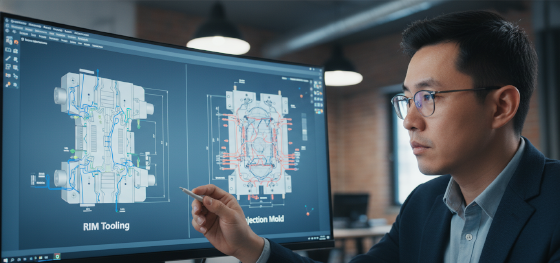
Mechanical integrity at scale depends on the material's ability to cross-link without the crushing force of thousands of psi. Jucheng Precision addresses these critical manufacturing dilemmas by acting as a technical consultant before the first tool is ever cut. JUCHENG utilizes a fleet of 150+ CNC machines and 25 5-axis Haas/Mazak units to provide unbiased advice on whether your project belongs in a high-pressure press or a low-pressure liquid system. By providing a free DFM analysis in 24 hours, JUCHENG helps developers identify the optimal path for Low Volume Manufacturing, ensuring that your hardware survives the scrutiny of clinical trials and the harsh reality of the industrial floor without the burden of excessive tooling debt.
Operating under a triple mandate of ISO 13485, ISO 14001, and IATF 16949, Jucheng Precision provides the unyielding foundations for global innovation teams. We transform raw liquid chemistry and solid thermoplastic resins into validated structural hardware, offering a "Bridge to Production" that scales with your success. This guide explores the essential process fundamentals, tooling economics, and material science required for mastering reaction injection molding vs injection molding to ensure your next fleet of autonomous machines is built on a foundation of reliability and financial logic.
content:
Process Fundamentals: Low-Pressure Liquid vs. High-Pressure Melt
Tooling Comparison: Why Aluminum Beats Steel for Mid-Scale?
Scaling for Size: Why RIM Owns the Large Part Market?
Material Properties: Thermoset Stability vs. Thermoplastic Melting
Speed to Market: Comparing Mold Lead Times and Production
Breakeven Analysis: Finding the Magic Number for ROI
Surface Aesthetics: Solving the Sink Mark Crisis in Design
JUCHENG Solution: Unbiased Guidance for High-Value Hardware
FAQ: Critical Questions for Process Selection and Logistics
Process Fundamentals: Low-Pressure Liquid vs. High-Pressure Melt
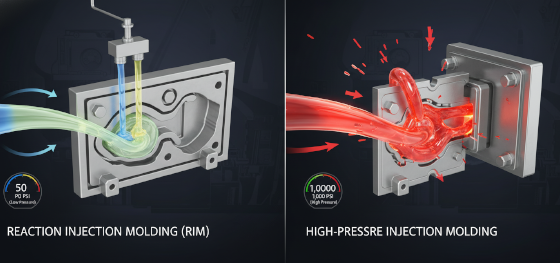
The primary physical difference between these two giants of manufacturing is the state of the material as it enters the mold. In traditional injection molding, solid plastic pellets are heated to a molten state and forced into a cavity at pressures often exceeding 15,000 psi. This high-heat, high-pressure environment requires massive steel machines to keep the mold halves closed. In contrast, Polyurethane Molding Services utilize a chemical reaction between two room-temperature liquids. These components are mixed in a high-pressure head and then flow into the mold at less than 100 psi. Because the liquid has the viscosity of water before it begins to thicken, it can fill complex internal ribs and thin-walled sections with ease, providing a level of Design Freedom that is impossible for viscous thermoplastic melts.
Is the molecular structure of the final part different?
Yes. RIM creates a three-dimensional cross-linked network (thermoset) that is permanently rigid, while injection molding creates linear chains (thermoplastic) that can be re-melted.
Laminar flow control is the second pillar of the RIM advantage. High-pressure injection often creates turbulent flow fronts that trap air and cause knit-line free gating challenges. Because the RIM process allows the material to flow slowly and displace the air in front of it, parts are delivered with 100% solid density and zero surface pinholes. JUCHENG utilizes specialized tilt-filling machines to manage this fluid dynamics, ensuring that every 2.5-meter long panel for a diagnostic scanner is dimensionally stable and aesthetically perfect. This low-stress molding approach is the secret to manufacturing oversized hardware that maintains sub-millimeter tolerances over years of field use.
Temperature management during the cycle also favors the liquid approach. Conventional molding requires keeping massive barrels of plastic at 300 degrees Celsius, consuming enormous amounts of electricity. JUCHENG’s RIM operations align with ISO 14001 standards by utilizing near-room temperature curing chemistry. The only heat required is the moderate 50 degrees Celsius needed to stabilize the aluminum mold. This energy efficiency not only reduces your carbon footprint but also lowers the overhead cost of production for your Alpha and Beta trial fleets. By delivering "Cool-Cured" hardware, JUCHENG provides a sustainable manufacturing path that doesn't compromise on mechanical toughness.
Tooling Comparison: Why Aluminum Beats Steel for Mid-Scale?
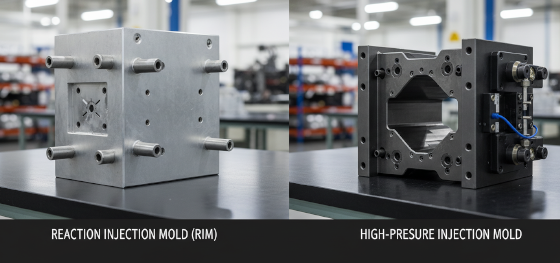
Economic optimization in hardware development is determined by the RIM vs Injection Molding Tooling Cost. Because the internal cavity pressure of the RIM process is less than 1% of that found in injection molding, the tool does not need to withstand millions of hydraulic hammer strikes. This allows JUCHENG to utilize aerospace-grade aluminum molds instead of hardened P20 or H13 tool steel. Aluminum is three times faster to CNC machine and significantly easier to polish to a mirror-finish. For large diagnostic enclosures, an aluminum RIM tool often costs only 20% of an equivalent steel injection mold. This reduction in CapEx allows startups to preserve their R&D budget for critical software and sensor integration.
How long does an aluminum RIM tool last?
JUCHENG’s high-strength 7075 aluminum tools are engineered to deliver up to 10,000 shots with zero dimensional drift, making them ideal for the low-to-medium volume needs of the robotics sector.
Maintenance and design agility represent the secondary layer of tooling logic. If a field trial reveals that a sensor mounting hole needs to move by 10mm, modifying a hardened steel mold is a multi-thousand dollar setback that can take weeks. JUCHENG’s aluminum RIM tools can be welded and re-machined in our CNC bay within 48 hours. This Agile Tooling capability ensures that your hardware development moves at the same speed as your code, providing a clear path to market for innovative prototype robot designs. We manage these iterations in-house, ensuring that the tool split-lines and venting remain optimized through every design version.
Surface texturing is also more cost-effective in aluminum. JUCHENG utilize 5-axis laser texturing to apply VDI 3400 standardized grains directly to the mold surface. Because aluminum is more receptive to chemical etching than tool steel, we can achieve high-fidelity leather or grit patterns with much greater consistency. This results in parts that possess a retail-ready aesthetic directly off the mold, reducing the need for expensive secondary painting. By combining high-accuracy machining with low-cost materials, JUCHENG delivers a "Billion-Dollar" look for your hardware without the massive upfront investment associated with traditional Custom Plastic Molding.
Scaling for Size: Why RIM Owns the Large Part Market?
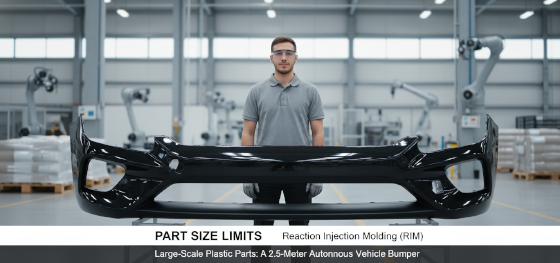
Managing the physical scale of modern autonomous fleets requires a move beyond the RIM vs Injection Molding Part Size Limits found in standard shops. In traditional injection molding, a 1-meter long part requires a press with at least 3,000 tons of clamping force, a machine that often costs over $2 million and occupies massive floor space. Because RIM is a low-pressure process, JUCHENG can produce parts up to 2.5 meters in length on machines with a much smaller physical and financial footprint. This allows us to handle oversized tractor hoods and multi-part hospital scanner shells that standard machines simply cannot touch, providing the unyielding foundations your autonomous innovation requires.
What is the maximum part length JUCHENG can mold?
We regularly manufacture structural panels and fenders up to 2,500mm in length with consistent wall thickness and zero internal voids.
Geometric complexity further increases the size advantage of RIM. In traditional molding, thick sections cause massive internal shrinkage, leading to warpage prevention issues that can ruin the fitment of large panels. RIM polyurethane expands to fill the mold, ensuring that even a 2-meter tall console panel remains perfectly flat. JUCHENG’s free DFM analysis in 24 hours service identifies these "Growth Zones" in your CAD, suggesting variable wall thickness limits (3mm-15mm) that maximize rigidity without adding unnecessary mass. This structural optimization ensures your robot chassis survives the high-vibration environment of a warehouse or construction site.
Handling and logistics for these giant parts are managed within JUCHENG’s integrated hub. We understand that a 20kg plastic shell is a fragile asset. We provide custom-fitted wooden flight cases and specialized internal shock-dampening for all oversized functional prototypes. By managing the entire lifecycle—from the 2.5-meter mold to the international shipping crate—JUCHENG ensures that your hardware arrives in the lab calibrated and ready for its first power-up. This focus on "Oversized Reliability" is what makes JUCHENG a trusted partner for the world's most aggressive AgTech and industrial robotics firms.
Material Properties: Thermoset Stability vs. Thermoplastic Melting
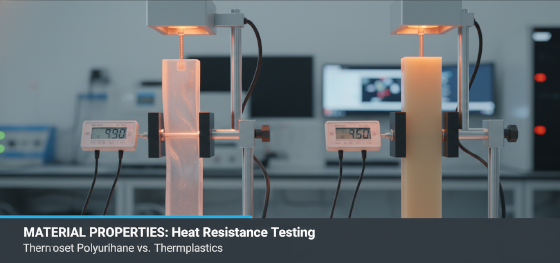
Material integrity in the field is dictated by the Thermoset RIM vs Thermoplastic Injection molecular logic. Injection molding uses thermoplastics like ABS, PC, or PP, which are essentially solidified liquids. When these parts are exposed to the heat of a desert vineyard or the high-output compute stack of an AI robot, they can soften and permanently deform. RIM utilize thermoset polyurethanes that undergo a permanent chemical cross-linking. Once cured, these materials do not have a melting point; they will char but will not sag or flow under heat. This thermal expansion stability ensures that your sensor mounts and door seals remain perfectly aligned regardless of the ambient temperature.
Can RIM materials simulate standard plastics?
Yes. JUCHENG can formulate polyurethane blends that simulate the stiffness of ABS, the impact toughness of PP, or the optical clarity of PC, providing thermoset durability with a familiar mechanical feel.
Chemical resistance is another byproduct of the cross-linked matrix. Standard injection-molded parts are highly susceptible to environmental stress cracking (ESC) when exposed to hospital disinfectants or industrial fertilizers. The residual stresses from the high-pressure melt provide the energy for these chemicals to penetrate and shatter the part. Because JUCHENG’s RIM parts cure in a relaxed state at low pressure, they possess near-zero internal stress. Combined with the naturally inert chemistry of polyurethane, this ensures your hardware survives thousands of sterilization cycles or chemical washdowns without a single surface crack, a mandatory requirement for ISO 13485 compliance.
Impact resistance in [2026] hardware is often the deciding factor for field survival. Traditional thermoplastics can become brittle at low temperatures, leading to shattered fenders in winter harvests. JUCHENG’s elastomeric RIM formulations maintain their "Spring-Back" flexibility down to -40 degrees Celsius. We utilize high-performance polyols that exhibit 100% flexural memory, allowing a robot bumper to absorb a 10-G impact and return to its exact CAD geometry. This level of Bionic Toughness is why RIM remains the preferred material for the "Armor" of high-value autonomous systems operating in the most hostile environments on earth.
Speed to Market: Comparing Mold Lead Times and Production
Winning a market window requires a partner that dominates the RIM vs Injection Molding Lead Times. In the robotics race, being late by one month can mean losing an entire season of agricultural data or a hospital deployment contract. Conventional injection molding lead times are plagued by the 8-to-12 week wait for hardened steel tools. JUCHENG utilizes high-speed CNC milling to cut aluminum RIM tools in as fast as 10 business days. This allows us to deliver T1 samples and begin 4-day rapid delivery of initial functional units while your competitors are still waiting for their steel mold to be designed.
How does JUCHENG reduce lead times for large parts?
By controlling the entire process—from 5-axis mold making to in-house painting and assembly—we eliminate the multi-week delays associated with third-party finishing and shipping.
The Bridge to Production strategy is our most valuable service for R&D teams. Many clients use JUCHENG’s RIM process to launch their first 500 machines while their high-volume steel tool is still being built. This allows for real-world field feedback and software calibration to happen early in the cycle. If a design flaw is found, modifying the aluminum RIM tool is simple and fast. This iterative agility ensures that when you finally commit to mass-production steel tooling, the design is "Frozen" and validated, preventing the multi-million dollar disaster of a late-stage production redesign.
Supply chain resilience in Shenzhen provides the ultimate speed buffer. Because our facility is surrounded by the world's dense hardware ecosystem, we can source specialized resins, metal inserts, and custom pigments within hours. This local speed allows JUCHENG to handle sudden design pivots—such as a reinforced mounting plate or a change in surface texture—without resetting the production clock. Whether you need 10 sets of enclosures for an investor demo or 1,000 units for a commercial rollout, JUCHENG provides the manufacturing horsepower that ensures your innovation stays ahead of the competition.
Breakeven Analysis: Finding the Magic Number for ROI
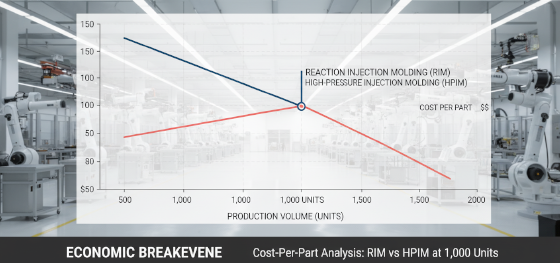
Economic optimization in hardware depends on identifying the Reaction Injection Molding Breakeven Point . For small parts, injection molding almost always wins on piece-price. However, as the part size increases, the tooling cost for injection molding grows exponentially. Jucheng Precision helps procurement managers calculate the "Real ROI" by factoring in both NRE (Non-Recurring Engineering) and piece-part costs. For a 1-meter robotic shell, the breakeven point between RIM and injection molding typically falls between 1,000 and 3,000 units. If your annual volume is under 2,000 units, RIM is the clear financial winner, saving you up to 80% in upfront capital.
When is injection molding the better choice?
Once your annual volume exceeds 5,000 units and the design is 100% stable, the lower piece-price of injection molding will eventually pay off the high initial cost of the steel tool.
The "Hidden Costs" of high-pressure molding must also be considered. Large injection-molded parts often have higher scrap rates due to warpage and sink marks, which can inflate the effective unit price. Because JUCHENG’s RIM process is so dimensionally stable, we achieve nearly 100% yields even on complex medical assemblies. This stability reduces the need for expensive "Secondary Fitment" labor at your facility. By delivering parts that are ready to bolt on, we save your engineering team thousands in manual labor, effectively shifting the breakeven point in favor of RIM for high-complexity, low-volume machines.
Market volatility favors the No MOQ policy of JUCHENG’s RIM facility. In the fast-moving robotics sector, market demands can change in months. Committing to a $100,000 steel mold is a high-risk gamble. JUCHENG allows you to source hardware in batches of 50 or 100 units, preserving your cash flow and giving you the flexibility to pivot your business model without being anchored to outdated tooling. This capital agility is essential for maintaining a healthy R&D runway, allowing you to iterate on your product-market fit with the same precision you apply to your mechanical designs.
Surface Aesthetics: Solving the Sink Mark Crisis in Design
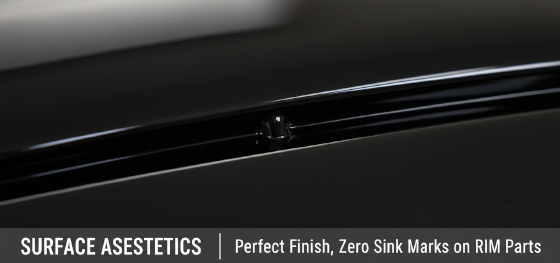
Visual perfection is a functional requirement for high-end medical and consumer-facing robots. In the comparison of Surface Finish: RIM vs Injection Molding, the "Anti-Sink" nature of polyurethane is the primary aesthetic win. Traditional injection molding requires wall thicknesses to be uniform; any internal rib or boss thicker than 60% of the wall will create a "Sink Mark"—a visible depression on the exterior skin. Because RIM uses an expanding chemical reaction, JUCHENG can produce 10mm thick structural ribs against a 4mm wall with zero surface defects. This allows you to design unyielding hardware with integrated mounting features while maintaining a mirror-smooth Class-A finish.
Is RIM a good substrate for painting?
Yes. Polyurethane is the industry favorite for painting due to its high surface energy, ensuring that automotive-grade coatings bond permanently without the peeling issues common in PP or PE.
Integrated textures can be molded directly into the RIM skin, providing a durable, "Color-Through" aesthetic that hides scratches better than paint. JUCHENG utilize 5-axis CNC to machine VDI 3400 textures and custom brand logos directly into the mold cavity. These textures are especially vital for industrial robot parts that operate in abrasive environments, ensuring the machine looks professional even after years of field use. We also provide secondary services like Silk-Screening and Laser Marking in our Shenzhen hub, allowing you to add instruction labels and high-fidelity branding that survives 1,000+ clinical disinfection cycles.
Final surface verification is performed using non-contact optical metrology. JUCHENG’s QC team scans the entire aesthetic surface of your part to detect any "Orange-Peel" or microscopic waves before the part enters our dust-free painting suites. This level of technical oversight ensures that your 2-meter tall MRI shell or autonomous tractor hood possesses the retail-ready perfection that secures investor demo success and customer buy-in. By delivering hardware with integrated "Visual Stability," JUCHENG allows your team to focus on the high-value AI integration rather than manual surface rework.
JUCHENG Solution: Unbiased Guidance for High-Value Hardware
Dominating the large-format hardware market requires a partner that doesn't just sell one process, but understands them all. Jucheng Precision operates with a 24/7 manufacturing mindset in our Shenzhen precision manufacturing hub, delivering both high-pressure Custom Plastic Molding and low-pressure RIM solutions. We provide a bridge to production that ensures your innovations move from CAD to field trial with 100% metallurgical and dimensional confidence. we provide free DFM analysis in 24 hours to ensure your design is optimized for the unyielding reality of the field, whether you are building an autonomous medical assistant or a heavy-duty industrial mobile base.
Integrating your structural design with JUCHENG’s expertise ensures that your reaction injection molding vs. injection molding decision is based on performance data, not guesswork. we offer comprehensive DFM reviews within 24 hours, identifying potential thermal-expansion risks or machining bottlenecks in your design before they become field failures. Whether you are building an autonomous vineyard scout or a multi-part MRI housing, Jucheng Precision provides the rigid, precise, and chemicals-optimized foundations that keep your innovation moving through the high-stakes cycles and the years of hard labor.
Our facility is equipped with dedicated high-pressure RIM assembly cells and dedicated ISO-standard quality labs, allowing us to manage the entire hardware lifecycle in one location. we manage the complexity of multi-material bonding and automotive-grade finishing so your engineering team can focus on the motion control and the AI. By combining Shenzhen's speed with industrial-grade material verification and global quality standards, JUCHENG remains the preferred partner for the world's most aggressive hardware challenges. Contact the Shenzhen hub today to start your next project.
FAQ: Critical Questions for Process Selection and Logistics
Is RIM molding only for large parts?
While it owns the large part market, RIM is also superior for small parts requiring encapsulation of delicate electronics or complex variable walls.
How do you handle the high piece price of RIM at high volumes?
Once your annual volume exceeds 5,000 units, we help you transition to high-pressure injection molding using our in-house steel tooling department.
Can JUCHENG machine gasket grooves into 2-meter shells?
Yes. We utilize oversized 5-axis CNC machines to finish seal interfaces on molded blanks with +/- 0.05mm accuracy.
Is the RIM process suitable for medical-grade PEEK?
No. PEEK requires thermoplastic injection; for large medical parts, we use thermoset polyurethanes that simulate PEEK’s stiffness and chemical resistance.
What is the typical shipping time from Shenzhen for large prototypes?
We provide air-freight and sea-freight logistics with typical delivery to North America and Europe in 3 to 7 business days.
Mechanical instability and high tooling debt are absolute innovation killers for 2026 hardware. Partnering with Jucheng Precision ensures that your functional iterations are built with the cost-effective polyurethane reaction injection molding and specialized reaction injection molding vs injection molding knowledge the industry demands. Reach out to our Shenzhen manufacturing hub today for a complete DFM review and build the unyielding foundation your autonomous fleet requires.

