


Evaluating the visual appeal of a 2-meter long medical scanner shell or a humanoid robotic torso reveals the final hurdle in hardware development: achieving a retail-ready exterior without the defects of mass production. In the high-stakes competition between reaction injection molding vs injection molding, the debate often shifts from structural strength to the "First Impression" on the trade show floor. While high-pressure molding is capable of producing smooth parts, it introduces massive internal stresses that often manifest as surface depressions and waves in oversized formats. Achieving Surface Finish: RIM vs Injection Molding excellence requires a technical departure from traditional melt-flow dynamics toward a low-pressure liquid chemistry that ensures every aesthetic face remains perfectly planar and free from thermal shrinkage artifacts.
Aesthetic perfection in large-scale hardware depends on the material's ability to maintain its dimensions over thick internal supports. Traditional Custom Plastic Molding often forces engineers to limit rib thickness to 60% of the wall to prevent sink marks, resulting in flimsy enclosures that feel cheap to the touch. Jucheng Precision addresses these visual hurdles by providing high-tier Polyurethane Molding Services that utilize Zero-Sink Surface perfection. Jucheng Precision utilizes a fleet of 150+ CNC machines and 25 5-axis Haas/Mazak units to manufacture aluminum tools that produce bionic structures with unyielding stiffness and mirror-smooth skins in our Shenzhen precision manufacturing hub.
Operating under a dual mandate of ISO 13485 and ISO 14001, Jucheng Precision acts as the finishing expert for global MedTech and robotics OEMs. Jucheng Precision delivers a free DFM analysis in 24 hours to ensure your large-scale designs are optimized for our in-house painting and texturing suites. This guide explores the essential sink-mark mitigation standards, the paint adhesion molecular handshake, and the VDI 3400 texture replication required for mastering Surface Finish: RIM vs Injection Molding to ensure your Beta trial hardware captures investor confidence and market share.
content:
The Sink Mark Advantage: Why RIM Achieves Flawless Surfaces?
Technical Data: Comparing Ra Roughness and Gloss Retention
Paint Adhesion: Why Polyurethane is the Best Substrate for Color?
Textures and Branding: Replicating VDI 3400 and Molded Logos
JUCHENG Hub: Managing One-Stop Post-Processing in Shenzhen
FAQ: Real Answers for Painting, Textures, and Quality Control
The Sink Mark Advantage: Why RIM Achieves Flawless Surfaces?
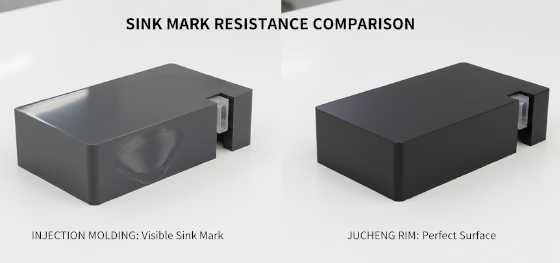
Dimensional beauty in medical device prototyping is often ruined by the physics of cooling. In traditional injection molding, molten plastic shrinks as it solidifies; if the material is thicker in one area—such as an internal reinforcement rib—it pulls the outer surface inward, creating an ugly dimple known as a sink mark. In the comparison of Surface Finish: RIM vs Injection Molding, the low-pressure chemistry of RIM offers a complete solution. Because the liquid resin expands during the exothermic reaction, it exerts an outward "Packing Force" that holds the skin tight against the mold wall until the material is fully cross-linked. This ensures that even a 10mm thick structural boss remains invisible from the high-gloss exterior of your medical console.
Can RIM achieve a mirror finish directly from the tool?
Yes. By utilize sub-micron diamond polishing on our aluminum molds, Jucheng Precision delivers RIM parts with Ra 0.2 surface finishes that require zero sanding before painting.
Internal stress management further improves the surface stability over time. High-pressure molding results in "Frozen-In" stresses that can cause the surface to become wavy or "Orange-Peel" months after the part is delivered. Because JUCHENG’s RIM parts cure in a relaxed state at less than 100 psi, the molecular matrix is inherently stable. This prevents the surface degradation that often occurs when large scale plastic parts are exposed to the heat of internal AI processors or external solar loading. By delivering hardware with "Locked-In" aesthetics, Jucheng Precision ensures your diagnostic scanner or autonomous robot looks as professional on its 500th day as it did on day one.
Surface flatness on 2.5-meter panels is the final pillar of the RIM advantage. Jucheng Precision utilize 5-axis CNC machining to finish the parting lines of our molds to +/- 0.02mm tolerances. This precision minimizes the "Flash" and witness lines that ruin the retail aesthetic of large shells. For robotics OEMs, this means the assembly gaps between panels are perfectly uniform, providing the high-end design language expected in the current luxury automation market. Our Shenzhen facility manages these visual variables through 100% optical inspection, ensuring your prototype robot remains a masterpiece of industrial design.
Technical Data: Comparing Ra Roughness and Gloss Retention

Success in hardware validation depends on the numbers. If your industrial designer requires a specific gloss level or texture depth, the manufacturing process must be capable of repeatable execution. Jucheng Precision provides full metrology reports to help your design team validate their aesthetic goals. The following table compares the essential performance metrics of Surface Finish: RIM vs Injection Molding for the current high-end hardware market.
| Metric | Polyurethane RIM (Jucheng) | Thermoplastic Injection | Aesthetic Impact |
|---|---|---|---|
| Surface Ra (as molded) | 0.4 - 0.8 μm | 0.8 - 1.6 μm | Saves 40% Sanding Labor |
| Sink Mark Resistance | Exceptional (Anti-Sink) | Poor (Thickness limited) | Ensures Flat Reflections |
| Paint Adhesion (5B) | 100% Reliable | Variable (Requires Primer) | Prevents Field Peeling |
| Texture Replication | High Fidelity (Low stress) | Moderate (Melt shear) | Crisp Branding Logos |
The "Sink Mark Resistance" data is the primary reason why RIM is the only logical choice for large medical diagnostic equipment. In these applications, the panels are often painted with high-gloss automotive whites or metallic silvers that act like a magnifying glass for surface defects. Jucheng Precision’s RIM process allows for the integration of 15mm thick mounting blocks directly against the aesthetic skin with zero "shadowing" or depressions. This capability allows you to build High Stiffness Structural Plastic hardware that maintains a jewelry-like finish, essential for winning market share in the [2026] clinical sector.
Paint Adhesion: Why Polyurethane is the Best Substrate for Color?

Mechanical integrity is often compromised by the lack of a "Molecular Handshake" between a plastic part and its coating. In the context of Surface Finish: RIM vs Injection Molding, the material chemistry of polyurethane provides a significant advantage for secondary processes. While olefin-based plastics like Polypropylene act like a non-stick pan that repels paint, polyurethane is inherently polar. When JUCHENG applies automotive-grade 2K urethane topcoats in our dust-free painting facility, the molecules of the paint actually create a chemical bond with the substrate. This ensures that your brand colors and instruction labels remain permanent even after repeated chemical disinfection cycles or gravel-strikes on a farm.
How to prevent paint peeling on large parts?
Utilize automated flame treatment at Jucheng Precision to temporarily increase the surface energy, allowing the primer to fuse molecularly with the RIM part.
Antistatic cleaning is the final barrier to a perfect finish. Large plastic panels are magnets for dust due to the static charge generated during the molding and handling phases. JUCHENG utilizes ionized air blow-offs and specialized tack-cloths immediately before the part enters the spray booth. This ensures that no tiny specks of dust are trapped under the clear coat, which is vital for medical devices where surface imperfections can harbor bacteria. By delivering "Surgically Clean" painted parts, JUCHENG helps your Beta fleet meet the hygiene standards of the modern hospital ward while providing the high-end visual presence your innovation deserves.
Environmental resilience of the finish is tested in our Shenzhen hub using accelerated weathering chambers. We verify that our paint-to-RIM bond survives 1,000+ hours of high-intensity UV exposure and 95% humidity without bubbling or fading. This level of validation is essential for autonomous outdoor robotics, where the hardware will be exposed to rain, mud, and intense sun for years. Jucheng Precision’s multi-layered defense strategy—incorporating UV-stable pigments and ceramic-infused clear coats—ensures that your industrial robot parts maintain their structural and visual integrity in any global climate.
Textures and Branding: Replicating VDI 3400 and Molded Logos

Planning for the "Final Polish" should begin at the CAD level, not at the assembly bench. Jucheng Precision leverages its 150+ CNC machines capacity to machine high-fidelity textures directly into our aluminum RIM mold cavities. We can replicate the exact surface grain of an injection-molded part, including VDI 3400 texture replication and Mold-Tech standards. This eliminates the need for expensive secondary vinyl wrapping or hydro-dipping, providing a "Finished-in-the-Mold" component that saves you 30% in post-processing costs. Whether you require a matte "Grit" texture for a robot bumper or a sleek satin finish for a diagnostic console, JUCHENG provides the unyielding foundations your brand requires.
Can I integrate my company logo into a 2-meter part?
Yes. JUCHENG utilize 5-axis CNC laser engraving to machine high-fidelity logos directly into the mold cavity, resulting in an embossed or debossed brand that never fades or peels.
Integrated features for Silk-Screening and Laser Marking are the final design details that maximize ROI. JUCHENG often machines "Locating Features" on the interior flanges of large parts that lock into our custom printing fixtures. This ensures that every logo and instruction label is applied with +/- 0.1mm positional accuracy across your entire production run. By managing the complexity of multi-material branding in our Shenzhen hub, we deliver "Retail-Ready" hardware that incorporates your corporate identity into the very molecular structure of the part. This attention to detail is what makes Jucheng Precision the preferred partner for the world's most visually ambitious robotics firms.
Alignment of seams and parting lines dictates the perceived quality of a multi-part assembly. In oversized hardware, a misaligned parting line is a magnet for dirt and bacteria. Jucheng Precision utilize "Stepped Parting Lines" to hide the mechanical split of the mold within existing design grooves or texture breaks. This results in a prototype robot or equipment shell that feels like a single monolithic unit. By delivering hardware with integrated "Visual Stability," Jucheng Precision allows your engineering team to focus on the motion control and the AI, while we manage the complex thermodynamics of surface perfection.
JUCHENG Hub: Managing One-Stop Post-Processing in Shenzhen

Dominating the large-format hardware market requires a partner that doesn't just mold plastic, but understands the economics of finishing. Jucheng Precision operates with a 24/7 manufacturing mindset in our Shenzhen precision manufacturing hub, delivering high-tolerance RIM components and structural industrial robot parts with industry-leading speed. JUCHENG provides a "Bridge to Production" that allows you to move from a single hand-painted prototype to a commercial deployment of 5,000 units with consistent aesthetic and tactile quality. we have No MOQ, allowing you to source 1 to 10 units for user-testing without the crushing cost of mass-production tools.
Integrating your structural design with JUCHENG’s expertise ensures that your Surface Finish: RIM vs Injection Molding decision is based on performance data, not guesswork. JUCHENG offers a free DFM analysis in 24 hours, identifying potential "Paint-Traps" or texture-shadows in your design before they become visual failures. Whether you are building an autonomous medical assistant or a heavy-duty industrial mobile base, Jucheng Precision provides the rigid, precise, and flawlessly finished foundations that keep your innovation moving through the high-speed cycles and the years of hard labor.
Our facility is equipped with dedicated high-pressure RIM assembly cells and dedicated ISO 13485 quality labs, allowing JUCHENG to manage the entire hardware lifecycle in one location. JUCHENG manages the complexity of multi-material bonding and automotive-grade finishing so your engineering team can focus on the clinical outcomes and the AI. By combining Shenzhen's speed with industrial-grade material verification and global quality standards, JUCHENG remains the preferred partner for the world's most aggressive hardware challenges. Contact the Shenzhen hub today to start your next project.
FAQ: Real Answers for Painting, Textures, and Quality Control
Which process is better for high-gloss medical white?
RIM. The lack of internal stress ensures a perfectly flat surface that reflects light uniformly, unlike the "wavy" surfaces of large injection molded parts.
Can JUCHENG match my specific corporate Pantone color?
Yes. We use computer-controlled paint mixing to match Pantone and RAL colors with high precision in our in-house dust-free booth.
Does the texture on a RIM part wear off easily?
No. Because the texture is molded into the polyurethane material, it is a permanent surface feature that survives repeated abrasion and cleaning.
How do you handle bubbles or pinholes on the surface?
Jucheng Precision utilize vacuum degassing and tilt-filling machines to eliminate air traps, ensuring a 100% dense surface directly from the mold.
What is the typical lead time for a fully painted 1.5-meter enclosure?
Fully finished and assembled RIM assemblies are typically delivered in 15 to 20 business days, including tool fabrication.
Visual failures and surface sink marks are absolute innovation killers for high-end robotic systems. Partnering with Jucheng Precision ensures that your functional iterations are built with the unyielding polyurethane reaction injection molding and specialized Surface Finish: RIM vs Injection Molding techniques the industry demands. Reach out to our Shenzhen manufacturing hub today for a complete DFM review and build the unyielding foundation your autonomous fleet requires.

