


Observing a 2-meter long medical scanner shell or a massive autonomous tractor hood in a modern factory reveals a significant mechanical boundary: the point where traditional manufacturing fails. In the high-stakes world of reaction injection molding vs injection molding, the primary decision driver is often the physical scale of the hardware. While high-pressure molding owns the market for small consumer components, it hits a technical and financial wall once a part exceeds 1,000mm. Achieving the structural integrity and retail-ready aesthetics required for oversized monolithic enclosures demands a mastery of the physical differences in how liquid chemistry and molten plastic handle large surface areas.
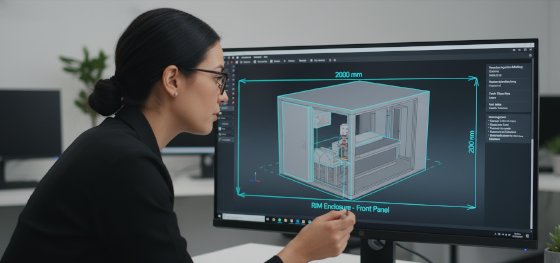
Scaling hardware for next-generation robotics requires a departure from high-pressure melt-flow physics. As the projected area of a part increases, the clamping force required to keep a mold shut grows exponentially, often requiring multi-million dollar presses for standard thermoplastics. Jucheng Precision addresses these large-format hurdles by providing high-tier Polyurethane Molding Services that prioritize low-pressure liquid dynamics. Jucheng Precision utilizes a fleet of 150+ CNC machines and 25 5-axis Haas/Mazak units to manufacture the oversized aluminum tools required to produce large scale plastic parts with zero internal stress in our Shenzhen factory hub.
Operating under the unyielding quality standards of ISO 13485, ISO 14001, and IATF 16949, Jucheng Precision serves as the strategic structural partner for global OEMs. Jucheng Precision delivers a free DFM analysis in 24 hours to ensure your oversized CAD models are optimized for the RIM cycle, preventing the warpage prevention issues that ruin large-scale assemblies. This guide explores the essential tonnage barriers, footprint efficiencies, and the internal stress profiles required for mastering RIM vs Injection Molding Part Size Limits to ensure your autonomous innovations scale without the crushing financial or technical penalties of conventional molding.
content:
The Tonnage Barrier: Why Large Parts Kill Injection Molding?
Technical Data: Comparing Dimensional Limits and Clamping Forces
Footprint Efficiency: Why RIM Equipment Scales Up Easier?
Dimensional Stability: Stopping Warpage in 2-Meter Panels
JUCHENG Hub: Mastering Giant Enclosures in the Shenzhen factory
FAQ: Real Answers for Sizing, Tolerances, and Shipping
The Tonnage Barrier: Why Large Parts Kill Injection Molding?
Structural failure in large-scale plastic parts is often a result of the pressure used during fabrication. In conventional injection molding, molten plastic is forced into the tool at pressures reaching 20,000 psi. When a part spans 1.5 meters, this pressure creates a massive hydraulic force that wants to blow the mold halves apart. To counteract this, a manufacturer must use a machine with at least 3,000 to 4,000 tons of clamping force. These machines are rare, expensive to operate, and require steel molds that can cost upwards of $150,000. This tonnage barrier represents the point where traditional molding becomes economically impossible for startups and niche OEMs.
What is the maximum part size for standard injection molding?
Most industrial injection molders hit a cost and technical limit at about 1,000mm; beyond this, the mold weight and machine clamping requirements become a financial liability.
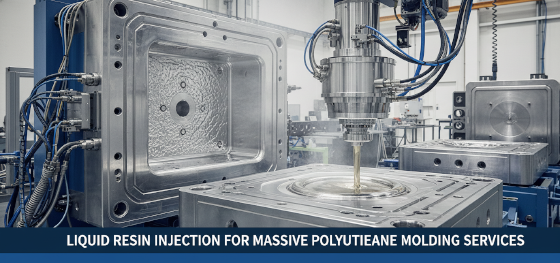
Liquid chemistry offers a physical escape from this pressure trap. In the context of RIM vs Injection Molding Part Size Limits, the internal cavity pressure typically remains below 100 psi. Because the A and B polyurethane components are injected as low-viscosity liquids that react chemically, they flow easily into every rib and boss of a 2-meter long shell without needing extreme hydraulic force. Jucheng Precision utilize this "low-pressure physics" to deliver unyielding foundations for diagnostic consoles and robot chassis, allowing designers to dream bigger without being anchored by the limitations of traditional Custom Plastic Molding.
Shrinkage management is the secondary victim of the tonnage barrier. Molten plastic shrinks significantly as it cools, and in a 1-meter part, a 2% shrinkage rate translates to a 20mm dimensional change. This creates massive internal stresses that eventually cause the part to warp or crack in the field. RIM polyurethane expands slightly during the exothermic reaction, resulting in a shrinkage rate of less than 0.15%. This stability ensures that the large-scale panels Jucheng Precision produces for global clients maintain their fitment and "Zero-Gap" aesthetics through years of hard labor in non-climate-controlled environments.
Technical Data: Comparing Dimensional Limits and Clamping Forces
Success in hardware R&D depends on matching the mechanical architecture to the intended scale. If your design assumes the limits of standard molding, you are leaving performance on the table. Jucheng Precision provides full FEA-ready material data to help your engineering team validate their designs. The following table compares the essential performance metrics of RIM vs Injection Molding Part Size Limits for an oversized structural panel in the current global market.
| Metric | Reaction Injection Molding (RIM) | Conventional Injection Molding | Scaling Advantage |
|---|---|---|---|
| Typical Max Length | 2,500mm+ | < 1,000mm | Enables Monolithic Designs |
| Clamping Force (Tons) | 50 - 150 | 2,000 - 4,000+ | 95% Lower Infrastructure Load |
| Cavity Pressure (psi) | 40 - 80 | 15,000 - 20,000 | Zero Surface Sink Marks |
| Tooling Weight (kg) | 1,000 - 2,500 (Alu) | 10,000 - 25,000+ (Steel) | Safer & Faster Setup |
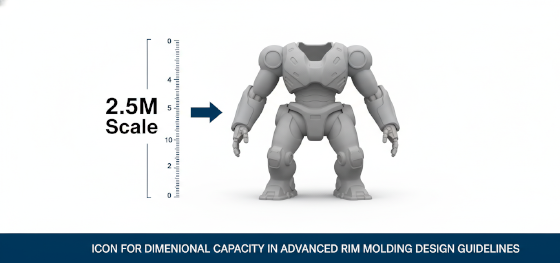
The "Max Length" data illustrates why RIM owns the large part market. Jucheng Precision regularly produce structural fenders and hoods up to 2.5 meters in length. In a high-pressure environment, a part of this scale would be physically impossible for 99% of manufacturing facilities worldwide. By utilizing the RIM vs Injection Molding Part Size Limits advantage, we allow you to design massive monolithic panels that reduce the number of individual parts in your assembly, effectively lowering your assembly labor costs and increasing the structural rigidity of your machine.
Footprint Efficiency: Why RIM Equipment Scales Up Easier?
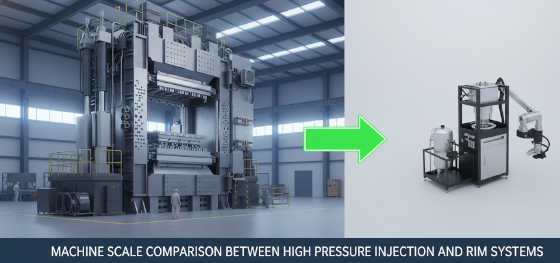
Engineering freedom in oversized hardware is often restricted by the footprint of the machinery. In high-pressure injection molding, the machine must be significantly larger than the part it produces to handle the hydraulic platens and cooling barrels. For a part over 1 meter, the machine becomes the size of a small house. Because RIM is a low-pressure process, the machinery can be far more efficient. Jucheng Precision utilize low pressure clamping infrastructure—simple hydraulic frames that provide enough force to contain the chemical expansion without the massive energy overhead of heavy industrial presses. This efficiency allows us to dedicate more floor space to quality control and medical device hardware validation services.
How does machine footprint impact project cost?
Lower infrastructure costs and energy consumption allow Jucheng Precision to offer competitive piece prices for oversized parts, even at low volumes of 100 to 5,000 units.
Energy sustainability is integrated into Jucheng’s ISO 14001 environmental system. Conventional injection machines must keep massive barrels of plastic at 300 degrees Celsius 24 hours a day. Our RIM process operates at near room temperature, using only enough heat to stabilize the aluminum mold. This 80% reduction in thermal energy consumption not only lowers your production carbon footprint but also reduces the thermal wear on the mold itself. By delivering "Cool-Cured" hardware, Jucheng Precision provide a sustainable manufacturing path that aligns with the ESG goals of modern global corporations.
Tooling weight also dictates the speed of your R&D cycle. A steel injection mold for a car bumper weighs over 20 tons and requires specialized cranes to move. An equivalent Jucheng aluminum RIM tool weighs only a fraction of that, allowing for rapid tool swaps and faster 4 day rapid delivery of initial functional samples. This logistical agility is essential for prototype robot teams who need to iterate on their design mid-season. If a field trial reveals a sensor mounting hole needs to move, Jucheng Precision can weld and re-machine the aluminum tool in our Shenzhen CNC bay within 48 hours, a process that would be impossible with a massive steel tool.
Dimensional Stability: Stopping Warpage in 2-Meter Panels
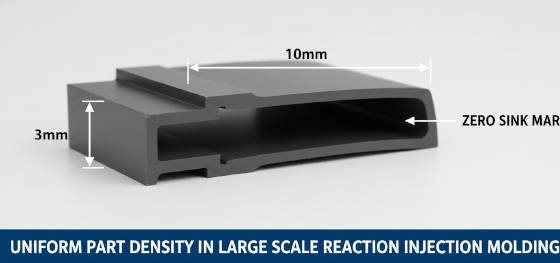
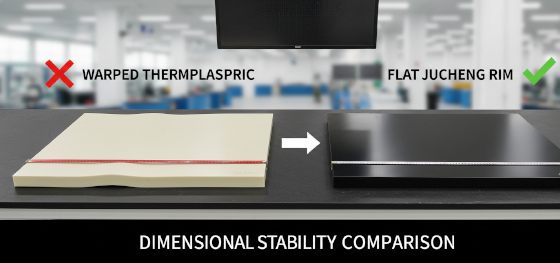
Residual internal stress is the silent killer of large plastic assemblies. When molten plastic is forced into a mold under high pressure, the polymer chains are stretched and frozen in place as they hit the cold tool walls. Over months, these chains want to "Relax," leading to the warpage prevention failures that ruin door seals and sensor alignments. In the comparison of RIM vs Injection Molding Part Size Limits, the low-pressure cure is the ultimate geometric defense. Because the liquid polymer cross-links chemically in a neutral state, the parts are essentially stress-free from the moment they are demolded. This is why RIM is the only choice for a 1.5-meter console that must remain perfectly flat for a 10-year lifecycle.
How to ensure zero-warp on giant panels?
Utilize low-pressure liquid chemistry to ensure isotropic shrinkage and uniform molecular cooling across the entire 2.5-meter part surface.
Variable wall thickness capability further enhances the stability of large shells. In traditional molding, thick sections cause massive internal shrinkage (sink marks). Jucheng Precision utilize the Anti-Sink properties of the RIM process to produce parts with 10mm thick structural ribs against a 3.5mm aesthetic skin with zero surface distortion. This allows you to design unyielding hardware with integrated mounting features, providing the "Bionic Rigidity" required for high-speed robotic limbs and diagnostic scanner frames. We perform 100% CMM verification on all structural nodes to ensure your hardware maintains its "Geometric Zero" in the field.
Thermal expansion stability must be addressed at the design level. When a large panel moves from a cool lab to a hot sunny loading dock, it will grow. Jucheng Precision recommends utilized curvature and crown logic, where every large surface has a slight 1% arc. This geometry masks minor material movement and provides a higher bending stiffness. By delivering hardware with integrated "Visual Stability," Jucheng Precision ensure that your prototype robot looks like a premium retail product even after years of environmental exposure. Our Shenzhen hub manages these complex thermodynamic variables, providing the unyielding foundations your autonomous innovation demands.
JUCHENG Hub: Mastering Giant Enclosures in the Shenzhen factory

Dominating the large-format hardware market requires a partner that doesn't just mold plastic, but understands the chemistry of survival. Jucheng Precision operates with a 24/7 manufacturing mindset in our Shenzhen precision manufacturing hub, delivering high-tolerance RIM components and structural industrial robot parts with industry-leading speed. we provide a "Bridge to Production" that ensures your innovations move from CAD to field trial with 100% metallurgical and chemical confidence. Jucheng Precision has No MOQ, allowing you to source 1 to 5 units for initial sizing validation without the crushing cost of mass-production infrastructure.
Integrating your structural design with Jucheng Precision’s expertise ensures that your RIM vs Injection Molding Part Size Limits decision is based on performance data, not guesswork. Jucheng Precision offers a free DFM analysis in 24 hours, identifying potential air-pockets or thermal-expansion risks in your design before they become field failures. Whether you are building an autonomous vineyard scout or a multi-part MRI housing, Jucheng Precision provides the rigid, precise, and chemically optimized foundations that keep your innovation moving through the high-stakes cycles and the years of hard labor.
Our facility is equipped with dedicated high-pressure RIM assembly cells and dedicated ISO 13485 quality labs, allowing us to manage the entire hardware lifecycle in one location. Jucheng Precision manages the complexity of multi-material bonding and automotive-grade finishing so your engineering team can focus on the motion control and the AI. By combining Shenzhen's speed with industrial-grade material verification and global quality standards, Jucheng Precision remains the preferred partner for the world's most aggressive hardware challenges. Contact the Shenzhen hub today to start your project.
FAQ: Real Answers for Sizing, Tolerances, and Shipping
What is the absolute maximum part size Jucheng can RIM mold?
We regularly produce monolithic structural panels up to 2,500mm in length and 1,200mm in width.
Can large RIM parts be CNC machined after molding?
Yes. We use our oversized 5-axis CNC units to finish-machine critical bearing seats and sensor mounts with +/- 0.05mm accuracy on molded parts.
How do you handle the shipping of 2-meter fragile parts from China?
Jucheng Precision provide custom-fitted wooden flight cases with internal shock-dampening for all international shipments to prevent transit damage.
Does part size increase the lead time for RIM?
Only slightly. Large molds take longer to machine, but the reaction injection molding process itself remains extremely fast compared to steel tool-builds.
Are there color limitations for large scale RIM parts?
No. We can match any Pantone or RAL color and provide automotive-grade painting for oversized enclosures in our dust-free facility.
Tooling debt and oversized part warpage are absolute innovation killers for high-end robotic systems. Partnering with Jucheng Precision ensures that your functional iterations are built with the cost-effective polyurethane reaction injection molding and specialized RIM vs Injection Molding Part Size Limits knowledge the industry demands. Reach out to our Shenzhen manufacturing hub today for a complete DFM review and build the unyielding foundation your autonomous fleet requires.

