


Executing precise geometric deformations requires a deep understanding of metallurgical physical properties. Achieving structural accuracy during sheet metal bending depends on managing physical stress without fracturing the raw material. This mechanical process relies on heavy industrial force to plastically deform plate stock along straight axes, transforming flat layouts into complex three-dimensional enclosures.
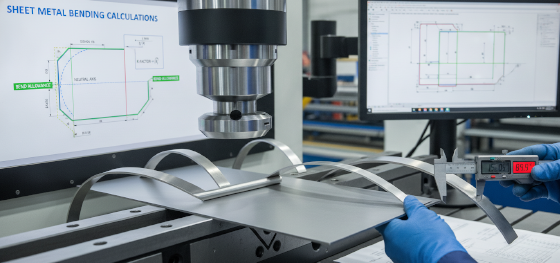
Suffer from parts that fail to align on your assembly line due to random dimensional drift? Guesswork in press setup leads to massive material waste and delayed product launches. Working with an experienced manufacturing team ensures that mechanical variables are mathematically calculated long before any metal meets the tooling.
Balancing metal elongation against press clearances separates seamless structural fabrications from cheap, warped assemblies. Let's examine the core mechanics of CNC press brakes, demystify K-factor math, and review the essential minimum radius design guidelines for common industrial alloys.
content:
The Mechanics of Press Brake Bending
Understanding Bend Allowance and K-Factor
Design Rules: Minimum Bend Radius for Different Materials
From Flat Patterns to 3D Shapes
Advanced CNC Bending Services at JUCHENG
FAQ: Critical Questions About Precision Sheet Metal Bending
The Mechanics of Press Brake Bending
How do hydraulic CNC press brakes shape sheet metal?
Press brakes secure a flat metal plate over an open V-die, driving a hardened top punch down to force the metal into the V-groove, altering its geometry along a targeted line.
Understanding the core physics of modern press brake bending is essential to managing tight hardware tolerances. During a standard press brake bending cycle, the sheet is placed against automated back gauges, which dictate the precise location of the bend axis. As the top punch descends, the metal undergoes localized compressive stress on the inner radius and high tensile stress on the outer radius.
This severe physical stretching forces the metal past its elastic limit and into its plastic zone. When the punch retracts, the metal naturally exhibits elastic recovery, commonly known as springback. CNC programmers must pre-calculate this angular rebound, over-bending the metal by a few degrees so the final cooled part relaxes exactly into the targeted angle.
Understanding Bend Allowance and K-Factor
What is the difference between bend allowance and K-factor?
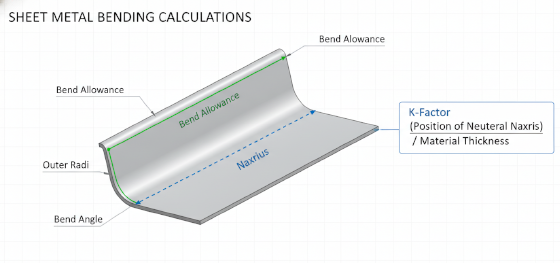
The K-factor represents the ratio of the shifting neutral axis relative to the overall material thickness, while bend allowance is the physical length of the arc along that neutral axis.
Using incorrect data sheets for sheet metal bending leads to severe assembly alignment problems. When metal deforms, the inner surface compresses while the outer surface stretches. Somewhere between these opposing forces lies a theoretical region that experiences zero dimensional change, known as the neutral axis.
We define this specific anatomical shift as the K-factor. Harder alloys compress differently than softer plates, meaning the neutral axis shifts deeper toward the inner radius. Calculating the precise bend allowance and bend deduction using these mathematical variables allows engineers to unfold 3D CAD models into flat sheets that correspond to accurate physical dimensions.
Design Rules: Minimum Bend Radius for Different Materials
What determines the minimum radius limits of sheet metal?
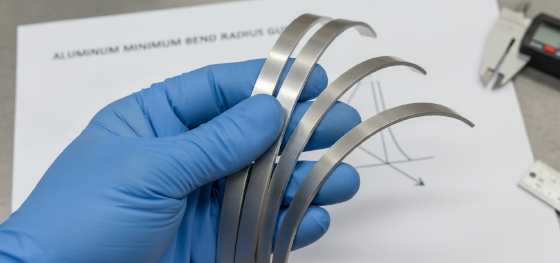
The limit is determined by the material ductility and tensile limits; bending metal past its recommended limits causes outer-edge micro-cracking and material failures.
Designing custom enclosures with extremely sharp inner corners is a common manufacturing pitfall. Applying an ultra-tight punch to a hard alloy forces the metal past its ultimate strength limit, tearing the outer fibers. To prevent mechanical failures, engineers must follow specific minimum bend radius parameters based on the chosen raw material:
| Material Group | Thickness Range | Standard K-Factor | Recommended Minimum Radius |
|---|---|---|---|
| Aluminum (e.g., 5052-H32) | 1.0 mm - 3.0 mm | 0.40 - 0.43 | 1.0 x Material Thickness |
| Stainless Steel (e.g., 304) | 1.0 mm - 3.0 mm | 0.44 - 0.46 | 1.5 x Material Thickness |
| Carbon Steel (e.g., SPCC) | 1.0 mm - 4.0 mm | 0.41 - 0.45 | 0.8 x Material Thickness |
From Flat Patterns to 3D Shapes
How do flat patterns transform accurately into finished 3D products?
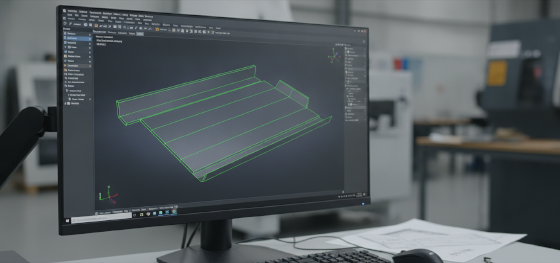
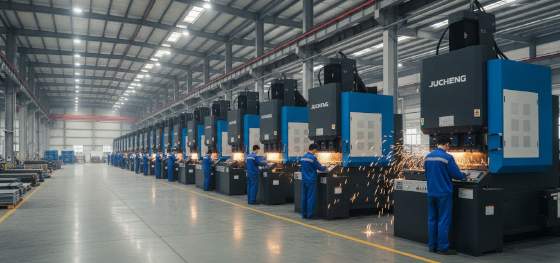
Flat patterns must incorporate calculated bend deductions in their nesting software, ensuring that the sheet stretches to the exact target size during the physical strike.
Every physical folding process begins with a calculated flat pattern. If an engineer models a bracket with straight dimensions and neglects material elongation, the finished formed part will always exceed its intended size. Unfolding software handles this by subtracting a calculated deduction for each fold.
This transition from digital flat layouts to structural parts is the defining stage of the entire sheet metal fabrication process, bridging the gap between flat plate stock and rigid functional enclosures. Proper orientation of these flat patterns relative to the metal grain structure is also essential. Folding plate stock parallel to the rolling grain can cause severe cracking, so our programmers nest parts at angles to maximize mechanical strength.
Advanced CNC Bending Services at JUCHENG
What sets JUCHENG's custom press brake services apart?
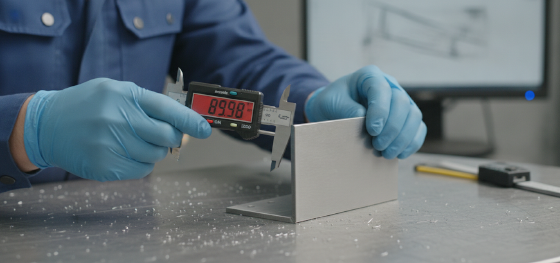
We operate high-precision multi-axis CNC bending systems that utilize dynamic back gauges to ensure angle consistency across prototyping and production orders.
At JUCHENG, our CNC press brake workstations simplify sheet metal bending by automating the angle adjustment and back gauge positioning. This high-level automated execution allows us to process complex parts with multiple consecutive folds without requiring manual repositioning, ensuring perfect consistency across every batch.
We process a wide range of materials, including aluminum, stainless steel, and carbon steel, matching each to its mathematically calculated V-die and punch setups. Our engineering queue provides a 24-hour free DFM review, checking your CAD models for flange length limits and punch collisions before production. With our no MOQ policy and rapid turnaround times, we provide highly agile support for your rapid prototyping and low-volume production needs.
FAQ: Critical Questions About Precision Sheet Metal Bending
How do you resolve excessive angular springback in hard metals?
We address springback by over-bending the metal by a mathematically calculated margin or utilizing CNC press brakes with integrated angle-measuring systems. These machines continuously monitor the bend angle in real time and dynamically adjust the punch stroke to hit the targeted angle.
What is the minimum flange length that a press brake can bend?
The minimum flange length must be wide enough to span across the selected V-die opening during the descent. If a flange is too short, it will slide straight into the die instead of bending. As a general manufacturing rule, the minimum flange length should be at least four times the material thickness.
Why do some metals tear on the outer bend radius?
Tearing occurs when the inner radius is set too tight for the material's ductility, or when a fold is executed parallel to the raw rolling grain of the plate. To resolve this, we increase the punch radius and adjust our sheet nesting layout to bend across the grain.
Does heat treatment affect the bendability of hard alloys?
Yes, heavily. Annealing alloys like aluminum 6061 from an extremely hard T6 temper down to a softer state increases its ductility, allowing for much tighter radii without cracking. We can then heat-treat the finished part back to its hardened state if your application requires high structural strength.

