


Controlling the localized thermal dynamics of a high-temperature electric arc is where theoretical CAD designs meet shop floor reality. While a structural enclosure can look pristine on a computer screen, igniting a weld torch can instantly compromise raw tolerances if the heat input is not meticulously managed. For product developers, mastering sheet metal welding represents the ultimate step in creating watertight, rugged, and structurally sound enclosures.
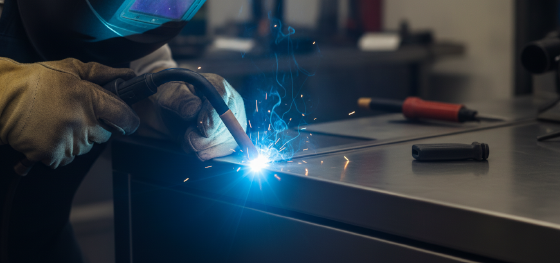
Unlike mechanical fast-locking systems that leave physical gaps, a fused metallurgical joint behaves as a single continuous structure, distributing stress evenly under heavy dynamic loads. However, thin metal sheets are highly sensitive to thermal energy. If your manufacturer lacks dedicated fixturing and correct torch setups, you will face severe warping, burn-through holes, and costly cosmetic rejections.
Let's dive into the core physics of thin-plate thermal management, analyze when to choose TIG over MIG for delicate alloys, and explore how professional post-weld grinding delivers seamless, retail-ready surfaces.
content:
The Challenge of Welding Thin Sheet Metal
TIG vs. MIG Welding for Aluminum and Stainless Steel
Spot Welding for High-Speed Enclosure Assembly
Post-Weld Grinding and Polishing
Flawless Welding and Fabrication at JUCHENG
FAQ: Critical Questions About Sheet Metal Welding
The Challenge of Welding Thin Sheet Metal
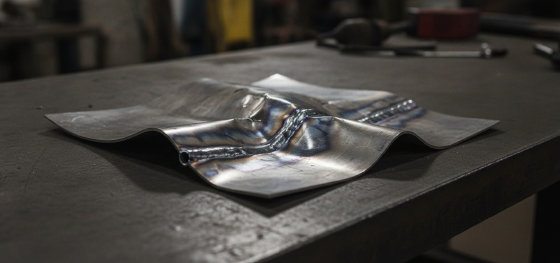
Why do thin metal sheets warp so easily during thermal welding?
Thin-gauge plates possess limited thermal mass, meaning the intense heat of an electric arc quickly concentrates in a small area, causing localized expansion and severe heat distortion upon cooling.
When welding materials under 2mm thick, the welder is constantly walking a tightrope between complete penetration and blowing a hole through the joint, a failure known as burn-through. As the metal liquifies, capillary action can pull the weld puddle downward if the arc gap is too wide or the travel speed is too slow.
To control this high-energy heat input, professional fabricators deploy custom-designed rigid fixtures backed by copper chill bars. Because copper absorbs heat much faster than steel or aluminum, placing these chill blocks directly beneath the joint lines draws away excess thermal energy. This simple mechanical setup restricts the localized expansion, eliminating the ugly buckling and waves that ruin thin-gauge panels.
TIG vs. MIG Welding for Aluminum and Stainless Steel
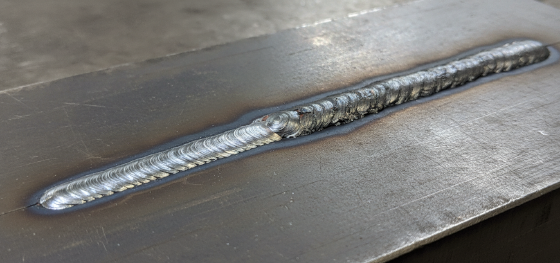
When should you choose TIG welding over MIG for custom enclosures?
Choose TIG for delicate, low-volume assemblies requiring ultra-clean, aesthetic weld beads; select MIG for thicker plates where high speed and deep joint penetration are the primary requirements.
When choosing the right method for aluminum and stainless steel, evaluating sheet metal welding techniques comes down to cosmetic versus speed requirements. For medical enclosures and consumer hardware, TIG welding is the gold standard. Using a non-consumable tungsten electrode, the operator controls the heat input with a foot pedal while manually feeding a filler rod, producing a series of overlapping, stack-of-dimes weld ripples with zero spatter.
Conversely, MIG welding utilizes an automatically fed consumable wire that acts as both the electrode and the filler metal. This continuous feed allows for rapid deposition rates, making MIG incredibly fast for long, straight seams on heavy structural steel. However, MIG introduces high weld spatter and a thicker bead profile, which requires extensive secondary labor to clean and blend flat.
Spot Welding for High-Speed Enclosure Assembly
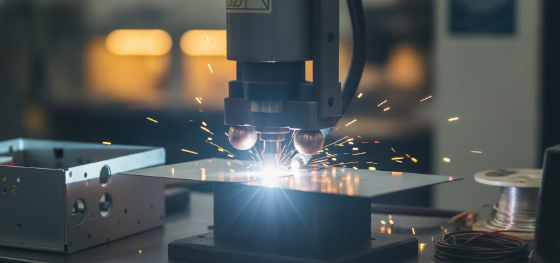
Why is spot welding so efficient for high-volume cabinet assembly?
Spot welding utilizes high electrical resistance to fuse overlapping metal sheets instantly at targeted points, requiring no filler rods, shielding gases, or specialized post-weld cleanup.
For sheet metal assemblies with multiple overlapping flanges, running a continuous weld seam is often a waste of machine time. This is where resistance spot welding dominates the production line. The pneumatic welding arms clamp two overlapping sheets between copper alloy electrodes, sending a high-current pulse directly through the contact point.
Because the resistance of the steel is higher than that of the copper electrodes, the metal instantly melts and fuses into a secure, localized nugget. This localized heating keeps the surrounding surfaces cool, preventing any noticeable thermal warping. It represents the fastest, most cost-effective path to assemble internal brackets, chassis frames, and cabinet skins.
Post-Weld Grinding and Polishing
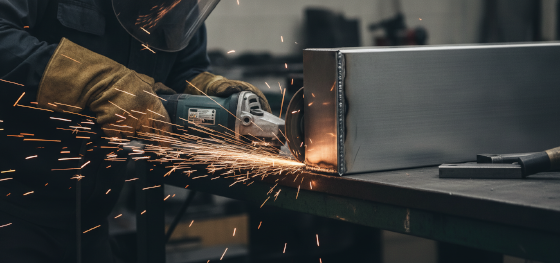
What secondary operations are required to make welded corners look completely seamless?
We grind down the raised weld bead using progressive abrasive wheels, carefully blending the joint flush with the surrounding parent metal before final powder coating.
An industrial welding joint straight out of the booth is rarely retail-ready. For high-end electronic chassis and medical carts, customers expect a solid, seamless corner that looks like a single molded block of metal. Achieving this look requires professional weld blending.
Our finishing technicians utilize variable-speed grinders fitted with flap discs of progressive grits, moving from aggressive 60-grit wheels down to ultra-fine 180-grit blending pads. The technician must maintain a light, flat touch; grinding too deep will thin the sheet wall, while grinding at an angle will leave permanent gouges. We align our polishing direction with the metal's natural grain direction, creating a uniform, continuous surface finish that hides the joint line completely under paint or anodizing.
Flawless Welding and Fabrication at JUCHENG
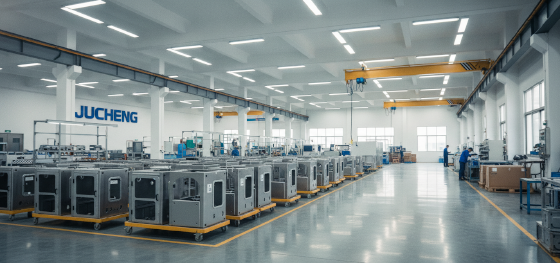
How does JUCHENG ensure consistent weld quality on complex custom chassis?
We operate high-end TIG, MIG, and resistance spot welders managed by certified fabricators, utilizing custom-designed alignment jigs to guarantee perfect geometric tolerances.
Our high-precision workstations integrate sheet metal welding with CNC machining and stamping to provide a turnkey manufacturing hub. As the final permanent assembly phase within the sheet metal fabrication process, our certified welders coordinate with our quality inspection team to ensure every welded joint meets structural and cosmetic requirements.
Whether your product calls for lightweight aluminum, high-strength stainless steel, or highly formable carbon steel, we match each alloy to its mathematically optimized heat-input parameter. Our technical department provides a 24-hour free DFM analysis to evaluate your CAD designs for weld access and joint clearance before we ignite a single torch. Supported by our no MOQ policy and rapid delivery schedules, we handle your assemblies from initial flat patterns to final cosmetic finishing.
FAQ: Critical Questions About Sheet Metal Welding
Why is welding aluminum significantly harder than stainless steel?
Aluminum possesses incredibly high thermal conductivity and a low melting point, meaning heat dissipates rapidly away from the joint, requiring much higher starting currents. Additionally, aluminum instantly forms a tough, non-conductive oxide layer on its surface, which must be chemically or mechanically removed immediately before welding to prevent severe weld porosity.
What causes weld spatter, and how does JUCHENG prevent it?
Weld spatter occurs during MIG welding when the electrical current fluctuates, causing molten metal droplets to fly out of the weld puddle and solidify on the surrounding sheet. We eliminate this by utilizing advanced synergic MIG welders that auto-stabilize the arc, and by applying protective anti-spatter sprays to the sheet surfaces before welding.
Is spot welding strong enough to replace structural MIG welds?
For thin-sheet electronic chassis and cabinet doors, spot welding is more than strong enough because the overlap joints are engineered to experience shear loads. However, for heavy structural load-bearing frames, continuous TIG or MIG welds are still required to handle high, multi-directional stress.
How do you inspect a welded joint for internal structural defects?
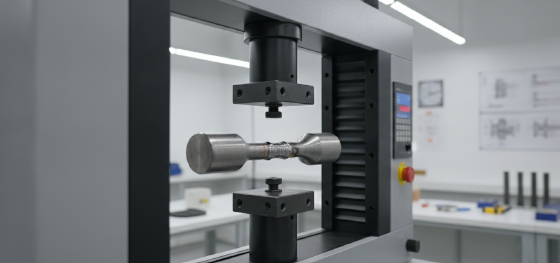
To guarantee leak-proof performance on fluid reservoirs and medical cabinets, we conduct dye-penetrant testing (PT) to expose micro-cracks on the surface, and run pressure-leak tests using pressurized air to identify pinholes that are invisible to the naked eye.

