


Your company is expanding. You have a successful product designed in Europe, and now you want to move its production to a global manufacturing partner to scale up and reduce costs. You send the technical drawings over.
A few hours later, you get a question from your new partner's engineering team: "Your drawing specifies a brass alloy we are not familiar with. It says 'CW614N'. Can you clarify?"
This is a common and potentially project-halting problem in global manufacturing. The world of materials is divided by different standards and naming conventions. This is a deep dive into a very important European alloy, and the world of 27450 brass machining.
Decoding the European Alphabet Soup
Its True Identity: A Free-Machining Champion
27450 vs. C360: A Tale of Two Cousins
Your Partner in Global Translation
Decoding the European Alphabet Soup

The first challenge is the name itself. The term "27450 brass" is not commonly used. It is a legacy numerical designation.
The more correct and modern name for this alloy is CW614N. This is its designation under the current European Norm (EN) standard. Before that, under the old British Standard, it was known as CZ121. And in the global UNS system, it is C38500.
All these different names refer to the exact same material. Knowing how to cross-reference these standards is the first job of a global manufacturing partner. But what is this material?
Its True Identity: A Free-Machining Champion
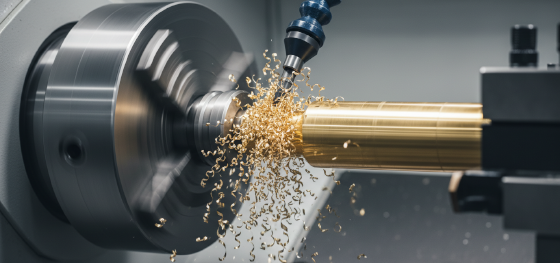
At its heart, CW614N (or 27450) is the European champion of free-machining brass. It is Europe's direct equivalent to the famous American C360 alloy.
Like C360, its recipe contains a small percentage of lead. This is its secret weapon. This lead acts as a microscopic chip breaker.
This means that during 27450 brass machining, the material produces small, brittle, and perfectly manageable chips. This is the hallmark of a "free-machining" alloy. It allows for incredibly high cutting speeds, long tool life, and is perfect for automated, high-volume production on CNC lathes. It is the material of choice for making millions of cost-effective, high-precision parts.
27450 vs. C360: A Tale of Two Cousins
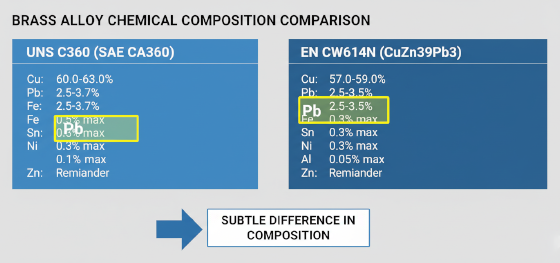
So, are CW614N (27450) and C360 identical? The answer is: almost, but not quite. They are like very close cousins.
Their chemical compositions are nearly identical. Both are a mix of copper, zinc, and a small amount of lead. The main difference lies in the exact percentages and the tolerance for impurities, which are governed by their respective regional standards (EN vs. ASTM).
From a performance perspective, they are virtually interchangeable for the vast majority of applications. They have the same excellent machinability. They have very similar strength, hardness, and corrosion resistance.
| Factor | CW614N (27450) - European | C360 - North American |
|---|---|---|
| Machinability | Excellent | Excellent |
| Primary Use | High-Volume Automated Machining | High-Volume Automated Machining |
| Interchangeable? | Yes, for almost all applications | |
Your Partner in Global Translation

This is where the right manufacturing partner becomes more than a supplier. They become your global translator.
When a European client sends a drawing specifying CW614N to a factory in North America, that factory might struggle to source the exact material. They might try to substitute it with C360 without fully understanding the implications.
A true global partner like JUCHENG understands this landscape. We are fluent in the language of both European (EN) and American (ASTM) standards. When we see a drawing for 27450 brass machining, we instantly recognize it as the European free-machining champion.
We can analyze your specific application. For 99% of projects, we can confidently confirm that the more readily available C360 is a perfect and acceptable equivalent. We will provide the documentation to support this. For that 1% of projects that might have a hyper-specific European regulatory requirement, we have the supply chain to source the certified CW614N material.
This expertise in navigating global standards is a critical service. It removes risk and uncertainty from your supply chain. It is the key to ensuring your product's quality and consistency, no matter where in the world it was designed or where it will be sold. This is a core part of our brass cnc machining expertise.

