


For engineers utilizing 3D printing, the infill setting is far more than a simple percentage—it is a critical structural parameter. Functional Infill Design is the engineering discipline that uses the part’s internal geometry to control its final mechanical strength, weight, thermal properties, and cost, transforming a basic prototype setting into a strategic decision for high-performance components.
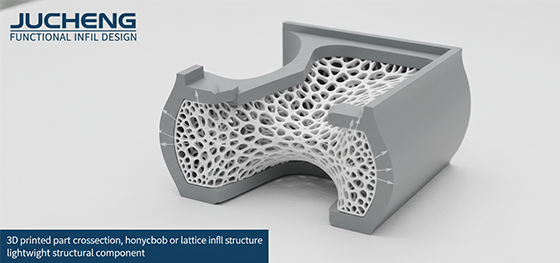
The right infill strategy depends heavily on the chosen technology (FDM, SLS, or MJF) and the expected load. This guide translates the common infill settings into tangible structural outcomes, helping B2B buyers optimize their 3D printed parts for both performance and manufacturing efficiency.
content:
Optimization Goals: Balancing Strength, Weight, and Cost
The Isotropic Challenge: Why Infill Matters Less for SLS and MJF
Shell-Infill Strategy: Prioritizing Outer Wall Thickness for Rigidity
Pattern Selection: Matching Infill Geometry to Load Bearing
Functional Sealing: Utilizing Infill for Watertight and Airtight Parts
Optimization Goals: Balancing Strength, Weight, and Cost
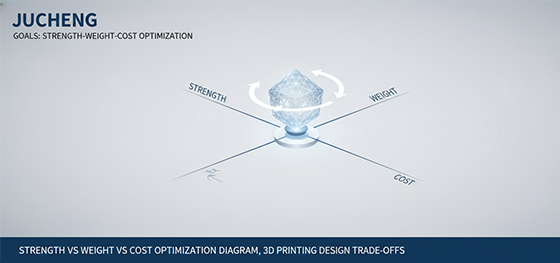
The primary goal of infill design is to find the perfect trade-off between competing requirements. Simply using 100% infill is structurally unnecessary and financially wasteful:
Strength vs. Weight: High infill maximizes strength but adds weight and material cost. Low infill minimizes weight (critical for drone or aerospace components) but requires a highly optimized outer shell for rigidity.
Cost vs. Time: In FDM, printing a 100% solid infill can take several times longer than a 20% infill. Since industrial printing is priced based on material use and machine hours, lower infill directly reduces cost and accelerates delivery.
Thermal Management: A hollow or low-infill design allows internal heat to dissipate more slowly than a solid part, which can be an advantage or disadvantage depending on the material and application.
The Isotropic Challenge: Why Infill Matters Less for SLS and MJF
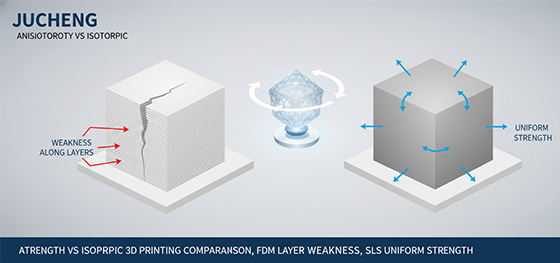
The effect of infill is highly dependent on the printing technology. In FDM, the infill pattern is critical because the part suffers from anisotropy (directional weakness):
FDM's Weakness: The bond between layers in FDM is the weakest point. Therefore, the infill pattern and its orientation must be carefully designed to counteract stress along the weak Z-axis.
SLS/MJF Advantage: In powder bed fusion (SLS, MJF), the laser or fusing agent creates a chemical bond between all particles and layers, resulting in near-isotropic properties. For these technologies, infill is mostly about hollowing the part for weight/cost savings rather than controlling strength direction.
Hollowing Strategy: For SLS/MJF, large parts are typically hollowed out with internal support ribs (lattice or honeycomb) to save material. The strength is then derived almost entirely from the strong, uniform outer shell.
Shell-Infill Strategy: Prioritizing Outer Wall Thickness for Rigidity
For the vast majority of mechanical and structural parts, the rigidity of the component is determined by the thickness of the outer shell (the walls) rather than the density of the internal infill:
Structural Contribution: In bending and torsional (twisting) stress, the material furthest from the center of the part contributes the most to rigidity. Therefore, increasing the shell thickness from 1mm to 2mm has a far greater impact on stiffness than increasing infill from 20% to 50%.
The Rule of Thumb: For prototypes, manufacturers often recommend a minimal infill (10% to 20%) combined with a robust shell (3 to 5 layers thick). This provides good rigidity and strength while minimizing print time and material cost.
Material Cost Savings: By adopting this strategy, material is strategically placed where it matters most, avoiding the material and time waste of filling the entire core with plastic that contributes minimal structural value.
Pattern Selection: Matching Infill Geometry to Load Bearing
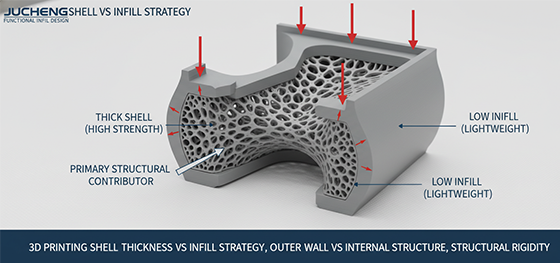
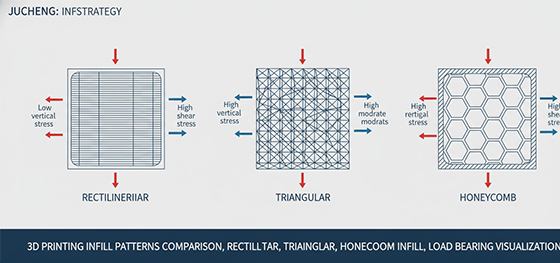
For FDM and hollowed SLS/MJF parts with internal lattice, the geometric pattern of the infill should be specifically chosen to resist the dominant type of force the part will encounter:
Triangular Infill: Considered one of the strongest patterns, as triangles resist force from all sides, making it ideal for structural parts under multidirectional stress.
Honeycomb (Hexagonal): Provides an excellent balance of strength, stiffness, and material savings, mimicking efficient structures found in nature. It is a common choice for general structural use.
Concentric Infill: Follows the outer shape of the part. This pattern is often used for flexible or aesthetic parts, as it provides a predictable bend path but offers low resistance to compression.
Functional Sealing: Utilizing Infill for Watertight and Airtight Parts
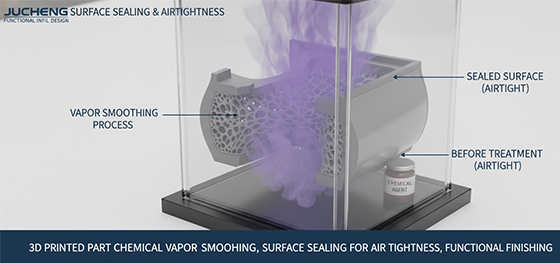
Beyond strength, infill strategy impacts a part's ability to contain fluids or gases, a critical requirement for medical, automotive, and fluid dynamics prototypes:
Porosity Risk: All additive processes, particularly those with low infill, leave internal air gaps or micro-porosity. This makes them inherently unsuitable for sealing unless treated.
Sealing Strategy: Achieving watertightness requires two approaches: either using 100% solid fill in critical fluid-contact areas, or chemically smoothing the part's surface (e.g., vapor smoothing MJF Nylon) to seal the micro-porosity and prevent leakage.
Post-Processing: For functional fluid prototypes, chemical smoothing is often mandatory for sealing. The chemical agent dissolves the surface layer, causing the material to flow into and permanently seal the microscopic pores.
Functional Infill Design is the key to unlocking the full potential of 3D printing. Jucheng Precision Technology’s expertise across FDM, SLS, and MJF ensures your components are designed with an internal structure that precisely meets your needs for strength, weight, cost, and functional sealing.
Secure structurally optimized 3D printed parts. Contact us today to discuss the best infill and manufacturing strategy for your next functional prototype.

