


For low-volume production and complex prototypes, 3D Printed Master Patterns are the indispensable starting point. These patterns, whether used for silicone soft tooling (Vacuum Casting) or complex investment casting, are the original blueprint. Every flaw, every micron of error, and every detail present on the master will be perfectly replicated in the final cast components.
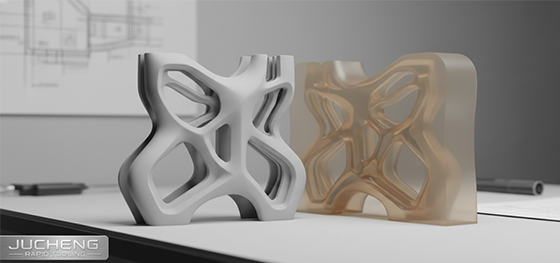
The manufacturing challenge is two-fold: first, achieving a perfect master model quickly and accurately; second, ensuring the material’s thermal stability allows for the subsequent high-temperature silicone molding process. This guide explores the strategic role of additive and subtractive manufacturing in creating flawless master patterns for high-fidelity casting.
content:
Master Pattern: The Definition of Dimensional Accuracy
Creation Strategies: CNC Machining vs. SLA 3D Printing
Surface Preparation: Achieving Flawless Finish for Silicone Tooling
Casting Integration: From Master Pattern to Final Urethane Part
Master Pattern: The Definition of Dimensional Accuracy
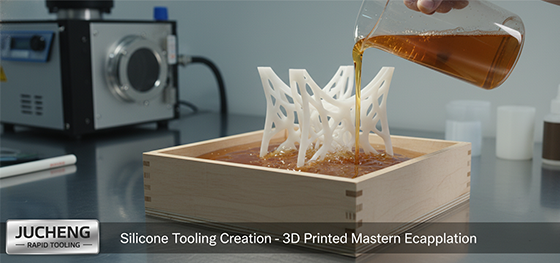
The master pattern is the core piece in the Vacuum Casting process. It is the physical model used to create the final silicone mold, which is then used to cast the finished polyurethane parts:
Source of Truth: The master pattern is the single source of truth for the final geometry. Its dimensional accuracy and surface finish are passed directly to the soft silicone mold, and subsequently to all 15-25 final cast parts.
Tolerance Strategy: The master must be manufactured to an even tighter tolerance than the final part. This is because the casting process itself (silicone shrinkage, resin shrinkage) introduces minor variations that must be offset by a perfect master.
Thermal Stability: The master pattern must be thermally stable enough to withstand the heat generated during the silicone mold curing process (often over 80 degrees Celsius) without warping or deforming.
Creation Strategies: CNC Machining vs. SLA 3D Printing
Two primary methods are used to manufacture high-quality master patterns, with the choice depending on geometric complexity and required tolerance:
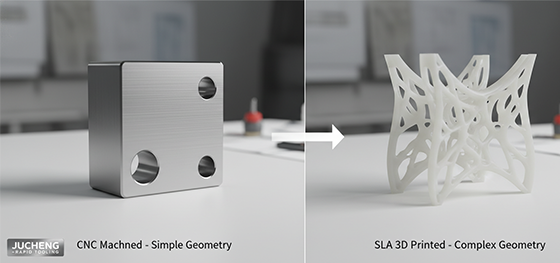
SLA 3D Printing: Ideal for highly complex, organic, or internal geometry that is difficult or impossible to machine. SLA (Stereolithography) uses a liquid resin and laser to achieve the highest resolution and best surface finish of any 3D printing process, making it the preferred method for master patterns.
CNC Machining: Used for simpler, blockier geometry that requires the absolute tightest dimensional tolerance. Cutting the master from solid engineering plastic (like ABS or PMMA) guarantees the material's homogeneity and dimensional accuracy.
Material Choice: The 3D printing resin or CNC stock must be chemically compatible with the liquid silicone, as any reaction (inhibition) would prevent the silicone mold from curing properly.
Surface Preparation: Achieving Flawless Finish for Silicone Tooling
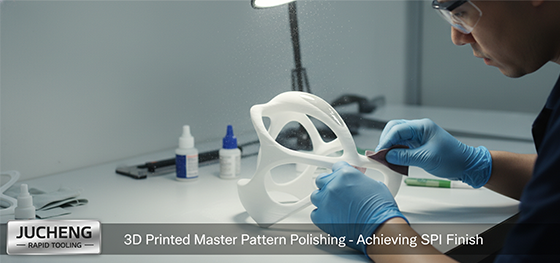
Every flaw on the master pattern—including 3D print layer lines, scratches, or tooling marks—will be transferred perfectly to the silicone mold and thus to every final cast part. Flawless surface preparation is mandatory:
Layer Line Removal: SLA and FDM master patterns require significant post-processing, involving progressive sanding and polishing to remove all traces of layer lines and achieve an SPI-grade smooth surface.
Priming and Sealing: After sanding, the master is often treated with a high-quality primer and sealed with a clear coat. This process fills microscopic porosity and ensures the silicone does not chemically adhere to the master.
Mating Surface Integrity: Critical mating surfaces and parting lines must be perfectly flat and sharp. Any deviation here creates "flash" (excess material) on the final cast parts, requiring costly manual trimming.
Casting Integration: From Master Pattern to Final Urethane Part

Once the perfect master pattern is created, the manufacturing focus shifts to the thermal and pressure stability of the silicone mold and the casting process:
Silicone Mold Life: The master pattern enables rapid mold creation. However, the resulting silicone mold is a "soft tool" with a limited lifespan (typically 15 to 25 cycles). The master pattern can be used repeatedly to make new molds as needed.
Vacuum Casting Resin: The master pattern is used to cast polyurethane resins that simulate final materials (like ABS, PC, or TPE). The process relies on a vacuum to ensure the final part is dense and free of bubbles, flaws that originate from poor casting technique, not the master.
Dimensional Drift: Over the lifespan of the silicone mold, the mold itself can soften or slightly expand due to repeated heating and cooling cycles, causing a predictable dimensional drift in the cast parts that must be monitored.
The foundation of high-fidelity casting is the 3D Printed Master Pattern. Jucheng Precision Technology integrates high-resolution SLA 3D Printing and precision finishing to deliver dimensionally accurate, flawless master patterns, ensuring your Vacuum Casting runs achieve injection-molded quality at low-volume cost.
Secure the blueprint for high-quality low-volume production. Contact us today to discuss the optimal master pattern creation and Vacuum Casting strategy for your next project.

