


For automotive manufacturers, "car spray paint" is a matter of strict engineering, not just color. The coating on a bumper, trim piece, or mirror cap must withstand extreme UV radiation, temperature swings, road abrasion, and chemical exposure for the vehicle's entire lifespan. Achieving this OEM-level quality requires rigorous control over every stage of Automotive Coating Quality, beginning with the substrate itself.
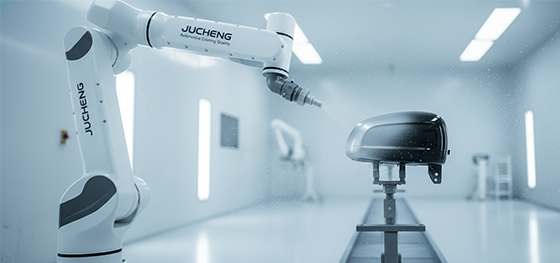
The most common cause of coating failure—peeling and blistering—is poor adhesion, which is often a direct result of inadequate preparation of the plastic or metal part before spraying. This guide details the IATF-level industrial processes required to ensure a permanent, showroom-quality finish that meets global durability standards.
Substrate Preparation: The Zero-Tolerance Rule for Cleanliness
Surface Activation: Chemically Priming Low Energy Plastic
Multi-Layer Structure: The Engineering of Primer, Basecoat, and Clearcoat
Thermal Curing: Managing the Substrate’s Heat Deflection Temperature
IATF Verification: Mandatory Testing for Adhesion and Durability
Substrate Preparation: The Zero-Tolerance Rule for Cleanliness
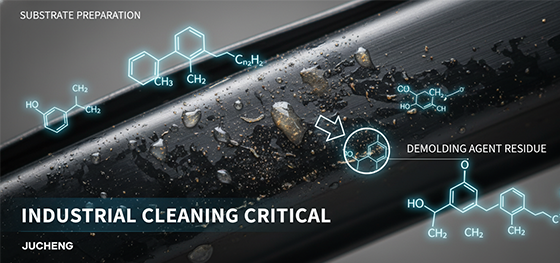
Contamination is the number one enemy of automotive paint. A single fingerprint, mold release agent residue, or microscopic oil particle can ruin a large, high-value component during the final finish:
Cleaning Protocol: Parts must undergo a rigorous, multi-stage cleaning process. This typically includes a solvent wipe (often isopropyl alcohol or proprietary cleaners) followed by an industrial deionized water rinse to remove all surface contaminants.
Defect Removal: Any surface defect created during Injection Molding (e.g., flash, sink marks) must be removed or filled, followed by detailed sanding up to 600-800 grit to ensure a uniform substrate for the primer.
Anti-Static: Electrostatic forces attract airborne dust. Before entering the paint booth, parts are often de-ionized to neutralize static charge, minimizing the risk of microscopic particles adhering to the surface.
Surface Activation: Chemically Priming Low Energy Plastic
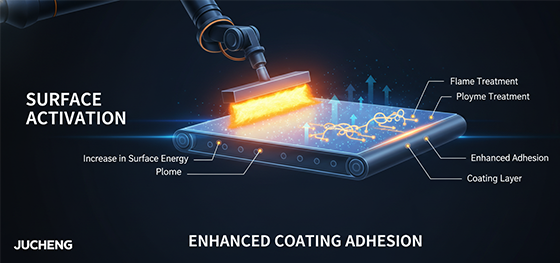
Automotive plastics like Polypropylene (PP) and thermoplastic polyolefins (TPOs) are chemically inert. They have "low surface energy," meaning they naturally repel paint. This issue is resolved through surface activation:
Flame Treatment: A highly effective industrial method where a precisely controlled, oxidizing flame is rapidly passed over the surface. This breaks the non-polar molecular bonds and chemically prepares the surface for paint.
Adhesion Promoter Primer: For difficult materials, a specialized clear adhesion promoter (primer) must be applied immediately after activation. This primer acts as a critical chemical bridge, forming a durable bond with the substrate and a reactive surface for the color coat.
Surface Energy Test: Professional facilities use Dyne testing or contact angle measurement to objectively verify that the activation process has successfully increased the surface energy to the level required by the paint system.
Multi-Layer Structure: The Engineering of Primer, Basecoat, and Clearcoat
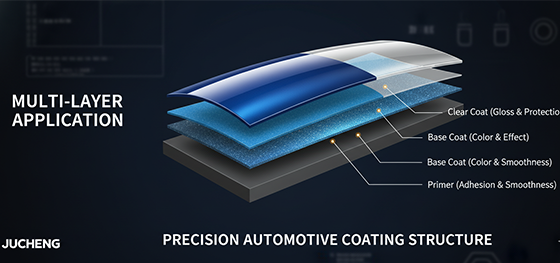
Automotive paint is not a single layer; it is a meticulously engineered system of three or more coatings, each serving a distinct structural and aesthetic function:
Primer: Applied first to promote adhesion and smooth out minor surface imperfections. For plastics, the primer is often a flexible coating that allows the part to flex under impact without the rigid top coats cracking.
Basecoat: This layer contains the pigment and is responsible for the component's color and metallic or pearl effect. Its thickness must be precise to ensure the color perfectly matches the vehicle's original finish.
Clearcoat: The final, hardest layer. It provides the gloss, UV protection, and resistance to scratches, acid rain, and chemical contaminants. The thickness and hardness of this layer determine the coating's durability.
Thermal Curing: Managing the Substrate’s Heat Deflection Temperature
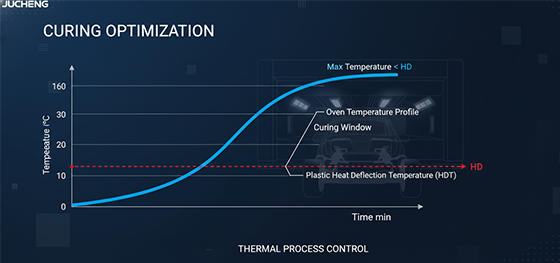
Automotive-grade paints are thermal-cured (baked) to achieve their full hardness. This is a critical risk step for plastic components, as the curing temperature must not deform the substrate:
HDT Limit: The curing temperature must be significantly below the plastic's Heat Deflection Temperature (HDT) to prevent warpage. Manufacturers often choose low-bake or specialized UV-curable paints to accommodate plastics with low HDTs.
Stress Release: Even temperatures below the HDT can release internal stresses locked into the plastic during Injection Molding, causing the component to warp after curing. Pre-molding annealing or advanced molding techniques are used to mitigate this risk.
Process Control: Industrial curing ovens use precise temperature mapping to ensure every area of the large component reaches the required temperature for cross-linking without overheating localized areas.
IATF Verification: Mandatory Testing for Adhesion and Durability
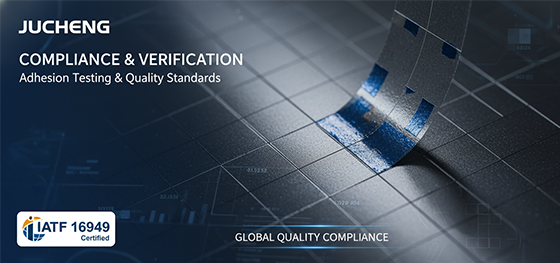
Automotive coatings must be proven to adhere and endure. This requires rigorous, IATF-level testing to verify structural compliance:
Cross-Hatch Adhesion Test: This standard test uses a tool to cut a grid pattern through the paint. Adhesive tape is applied and removed to quantify the percentage of paint that peels off, providing an objective score of the paint's bond strength.
Thermal Shock Testing: The part is rapidly cycled between extreme high and low temperatures to simulate real-world environmental stress, ensuring the coating does not crack or peel due to differential thermal expansion.
Chemical Resistance: The finish is tested against common automotive fluids and cleaning agents to ensure the clearcoat maintains its gloss and integrity without clouding or softening.
Achieving OEM-level Automotive Coating Quality is a holistic manufacturing process that integrates Injection Molding, surface activation, and clean room application. Jucheng Precision Technology offers end-to-end IATF 16949 certified manufacturing and finishing to guarantee the ultimate durability and aesthetic quality of your automotive components.
Secure guaranteed paint quality for your automotive parts. Contact us today to discuss the full-service manufacturing and finishing protocol for your next project.

