


The technique of Insert Molding is essential for manufacturing components that require the high strength of metal or electronic conductivity combined with the functional benefits of plastic. This process, which involves encapsulating a pre-manufactured part (the insert) with molten plastic, is highly complex. Its success depends entirely on managing the critical thermal and dimensional challenges inherent in joining two dissimilar materials.

For B2B buyers, a failed insert molded part is a costly structural liability. This guide explores the engineering mastery required to manage thermal stress, ensure absolute positional accuracy of the insert, and prevent plastic stress cracking over the component's lifespan.
Thermal Stress: The Root Cause of Plastic Cracking
Insert Tolerance: Why the Metal Component Must Be Precision CNC Machined
Tooling Strategy: Pinning, Locating, and Sealing the Insert
Material Compatibility: Preventing Galvanic Corrosion and Ensuring Adhesion
Automation and Quality: High-Volume Precision and Inspection
Thermal Stress: The Root Cause of Plastic Cracking

The primary risk in Insert Molding is the difference in thermal expansion between the metal insert and the plastic. As the molten plastic cools and shrinks around the rigid metal, massive internal stress is generated:
Differential Shrinkage: All polymers shrink significantly more than metal. As the plastic shrinks around the unyielding metal insert, a pulling force is created, leading to stress concentration around the insert's edges.
Stress Cracking: Over time, or when exposed to external factors like cleaning chemicals or temperature fluctuations, this internal stress leads to micro-cracking and eventual catastrophic failure of the plastic part around the insert.
Mitigation: Solutions include pre-heating the metal insert before injection (to reduce the temperature differential) and using specialized, high-ductility plastic resins that can absorb more internal strain.
Insert Tolerance: Why the Metal Component Must Be Precision CNC Machined
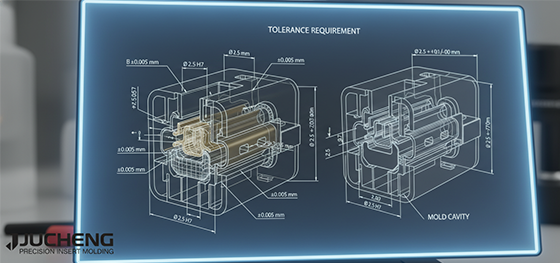
The metal insert (often a threaded bolt, connector, or electronic pin) must be manufactured to extremely tight tolerances for two critical reasons: positional accuracy and functional reliability:
Positional Accuracy: The mold relies on the insert's precision to position it correctly. If the insert's dimensions are inaccurate, it will seat incorrectly in the mold cavity, leading to misalignment of the final molded feature.
Functional Reliability: Metal inserts for electrical conductivity or structural fastening (e.g., screw threads) must be perfectly formed. This requires high-precision processes like CNC Machining and precision sheet metal stamping to ensure flawless mechanical or electrical function after molding.
Surface Prep: The insert's surface must be clean and often mechanically knurled or textured to ensure the molten plastic has maximum mechanical locking with the metal surface.
Tooling Strategy: Pinning, Locating, and Sealing the Insert

The Injection Mold for Insert Molding is significantly more complex than a standard mold. It requires specialized features to hold the insert rigidly against the force of the molten plastic:
Locating Pins and Cores: Precision pins or features within the mold cavity are used to align and hold the insert rigidly. These must be engineered to withstand the high injection pressure without bending or shifting.
Sealing Surfaces: The mold must seal perfectly around the insert's base to prevent molten plastic from escaping (flashing) around the part, which would ruin the mold and the part.
Gate Placement: The mold's gate (where the plastic enters) must be positioned to allow the molten plastic to flow smoothly around the insert without hitting it directly, which could displace the insert or cause weld lines.
Material Compatibility: Preventing Galvanic Corrosion and Ensuring Adhesion

The longevity of the final component relies on ensuring the metal and plastic are chemically compatible and do not cause premature corrosion:
Galvanic Corrosion: When dissimilar metals are used for the insert (e.g., copper and steel) and moisture is introduced, galvanic corrosion can occur. The insert material must be strategically chosen (e.g., using stainless steel or plating a dissimilar metal) to prevent this.
Plastic Chemical Attack: Some plastics (like certain polycarbonates) are susceptible to chemical attack from the heat and pressure of the molding process itself, leading to immediate stress cracking around the insert.
Resin Choice: High-performance resins like Nylon (PA) or PEEK are often used for their superior chemical resistance and strength, reducing the risk of material breakdown over the part's life.
Automation and Quality: High-Volume Precision and Inspection

For high-volume Insert Molding, manual placement of the inserts is too slow and error-prone. Automation and robust quality control are mandatory:
Robotic Placement: High-speed robotic systems are used to pick up and precisely place the inserts into the mold cavity between cycles, ensuring absolute positional accuracy and consistent cycle time.
Vision Inspection: Automated vision systems are integrated into the molding cell to verify that the insert is correctly seated before the mold closes. This prevents costly mold damage and ensures zero misalignment.
Final Verification: Critical parts are verified using CMM or X-ray imaging (especially for medical devices) to confirm the final position and integrity of the encapsulated insert without damaging the plastic overmolding.
Insert Molding is a high-risk, high-reward process that requires expert management of thermal expansion and dimensional fidelity. Jucheng Precision Technology integrates high-precision CNC Machining for the insert, specialized tooling design, and robotic automation to deliver components with guaranteed structural integrity and long-term reliability.
Secure structurally sound, multi-material assemblies. Contact us today to discuss the optimal insert molding and component manufacturing strategy for your complex project.

