


The STL file is the digital blueprint for most modern manufacturing, from 3D printing to CNC Machining and mold design. Yet, when an STL file contains hidden digital flaws—such as holes, non-manifold geometry, or inverted normals—it transforms from a plan into a major production risk. Successful STL File Repair is therefore the first and most critical step in mitigating costly delays and guaranteeing that the physical part matches the digital design.
For B2B buyers, relying solely on basic consumer software is insufficient. A professional manufacturing partner must provide expert STL file validation and repair, ensuring the file is "watertight" and ready for industrial processes across all material types. This guide explains the core defects and their real-world impact on manufacturing time and cost.
content:
Core STL Defects: Why the Digital Blueprint Fails Production
Multi-Process Impact: STL Failure in 3D Printing, CNC, and Casting
The Repair Strategy: Achieving a Watertight and Manifold Model
Sourcing Value: The Cost-Benefit of Professional File Validation
Core STL Defects: Why the Digital Blueprint Fails Production
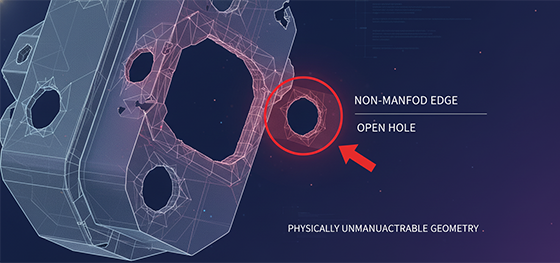
The STL file format represents a solid object as a collection of linked triangles (a mesh). When these triangles do not connect perfectly or violate basic physical rules, the model becomes impossible for slicing software and tool path generation programs to interpret:
Non-Manifold Geometry: This is the most common and complex error. It occurs when a point or edge is shared by three or more triangles, which is impossible in physical space (e.g., an internal wall with zero thickness). Manufacturing software cannot calculate tool paths for non-manifold edges.
Holes and Gaps: A "watertight" model means the mesh is completely sealed. Holes are gaps in the mesh that make the object resemble a shell rather than a solid volume, confusing slicing algorithms about what is inside and what is outside the part.
Flipped Normals: Every triangle has an "inside" and "outside" direction (the normal vector). If these normals are randomly flipped, the slicing software cannot distinguish between the interior and exterior of the part, often leading to tool path generation failure.
Multi-Process Impact: STL Failure in 3D Printing, CNC, and Casting
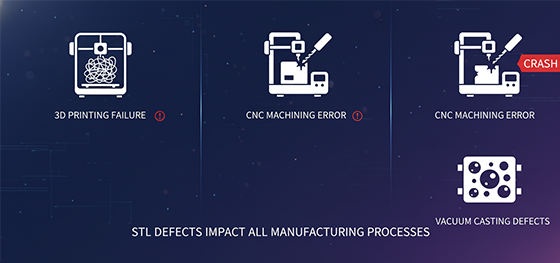
While most discussions center on 3D printing, a defective STL file poses an equally severe, often more costly, threat to high-precision subtractive and molding processes:
3D Printing Failure: A non-watertight model often results in partial fills, missing layers, or corrupted support structures, forcing a complete restart and wasting expensive powder or resin material.
CNC Machining Error: CNC programming software (CAM) uses the solid model to generate tool paths. A defective STL file can cause the CAM software to generate corrupted G-code, potentially leading to machine crashes, broken tools, and the scrapping of expensive metal or plastic blocks.
Vacuum Casting/Molding: If the model is a master pattern for Vacuum Casting or mold design, a flaw in the STL will be transferred directly to the physical pattern. This defect then propagates to the final silicone mold, requiring the entire costly tool-making process to be repeated.
The Repair Strategy: Achieving a Watertight and Manifold Model
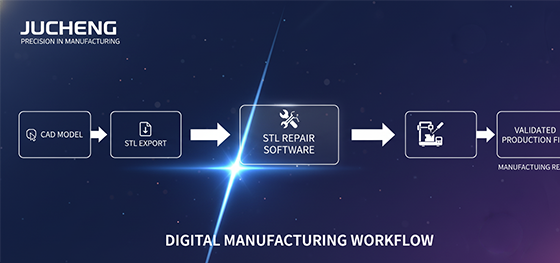
Professional STL File Repair aims to automate the cleanup of simple errors while requiring specialized engineering time for complex flaws, ultimately converting the defective mesh back into a manifold, watertight object:
Automated Healing: Software tools first automate simple fixes like closing small gaps, merging duplicated triangles, and ensuring all normals face outward.
Manual Intervention: Complex non-manifold geometry, especially those arising from intersecting or overly complex features, often requires an engineer to manually edit the mesh structure to restore logical geometric continuity.
Validation: The final repaired file must be verified using industry-standard analysis tools to ensure it meets the required geometric tolerances for the selected manufacturing method, guaranteeing "production readiness."
Sourcing Value: The Cost-Benefit of Professional File Validation

For B2B buyers, paying a small fee for expert file validation and repair is a critical insurance policy against much larger costs down the line:
Cost Avoidance: The cost of scrapping a few hours of 3D printing powder/resin or a large aluminum block due to a corrupted tool path far exceeds the cost of professional STL File Repair.
Time to Market: A properly validated file moves directly into production, eliminating the costly delays caused by back-and-forth communication or failed builds. Jucheng Precision Technology integrates file validation into the quoting process for maximum speed.
Full Service Integration: The best manufacturing partners don't just repair the mesh; they analyze the geometry against the selected manufacturing process (e.g., checking wall thickness for Injection Molding design rules), providing proactive DFM (Design for Manufacturing) advice.
STL File Repair is the invisible but indispensable first step in precision manufacturing. Jucheng Precision Technology’s integrated design validation and repair services ensure your digital blueprint is flawless and ready for production, mitigating risks across 3D Printing, CNC Machining, and soft tooling.
Secure production readiness from your digital assets. Contact us today to leverage expert file analysis for your next high-precision component.

