

Industrial Hand-Casting: Vacuum Casting as the Precision Alternative
Views: 2 Author: Allen Xiao Publish Time: 2025-04-03 Origin: Site


The term "hand mould casting" often conjures images of artistic, low-fidelity hobby kits. Yet, in the B2B world of rapid prototyping, Vacuum Casting represents the high-precision, industrial equivalent of hand-casting. It offers the low initial cost and speed of a manual process but delivers parts with the aesthetic quality, material properties, and dimensional accuracy needed for functional prototypes and limited production runs. For buyers needing dozens, not thousands, of complex parts, Vacuum Casting is the critical bridge between 3D printing and Injection Molding. This guide focuses on the technical advantages of this "soft tooling" method, detailing how it replicates engineering-grade plastics and why its process control is key to high-quality results. content: Vacuum Casting is a three-step replication process that uses a flexible silicone mold to produce high-fidelity copies (often up to 50 parts) from a single master model. Its efficiency lies in its low-cost tooling and quick turnaround. The Master Pattern: Everything begins with a highly accurate master model, typically produced via high-resolution SLA 3D Printing or precision CNC Machining. This master piece dictates the final accuracy of all subsequent copies. Silicone Tooling: The master pattern is suspended inside a box, and liquid silicone rubber is poured over it under vacuum. Once cured, the flexible silicone is cut open to remove the master, leaving a negative cavity that serves as the "soft mold." This eliminates the time and cost of hard metal tooling. The Vacuum Process: Polyurethane resin (the casting material) is mixed and poured into the silicone mold inside a vacuum chamber. The vacuum forces the resin into every minute detail and, crucially, removes all trapped air, preventing internal bubbles and surface porosity. The casting material used in Vacuum Casting is a two-part polyurethane resin, which can be precisely formulated to mimic the mechanical, thermal, and aesthetic properties of common engineering-grade plastics: Rigid Plastics: Resins like Hei-Cast 8150 or Axson PX5212 can replicate the stiffness and surface finish of ABS, PC, and Nylon, making the parts suitable for functional testing of consumer product enclosures and device housings. Elastomers (Rubber-like): Specialty flexible resins (such as Hei-Cast 8570 or 8743 series) can simulate the properties of soft rubber and TPU, allowing engineers to test seals, grips, and bellows with specific Shore A or D hardnesses. Specialized Resins: Specific resins can replicate properties like high-temperature resistance, flame retardancy, or transparency, making Vacuum Casting viable for specialized medical and automotive prototypes. The key differentiator of this process is the vacuum itself. If casting were performed in open air, trapped air would lead to pinholes, bubbles, and surface porosity, destroying the part's integrity. Degassing the Resin: Before pouring, the mixed resin itself is degassed in the vacuum chamber to remove microscopic air that gets introduced during mixing, ensuring the material is free of internal voids. Mold Filling: Filling the mold under vacuum ensures the resin reaches every fine detail and feature, providing a precise reproduction of the master pattern, which is critical for components with complex internal geometry. Post-Curing: After the initial cure in the vacuum chamber, the part is removed and often subjected to a controlled thermal post-cure (baking) in an oven to fully stabilize the polymer, optimizing its strength and heat deflection properties. Vacuum Casting sits in a sweet spot for B2B procurement, offering a rapid, low-risk solution for functional testing and limited-edition runs: Cost Efficiency: Since the mold is made of silicone (not expensive steel), the initial tooling cost is significantly lower than that of hard Injection Molding dies. This makes design iteration much cheaper. Volume Sweet Spot: The typical lifespan of a silicone mold is limited, usually producing 15 to 25 perfect copies before it begins to degrade. This makes the process ideal for production volumes between 10 and 500 units—perfect for market testing, short-run medical trials, or low-volume specialized device production. Rapid Tooling: The entire tooling process, from master pattern creation to mold readiness, can be completed in as little as 3-5 days, providing speed that neither traditional tooling nor metal casting can match. Vacuum Casting is the industrial answer to rapid, high-fidelity replication. Jucheng Precision Technology’s expertise in silicone tooling and material formulation ensures that your low-volume parts not only look like the final product but perform like it, bridging the gap between prototype verification and mass production. Secure injection-molded quality at prototype costs. Contact us today to discuss the optimal casting strategy for your next functional prototype or low-volume run.Vacuum Casting Demystified: The Science of Silicone Tooling
Material Fidelity: Replicating ABS, PC, and Soft Elastomers
Process Mastery: Vacuum’s Role in Eliminating Internal Defects
The Economics: Cost, Volume, and the Mold Lifespan
Vacuum Casting Demystified: The Science of Silicone Tooling
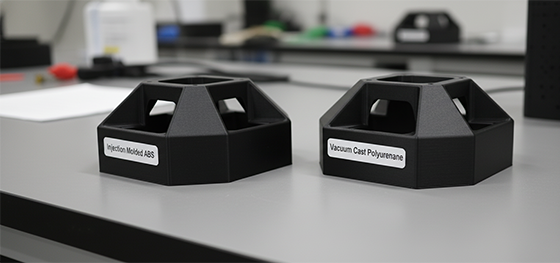
Material Fidelity: Replicating ABS, PC, and Soft Elastomers
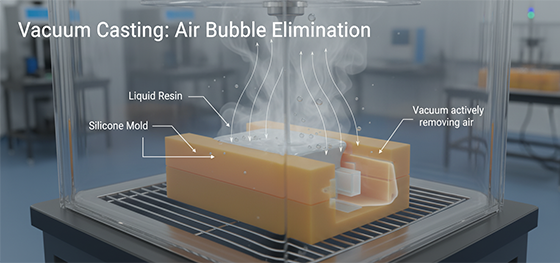
Process Mastery: Vacuum’s Role in Eliminating Internal Defects
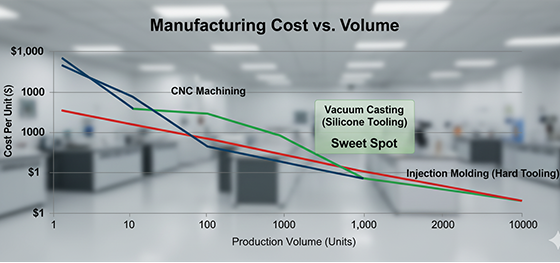
The Economics: Cost, Volume, and the Mold Lifespan


ㆍPrivacy: We respect your privacy. Here you can find an example of a non-disclosure agreement. By submitting this form, you agree to our terms & conditions and privacy policy.
