


The fusion of 3D printing and silicone molding has revolutionized rapid prototyping and small-batch manufacturing. This hybrid process leverages the speed and design freedom of additive manufacturing to create precise, complex molds that were previously expensive and time-consuming to produce via traditional methods like CNC machining.
content:
The Hybrid Workflow: 3D Printing and Silicone Casting
Choosing the Best 3D Printer for Silicone Molds
Critical Considerations for 3D Printing Molds for Silicone Casting
Post-Processing for a Perfect Custom 3D Printed Silicone Mold
Material Science: 3D Printer Resin for Silicone Molds
Advanced Applications: From Metal Composites to Waste Reduction
The Hybrid Workflow: 3D Printing and Silicone Casting
The main idea here isn't to 3D print with silicone directly—that’s actually pretty hard because silicone is too sticky and doesn’t dry like plastic. Instead, we use the 3D printer in a smarter way: to make molds out of silicone.
Here’s how it works in three simple steps:
First, you 3D print a positive model—also called a “master” or “pattern.” This is just a copy of the object you want to make.
Next, you use that master to make a silicone mold. This mold is like a negative version—it has the shape carved into it.
Finally, you pour materials like resin, epoxy, or even more silicone into the mold. Once it hardens, you take out your finished part!
This method is great for making lots of copies of something that has lots of detail, and you only need to print the master once.
Choosing the Best 3D Printer for Silicone Molds
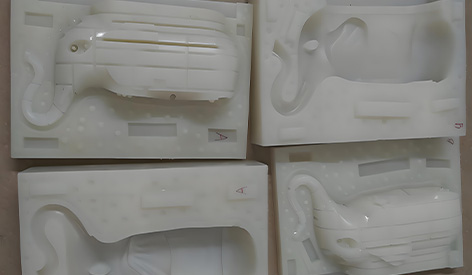
Selecting the right machine is critical for success. The best 3d printer for silicone molds is one that prioritizes ultra-high resolution, smooth surface finish, and water-tightness. While FDM (Fused Deposition Modeling) printers are accessible and can be used with extensive post-processing, they often leave layer lines that transfer to the silicone mold and subsequently to every cast part. For professional results, MSLA (Masked Stereolithography) and PolyJet printers are superior choices. MSLA printers, which use a UV light source to cure liquid resin layer by layer, excel at producing parts with exceptionally fine details and smooth vertical surfaces. This makes them ideal for creating masters for intricate silicone molds.
Critical Considerations for 3D Printing Molds for Silicone Casting
When preparing your 3D model for 3d printing molds for casting silicone, several factors must be addressed:
Orientation: Orient the master to minimize visible layer lines on critical surfaces. Support structures must be placed on non-cosmetic areas.
Draft Angles: Incorporating slight draft angles (1-2 degrees) on vertical walls is not always mandatory with flexible silicone but greatly eases the demolding of both the master from the silicone and the final cast part from the mold.
Wall Thickness: Ensure your master has a solid, thick wall to prevent flexing during the mold-making process.
Venting and Sprues: For complex parts, you may need to design and print integrated sprues (for pouring resin) and vents (for air to escape) directly onto your master pattern.
Post-Processing for a Perfect Custom 3D Printed Silicone Mold
A raw 3D print is rarely ready for mold making. Meticulous post-processing is the key to a successful custom 3d printed silicone mold. For resin prints, this involves:
Washing and Curing: Thoroughly wash the print in isopropyl alcohol to remove uncured resin, then post-cure it under UV light to achieve full polymerization and stability.
Sanding: Progressively sand the model with increasing grits of sandpaper (starting from 400 up to 2000+ grit) to eliminate layer lines.
Priming and Sealing: Apply a high-fill primer or a specialized coating like XTC-3D to create a perfectly smooth, sealed surface. This step is non-negotiable for creating a water-tight master; any porosity will trap air and cause defects in the silicone mold. The goal is an impeccably smooth surface that will result in a pristine mold.
Material Science: 3D Printer Resin for Silicone Molds
The choice of material is paramount. Not all resins are created equal. You must select a rigid 3d printer resin for silicone molds that is specifically formulated to resist the inhibitors in platinum-cure silicones. Standard resins contain sulfur-based compounds that can inhibit the curing of platinum-cure silicone, resulting in a tacky, uncured surface on your mold. Use "silicone-safe" or "inhibitor-free" resins, which are explicitly marketed for this application. For tin-cure silicones, this is less of an issue, but platinum-cure varieties are preferred for their superior properties and lack of shrinkage.

Advanced Applications: From Metal Composites to Waste Reduction
The versatility of this technique extends far beyond simple prototypes. Innovators are now metal cerami silicone using 3d printed molds. This involves casting specialized silicone compounds filled with metal powders (like bronze or iron) into a 3D-printed mold. After curing, the silicone part is removed and placed in a kiln, where the silicone binder burns away, leaving a solid metal object in a process known as "burn-out" casting. Furthermore, this technology offers a sustainable angle by providing a silicone mold for 3d print waste. Failed prints or support material can be collected and recycled by being melted down and cast into new forms using a 3D-printed silicone mold, promoting a circular economy within the workshop. The primary application remains the efficient production of functional components through 3d printing molds for silicone parts, such as gaskets, seals, soft-grip handles, and even biomedical devices.
Mastering the art of using a 3d printer to make silicone molds opens a world of manufacturing possibilities. By carefully selecting the right printer technology, employing a rigorous post-processing regimen, and choosing silicone-safe materials, designers and engineers can rapidly iterate and produce high-quality, functional parts. This hybrid approach democratizes manufacturing, making it faster, more affordable, and more accessible than ever before, while also paving the way for advanced material applications and sustainable practices.

