


Walking onto the chemical milling production floor, the sharp, biting scent of ferric chloride instantly hits the back of your throat. It is an unforgettable industrial aroma that signals micron-level precision. When a frustrated client handed me a 0.05mm thick stainless steel EMI shield cut by a generic fiber laser last month, I did not even need a microscope to diagnose the failure. Running my bare thumb across the profile, the jagged, hardened laser slag sliced right into my skin. Specifying high-heat thermal processes for paper-thin metal foils guarantees catastrophic warping and dangerous micro-burrs before the parts ever reach the assembly line.
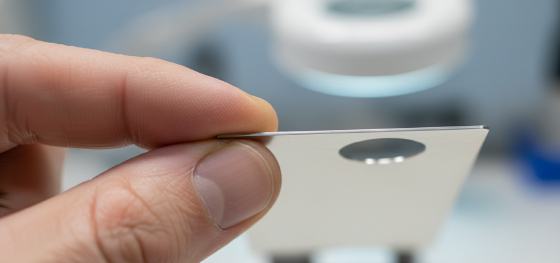
Deploying acid etching metal technology—formally known as photochemical machining (PCM)—completely rewrites the physical rules of thin-gauge fabrication. Instead of violently tearing raw steel with mechanical punches or melting it with 10kW fiber lasers, we use custom-formulated corrosive baths to gently dissolve the substrate at a molecular level. This purely cold-process methodology ensures the metallic crystal lattice remains completely undisturbed, delivering flawless, stress-free geometries.
Mastering this liquid subtractive matrix requires hardware procurement teams to brutally confront the limitations of fluid dynamics. Engineers must mathematically calculate the lateral "etch factor" to prevent undercut, evaluate the severe thickness restrictions on thick plates, and leverage the near-zero tooling costs to outmaneuver traditional stamping dies. Financial survival in precision [2026] hardware scaling demands absolute chemical supremacy.
content:
Acid Etching Metal vs Lasers: How Do They Compare?
When Should You Specify Chemical Milling for Foils?
When MUST You Avoid Photochemical Etching on Steel?
Etch Factor Tolerances and Lateral Undercut Limits
True NRE Cost Breakdowns for Custom Thin Parts
Jucheng Precision Etching Workflows in Shenzhen
Critical Chemical Milling and Metal Etching FAQs
Acid Etching Metal vs Lasers: How Do They Compare?

Does chemical etching prevent heat-affected zones (HAZ) better than lasers? Absolutely. Photochemical machining operates at room temperature, generating zero thermal stress and leaving the metal's magnetic properties and crystalline grain structure perfectly unaltered.
Laser cutting incinerates metal by pumping massive kinetic energy into a tiny focal point. When lasers slice through metal foils thinner than 0.5mm, the surrounding material absorbs the residual heat and violently warps. The cut edge instantly transforms into a brittle, carbonized slag line that physically alters the native temper of the alloy. If you are manufacturing sensitive beryllium copper electrical contacts, this heat-affected zone fundamentally destroys continuous electrical conductivity.
Chemical etching sidesteps thermodynamics entirely. Technicians laminate the metal with a UV-sensitive photoresist mask, expose it to ultraviolet light holding the CAD geometry, and spray highly pressurized etchants across the sheet. The corrosive fluid gently eats away only the unmasked regions. The parts drop out perfectly flat, completely burr-free, and require zero secondary deburring labor.
| Manufacturing Metric | Photochemical Machining (PCM) | Fiber Laser Cutting | Mechanical Stamping Press |
|---|---|---|---|
| Thermal Distortion (HAZ) | Zero (Cold Chemical Process) | High (Melted Slag Edges) | Zero (Cold Shearing Force) |
| Burrs and Micro-fractures | None (Molecular dissolution) | Slag & Micro-cracking risks | Heavy rollover and sharp burrs |
| Complexity Cost Penalty | Zero (Simultaneous dissolve) | High (Time charged per cut inch) | Extreme (Expensive punch dies) |
| Optimal Material Thickness | 0.01mm to 1.5mm (Ultra-thin) | 0.5mm to 25mm+ (Thicker) | 0.5mm to 10mm (Rigid sheets) |
When Should You Specify Chemical Milling for Foils?
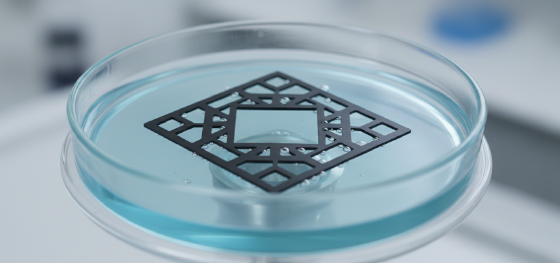
Is chemical milling ideal for complex electronics and medical implants? Yes. Specify etching exclusively for intricate lead frames, fine-mesh filtration screens, and titanium medical implants where mechanical tool pressure would crush the delicate geometry.
Designers routinely build optical encoder disks containing thousands of microscopic, high-tolerance slots. If you command a laser to cut ten thousand tiny holes, you pay an agonizing machine hourly rate for every single pierce point. Acid erosion dissolves all ten thousand holes simultaneously in the exact same timeframe it takes to process a single hole. Geometric complexity comes absolutely free of charge.
Aerospace engineers explicitly demand PCM for titanium and specialized inconel components. Because there is zero physical kinetic force applied to the sheet metal, delicate meshes featuring webs as thin as a human hair survive the fabrication process without buckling or snapping. It remains the only reliable pathway to produce high-density EMI shielding for sensitive telecommunication devices.
When MUST You Avoid Photochemical Etching on Steel?

Can strong chemicals cleanly cut through heavy 10mm steel plates? Absolutely not. Chemical etching fails catastrophically on materials exceeding 2.0mm thick due to severe lateral acid corrosion (undercutting) that destroys the vertical wall tolerance entirely.
I constantly reject CAD files from junior designers asking to chemically mill 5mm thick structural aluminum brackets. They fundamentally misunderstand fluid erosion physics. As the chemical aggressively burns vertically down into a thick plate, it spends agonizingly long minutes exposed to the top edges. The fluid eats sideways underneath the protective mask, turning a perfectly straight hole into a ruined, hourglass-shaped crater.
This physical limitation renders PCM entirely useless for heavy mechanical hardware, automotive chassis mounts, or thick load-bearing flanges. The moment your material thickness surpasses 1.5mm, you must immediately pivot your procurement strategy back to traditional CNC waterjets, high-definition plasma, or multi-axis milling centers to retain vertical edge integrity.
Etch Factor Tolerances and Lateral Undercut Limits
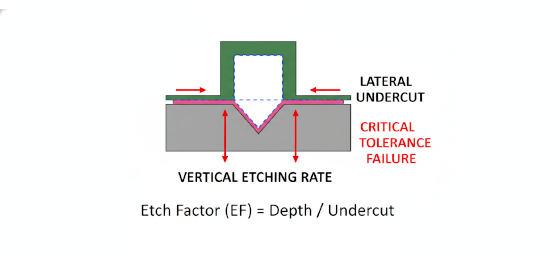
Why do chemically milled edges always feature a slight bevel? Because corrosive liquids dissolve matter isotropically (in all directions equally). While the fluid digs downward, it also attacks laterally, creating an unavoidable V-shaped taper.
Evaluating the mathematical "Etch Factor" separates elite tooling engineers from massive scrap piles. If you mask a perfect 2mm circle on the top surface, the lateral undercut means the final hole will measure significantly larger than 2mm once the fluid breaches the bottom. To hit a strict press-fit tolerance, the CAD file's protective mask must be artificially drawn smaller to compensate perfectly for this sideways bleed.
High-end facilities combat severe edge beveling by deploying synchronized double-sided etching. By spraying aggressive etchants at both the top and bottom of the metal sheet simultaneously, the fluids meet precisely in the middle of the core. This technique slices the total exposure time in half and minimizes the lateral undercut, creating a distinct, symmetrical "double-bevel" profile along the inner wall.
True NRE Cost Breakdowns for Custom Thin Parts
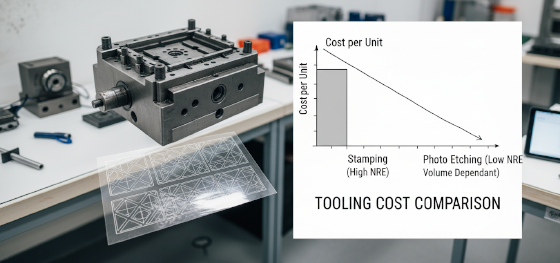
Is photochemical tooling cheaper than progressive stamping dies? Massively. Printing a digital CAD file onto two sheets of optical mylar film costs less than two hundred dollars, whereas a hardened D2 steel progressive stamping die demands upwards of forty thousand dollars in NRE.
Hardware startups relying on iterative rapid prototyping cannot survive the financial paralysis of hard steel tooling. If an engineer moves a mounting hole by 0.5mm on a stamping die, the entire heavy matrix must be scrapped and re-machined. In the chemical milling world, implementing that exact same design change requires merely printing a new piece of plastic film in fifteen minutes.
However, stamping reclaims its ultimate economic crown at astronomical production volumes. Once a steel die is paid for, it punches out millions of parts in seconds. Chemical processing operates significantly slower per sheet, meaning the variable unit cost remains higher. Procurement managers must carefully plot the intersection curve where the NRE savings cross paths with the raw speed of a mechanical punch press.
Jucheng Precision Etching Workflows in Shenzhen

Can a single facility handle both rapid chemical milling and volume CNC machining? Yes. Jucheng merges enclosed, eco-friendly spray etching lines directly alongside our 150-machine CNC fleet to provide uncompromised, hybrid tolerance solutions.
Operating out of the Shenzhen precision manufacturing hub, we refuse to let disjointed supply chains destroy your hardware launch. Handling aggressive industrial chemicals requires brutal environmental compliance. Our automated, roll-to-roll etching lines feature closed-loop wastewater neutralization, guaranteeing uninterrupted continuous production without sudden regulatory shutdowns.
We execute aggressive Free DFM reviews before printing your phototooling. If you specify a hole diameter smaller than the thickness of the metal plate, our senior engineers instantly flag the chemical impossibility. Backed by uncompromising ISO9001:2015 and IATF16949 protocols, our No MOQ policy empowers highly agile, stress-free iterations for aerospace innovators.
Critical Chemical Milling and Metal Etching FAQs

Resolving hardcore fluid dynamic variables prevents devastating assembly rejections when verifying tight geometric tolerances on ultra-thin custom hardware.
What is the absolute smallest hole diameter you can chemically etch?
The hard mathematical rule of PCM dictates that a hole's diameter must be at least 110% to 120% of the material's thickness. For example, if you are processing a 0.5mm thick copper sheet, you cannot successfully dissolve a hole smaller than 0.6mm wide. The fluid physics simply will not permit deeper vertical penetration without violently destroying the lateral walls.
Does chemical etching alter the temper or hardness of the metal?
Not at all. Because it is a completely cold, non-mechanical subtractive process, the base metal retains 100% of its original metallurgical properties. If you load full-hard, spring-tempered stainless steel into the acid bath, it emerges as full-hard, spring-tempered stainless steel. There is zero work hardening or accidental thermal annealing.
Can you chemically etch aluminum effectively?
Aluminum is notoriously difficult to photochemically machine compared to copper or stainless steel. The intense exothermic heat generated when corrosive fluids attack aluminum rapidly destroys the protective photoresist mask, causing catastrophic edge failure. While possible using highly specialized cool-bath chemistry, we generally advise shifting thick aluminum parts to precision CNC or laser profiling.

