


In 3D printing, infill density is how solid or hollow the inside of your print will be. It affects how strong, heavy, and long it takes to print something. Getting the right infill helps you save material and time while making sure your object works the way you want.
What is Infill Density?
Balancing Strength and Material Usage
Finding the Optimal Setting
Sparse and Specialized Infill Patterns
Software Integration and the Slicer
The Broader Impact on Prints
Material-Specific Considerations: ABS
What is Infill Density?
Infill density 3D printing refers to the internal structure of a printed object. Instead of being solid, most prints feature a internal lattice pattern that provides structural support while conserving material. This density is expressed as a percentage, where 0% means the object is completely hollow (with no infill) and 100% means it is entirely solid. The choice of infill density is a primary setting in any slicer software and directly dictates the object's mechanical properties and resource consumption. Similarly, when discussing 3d printer infill density, we are referring to the specific capability of a printer and its accompanying software to accurately generate and print these internal structures at the user-defined percentage.
Balancing Strength and Material Usage
The relationship between 3d print infill density vs strength is not linear but follows a curve of diminishing returns. Initially, a small increase in infill density, say from 10% to 20%, results in a significant gain in strength and stiffness. This is because the infill pattern effectively distributes stress throughout the part. However, as the density continues to increase beyond 40-50%, the gains in infill strength become less pronounced. The part becomes heavier, uses more material, and takes considerably longer to print, often for only a marginal improvement in performance. Therefore, identifying the optimal density for a specific application is key to efficient printing.
Finding the Optimal Setting
Determining the best infill density for 3d printing is highly application-dependent and there is no universal "best" value. For non-functional prototypes, visual models, or decorative items, a low density of 10-15% is often sufficient to provide basic structural integrity while minimizing time and material use. For functional parts, mechanical components, or items that will endure stress, a density between 25% and 50% is typically recommended. For parts requiring maximum strength, such as tools or high-stress gears, densities of 75% to 100% may be necessary, accepting the associated costs in time and filament.
Sparse and Specialized Infill Patterns
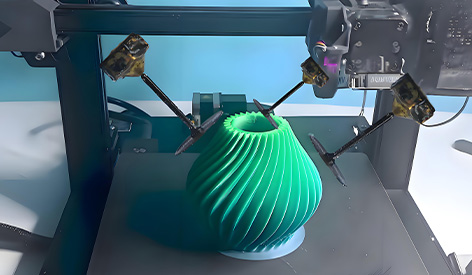
The term 3d printing sparse infill density is often used to describe the use of lower density percentages. "Sparse" infill implies that the internal structure is not dense, focusing on creating a supportive scaffold rather than a near-solid core. This is the standard approach for most prints to achieve efficiency. In contrast, 3d printing vase infill density is a unique case. When using the "Vase Mode" or "Spiralize Outer Contour" feature, the infill density is effectively 0%. The print consists of a single, continuously extruded wall, making it perfect for water-tight, decorative objects like vases or planters but offering no structural strength.
Software Integration and the Slicer
While not a slicer itself, 3D modeling software like Blender can be used to prepare models for printing. However, the setting for Blender 3d printing infill density is not typically applied within Blender. Instead, models are designed and exported as STL or OBJ files. The infill density is then assigned in a dedicated slicer program (like PrusaSlicer, Cura, or Simplify3D) where the user can specify the percentage, pattern, and other critical printing parameters before generating the toolpath (G-code) for t
he printer.
The Broader Impact on Prints
The effect of infill density on 3d print extends beyond just strength and weight. It significantly impacts print time and material consumption; higher densities can double or triple both. It also influences surface quality; very high densities can lead to minor top surface pillowing due to sagging over dense infill, while very low densities might not properly support upper layers. Furthermore, infill density affects part flexibility in certain materials and plays a role in thermal properties for parts used in high-temperature environments.

Material-Specific Considerations: ABS
When discussing infill density 3d printing abs, material properties introduce additional considerations. ABS filament is prone to warping and shrinkage during cooling. A higher infill density can increase internal stresses within the part, exacerbating these issues and potentially leading to layer adhesion problems or part deformation. Therefore, for ABS prints, it is often advisable to use an infill density that is adequate for the part's function but not excessively high. A range of 20-40% is common, coupled with an appropriate infill pattern like gyroid or rectilinear that helps manage internal stresses, and always in an enclosed printer to minimize drafts and temperature fluctuations.
Infill density is a powerful tool in the 3D printing workflow, offering a direct means to customize the properties of a printed object. By understanding the relationship between density, strength, weight, and print time, users can make informed decisions that optimize their prints for specific applications. Whether aiming for a lightweight prototype or a heavy-duty functional part, mastering infill density is essential for efficient and effective 3D printing. The key is to always match the infill density to the final purpose of the object, avoiding both the waste of excessive material and the weakness of insufficient support.

