


Precision motion control often relies on the silent efficiency of plastic power transmission. While metals are the standard for high-torque applications, the modern industrial landscape increasingly demands components that are lightweight, self-lubricating, and corrosion-resistant. This is where Machining Delrin Gears becomes the gold standard for engineers across the medical, consumer electronics, and appliance industries.
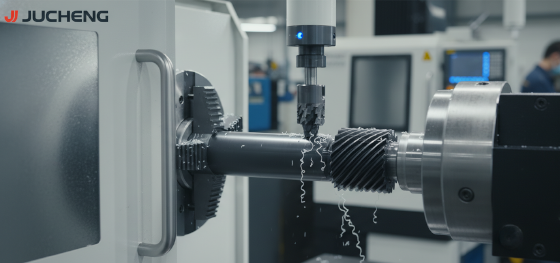
Achieving a perfect gear mesh in Acetal requires a deep understanding of the material's crystalline structure. Delrin, or Polyoxymethylene (POM), offers the ideal mechanical backbone for gears because it bridges the gap between the flexibility of plastics and the rigidity of metals. At Jucheng Precision, we specialize in pom delrin acetal cnc machining, utilizing advanced 4-axis and 5-axis centers to produce tooth profiles that remain accurate under constant cyclic loading. This guide dives into the technical realities of shaping these high-performance components.
Transitioning from design to a working gear assembly is a test of precision and thermal control. Whether you are dealing with spur gears, helical sets, or worm drives, the success of the part depends on the quality of the cut and the stability of the polymer. Let us explore the engineering pillars that define world-class acetal gear manufacturing.
content:
Mechanical Foundation: Why Acetal Dominates Gear Design
Manufacturing Methods: Hobbing vs. CNC Milling
Stability Secrets: Managing Moisture and Heat
Geometry Mastery: Designing the Perfect Involute
JUCHENG's Advantage: Live Tooling and Inspection
Mechanical Foundation: Why Acetal Dominates Gear Design
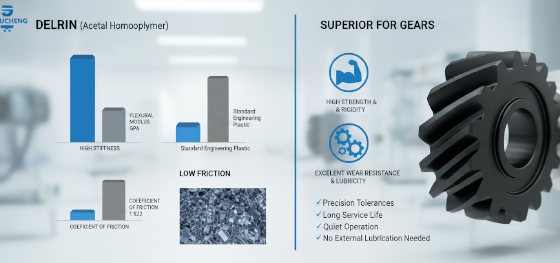
In the vast library of engineering polymers, few can match the specific strength of Delrin. Gears are unique mechanical elements; they don't just sit there—他们承受的是持续的、高频率的接触应力。Nylon is often too flexible, leading to tooth deformation under torque, while other plastics can be too brittle, snapping under a sudden shock load. Machining Delrin Gears provides the engineer with a material that possesses a high modulus of elasticity and exceptional fatigue resistance. This means that a Delrin gear can cycle millions of times without the teeth permanently "creeping" or losing their shape.
The secret to this performance is the crystalline nature of POM. It is a highly ordered polymer that resists the long-term deformations associated with amorphous plastics. Furthermore, Delrin has a naturally low coefficient of friction against metals and other plastics. In many gearboxes, this self-lubricating quality allows for "dry" operation, which is critical in food processing equipment or high-end office electronics where oils and greases are unacceptable. JUCHENG’s expertise in pom delrin acetal cnc machining ensures that these mechanical advantages are preserved. If a shop overheats the material during the cut, they can actually "de-crystallize" the surface, turning a tough gear into a soft one. We use optimized cooling and aggressive feed rates to keep the molecular structure intact, delivering gears that stand the test of industrial time.
Manufacturing Methods: Hobbing vs. CNC Milling
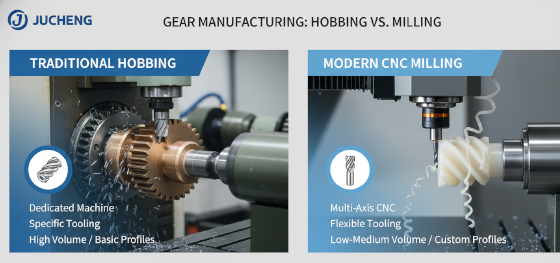
When it comes to creating the actual teeth of the gear, there are two primary schools of thought: traditional hobbing and modern CNC milling. Hobbing is a continuous cutting process that is incredibly efficient for standard spur gears in high volumes. However, it is limited by the availability of specialized "hobs" (cutting tools) for specific modules and pressure angles. If your design features a non-standard tooth profile or an integrated hub with complex 3D features, a traditional hobbing machine will struggle.
Jucheng Precision bridges this gap by utilizing high-speed 4-axis CNC milling. By rotating the part on an indexing head while a high-speed end mill carves the tooth profile, we can produce custom gears that would be impossible with traditional methods. This is a game-changer for Machining Delrin Gears. We can adjust the tooth thickness to manage backlash precisely or create internal gears that a hob cannot reach. The use of CNC milling also allows us to integrate features like keyways, D-bores, and weight-reduction pockets in a single setup. This "one-stop" approach minimizes the accumulation of tolerances that occurs when a part moves between multiple machines. Whether you need a standard AGMA-rated gear or a specialized gear-and-cam hybrid, our multi-axis capabilities ensure that the concentricity between the bore and the pitch circle is maintained within microns.
Stability Secrets: Managing Moisture and Heat
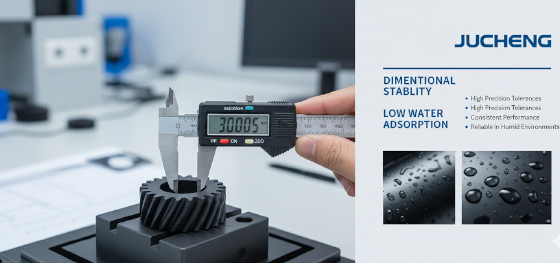
One of the most frequent reasons engineers switch from Nylon to Delrin gears is moisture. As we have documented in previous guides, Nylon is thirsty; it absorbs water and swells, which can cause a gearbox to seize in humid environments. Delrin is remarkably indifferent to water. Its moisture absorption rate is nearly ten times lower than that of Polyamides. This environmental stability is the primary reason why Machining Delrin Gears is the standard for precision instrumentation and subsea assemblies.
However, thermal expansion remains a factor. Plastic expands much more than steel as it warms up. During the high-speed passes of pom delrin acetal cnc machining, localized heat can cause a gear to grow while it is being measured. At Jucheng Precision, we use a stabilized, climate-controlled inspection protocol. We allow parts to reach thermal equilibrium at 20°C before final measurement. We also pay close attention to internal stress. For ultra-precision gears, we perform a mid-process annealing cycle. This releases the energy trapped during the roughing passes, ensuring that the gear teeth don't "warp" or move after they are finished. This level of technical rigor is what allows us to consistently maintain AGMA 10 or better quality levels on plastic gears—a feat that generalist shops simply cannot match.
Geometry Mastery: Designing the Perfect Involute
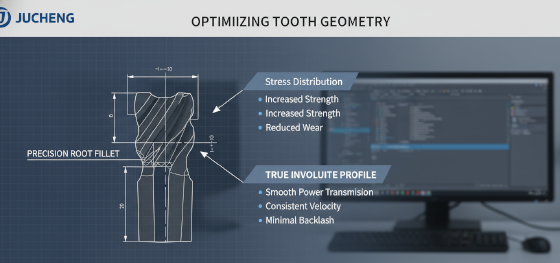
A gear is only as good as its geometry. The most common profile is the involute curve, which allows for smooth, constant-velocity power transmission. In metal, you can have very sharp root radii. In plastic, sharp corners are the enemy. When Machining Delrin Gears, JUCHENG engineers always look for opportunities to optimize the tooth root. A sharp corner in the root of a gear tooth is a massive "stress riser" where a crack can begin under a heavy shock load.
We advise our clients to incorporate a generous radius at the tooth root to distribute stress more evenly. Furthermore, we optimize the tooth thickness to account for the specific "pressure angle" required by the application. While 20-degree pressure angles are standard, a 14.5-degree angle might be better for quiet operation in a low-torque medical device. Our specialized gear-milling software allows us to simulate the contact patch between teeth before we ever cut a chip. This proactive DFM (Design for Manufacturing) approach ensures that the gear doesn't just meet the print—it meets the performance expectations of the real-world application. By choosing Jucheng Precision, you aren't just buying a part; you are buying the expertise required to ensure that your gears run silent and last for years.
JUCHENG's Advantage: Live Tooling and Inspection
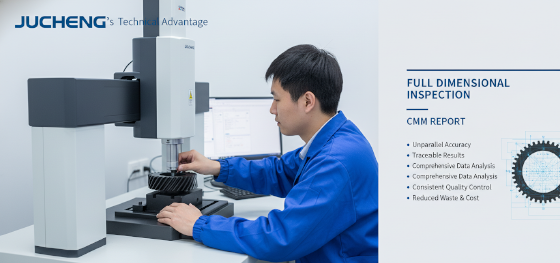
The final hallmark of a professional gear manufacturer is the ability to verify the work. A gear that looks perfect may have a concentricity error that causes it to vibrate and fail. Jucheng Precision utilizes state-of-the-art "Live Tooling" on our CNC turning centers. This allows us to turn the gear blank and mill the teeth in a single continuous operation. By never releasing the part from the chuck, we eliminate the primary source of runout. The gear bore and the gear teeth are perfectly concentric by default.
Once the Machining Delrin Gears cycle is complete, the parts move to our quality control lab. We utilize high-resolution Coordinate Measuring Machines (CMM) and optical comparators to verify the tooth spacing, pitch diameter, and involute accuracy. We provide our clients with detailed inspection reports that include these critical metrics. This level of transparency is essential for medical and aerospace applications where every component must have a documented quality history. Whether you are building a prototype for a new robotic actuator or a production run of thousands of household appliance gears, Jucheng Precision has the technical rigor and the manufacturing capacity to deliver. We don't just cut plastic; we engineer motion. Contact our team today for a technical consultation on your next pom delrin acetal cnc machining project.

