


Nylon (PA) is a premier engineering plastic, prized for its excellent strength, wear resistance, and low friction, making it indispensable for gears, bearings, and structural components. However, successfully processing it via CNC Machining requires meticulous planning to overcome four common challenges that can easily compromise dimensional stability and final part quality.
For B2B buyers relying on precision Nylon prototypes before committing to Injection Molding, managing moisture, heat, and material composition is critical. This guide, based on Jucheng Precision Technology's CNC Machining expertise, details the necessary strategies to ensure your Nylon components transition flawlessly from concept to final product.
The Hygroscopic Challenge: Managing Nylon’s Dimensional Stability
Thermal Management: Avoiding Melting and Distortion
The Composite Challenge: Machining Glass-Filled Nylon (PA+GF30)
Tooling and Strategy: High-Speed Cutting and Chip Evacuation
The Hygroscopic Challenge: Managing Nylon’s Dimensional Stability
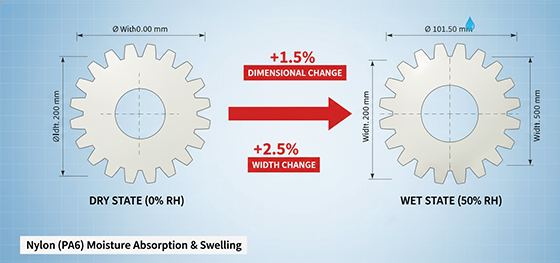
Nylon is notoriously hygroscopic, meaning it absorbs moisture from the air, which causes the material to swell and change dimensions. This is the single biggest threat to precision in machined Nylon parts.
The Problem: A part machined to a precise tolerance in a dry environment may grow out of tolerance by several thousandths of an inch when exposed to normal humidity. This makes it impossible for the part to fit into a critical assembly.
Pre-Machining Conditioning: Professional shops condition the Nylon stock before machining by storing it in a climate-controlled environment or by performing a mild annealing process to achieve a state of equilibrium, ensuring the material is as stable as possible during the cut.
The Buyer's Requirement: Always specify the required moisture content of the part at the time of final inspection. For highly critical parts, the final inspection may need to occur in a climate-controlled chamber.
Thermal Management: Avoiding Melting and Distortion

The friction from the cutting tool generates significant heat. Unlike metals which dissipate heat quickly, plastics like Nylon retain heat, posing a dual risk: the part can soften and melt, or it can distort and warp as internal stress is released.
Heat Control Strategy: The primary solution is high-speed cutting with light, fast passes (high RPM, high feed rate) to remove material quickly and prevent heat buildup. The tool spends less time in contact with the material, keeping temperatures down.
Cooling Technique: Instead of traditional cutting fluids (which Nylon may absorb or react to), compressed air is often used as a direct, high-volume stream to cool the cutting zone and evacuate chips rapidly, preventing the hot chips from re-melting onto the part.
Clamping: Nylon must be clamped lightly but securely. Over-tightening clamps can induce stress that will be released as the part is machined, leading to significant warpage and tolerance failure.
The Composite Challenge: Machining Glass-Filled Nylon (PA+GF30)
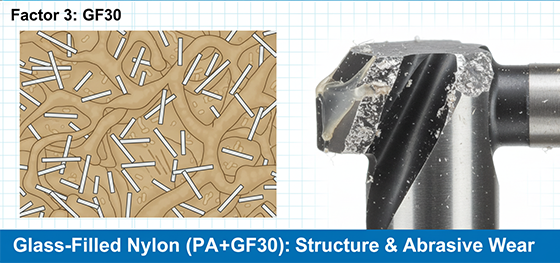
Glass-Filled Nylon (PA+GF30) offers vastly superior mechanical strength and dimensional stability compared to un-filled Nylon, making it ideal for structural applications. However, the glass fibers themselves present a major manufacturing hurdle: tool wear.
Tooling Abrasion: Glass fibers are highly abrasive and rapidly dull standard high-speed steel (HSS) and even carbide cutting tools. Dulling leads to rubbing, which generates heat, accelerating both tool wear and part melting.
The Solution: Professional shops use diamond-coated or specialized polycrystalline diamond (PCD) tools designed for extreme abrasion resistance. While more expensive upfront, these tools maintain a sharp edge longer, reducing heat and ensuring a high-quality surface finish.
Surface Finish: Glass-filled materials naturally leave a rougher surface finish due to the exposed fibers. If a smooth cosmetic finish is required, the component may need post-machining processes like bead blasting or painting.
Tooling and Strategy: High-Speed Cutting and Chip Evacuation
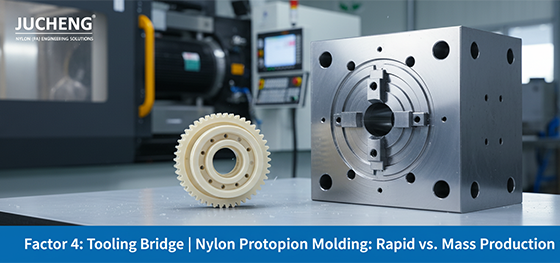
Successful machining of Nylon demands dedicated tooling and strategies that optimize the plastic's unique behavior:
Sharpness and Geometry: Tools must be extremely sharp, often having polished flutes and high rake angles to slice the material rather than push it. This minimizes heat and produces manageable, curled chips.
Chip Evacuation: Nylon produces long, stringy chips that can wrap around the tool, increasing friction and causing melting. Effective chip evacuation via strong air blasts or specialized vacuum systems is crucial for continuous, high-speed machining.
Prototype-to-Molding Bridge: CNC Machining Nylon stock is ideal for prototypes. Once verified, the material can be seamlessly transitioned to Nylon Injection Molding for low-volume production, utilizing Jucheng's one-stop capability to ensure material consistency.
CNC Machining Nylon is a specialized process that requires expert management of moisture, heat, and tooling abrasion to achieve reliable results. Jucheng Precision Technology’s certified and experienced machinists mitigate these risks through advanced thermal management, specialized composite tooling, and dimensional conditioning.
Secure dimensionally stable and structurally sound Nylon components. Contact us today to discuss the precision machining of your high-performance plastic prototypes and parts.

