


For the B2B buyer, Industrial 3D Printing is not a single technology; it is a spectrum of powerful tools—SLS, SLA, MJF, and FDM—each with a unique relationship to part strength, accuracy, and surface finish. The primary challenge is choosing the right process to ensure your prototype is genuinely functional and accurately validates the final product's design.
Relying on a one-size-fits-all approach risks prototype failure, misleading test results, and costly delays. This guide provides a strategic decision tree, enabling you to match your functional requirements directly to the optimal additive manufacturing technology, securing maximum value from your prototype investment.
The Functional Match: How to Choose Your Process by Performance Need
Structural Integrity: The Isotropic Advantage of Powder Bed Fusion (SLS/MJF)
Precision and Surface: When to Prioritize Accuracy (SLA) or Speed (FDM)
Prototyping Strategy: 3D Printing as the Bridge to CNC and Molding
The Functional Match: How to Choose Your Process by Performance Need
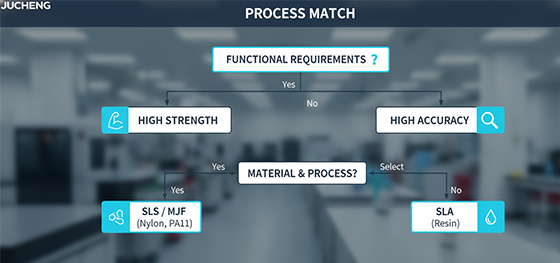
The decision-making process for Industrial 3D Printing should be driven by the part’s highest-priority requirement—not simply the lowest cost:
If you need the highest structural strength and durability: Choose Powder Bed Fusion (SLS or MJF) using engineering-grade Nylon (PA12). These parts have near-uniform strength in all directions, making them ideal for load-bearing prototypes.
If you need the highest detail and surface finish: Choose Stereolithography (SLA). SLA uses a liquid resin and laser to achieve the best resolution and smoothest surface, making it the choice for aesthetic models and complex internal channels (like fluid manifolds).
If you need the cheapest, fastest, largest volume: Choose FDM (Fused Deposition Modeling). FDM provides quick, low-fidelity prototypes for basic form and fit checks, where structural weakness is acceptable.
If you need the highest thermal or chemical resistance: Choose specialized materials only available in certain processes, such as ULTEM/PEEK in FDM or DMLS in Metal 3D Printing, for their extreme operating conditions.
Structural Integrity: The Isotropic Advantage of Powder Bed Fusion (SLS/MJF)
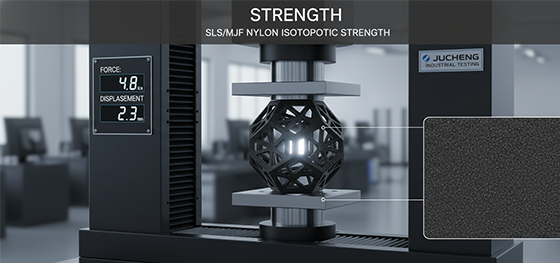
For any part that will undergo mechanical testing, the material's strength uniformity (isotropy) is non-negotiable. This is where SLS (Selective Laser Sintering) and MJF (Multi Jet Fusion) offer a significant advantage over FDM:
Near-Isotropic Strength: In SLS and MJF, the entire powder bed is heated close to the material’s melting point, and the laser/jet fuses the material layer by layer. This results in a chemical bond between the layers that is nearly as strong as the bond within the layer, creating uniform strength in all directions.
Density and Sealing: MJF, in particular, produces parts with very high density (low porosity), making them excellent candidates for simple fluid/air sealing applications after a minimal post-process treatment.
Material Range: SLS and MJF primarily use Nylon PA12 and PA11, which are true engineering-grade polymers with high fatigue resistance, chemical resistance, and toughness, perfectly simulating final production materials.
Precision and Surface: When to Prioritize Accuracy (SLA) or Speed (FDM)
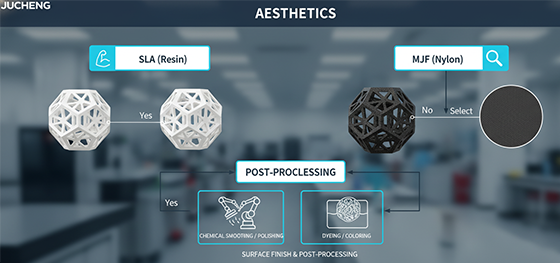
When your goal is visualization, presentation, or highly precise feature definition, surface finish and tolerance become the key drivers:
SLA for Accuracy: SLA offers the tightest dimensional tolerances and the smoothest surface finish straight off the machine. It is the choice for investment casting masters, complex assemblies with tight fitments, and prototypes intended for presentation.
FDM's Role: FDM remains the fastest and cheapest process for large-volume, low-fidelity prototypes where structural integrity and surface quality are irrelevant (e.g., check fixtures, large simple casings). Its primary limitation is visible layer lines.
Post-Processing: Both SLS and MJF parts can be chemically smoothed or dyed (part of post-processing) to achieve a final aesthetic that is often comparable to an Injection Molded part, making them suitable for final product launch samples.
Prototyping Strategy: 3D Printing as the Bridge to CNC and Molding
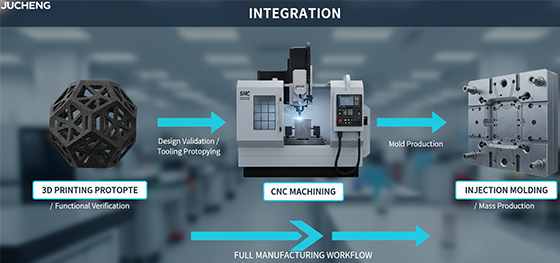
The most efficient B2B strategy treats 3D printing as one stage in a continuous manufacturing workflow that leads to mass production:
Early Stage Iteration: Use inexpensive FDM/SLA for quick, iterative design changes and ergonomic checks.
Validation Stage: Use high-precision CNC Machining (for the ultimate material fidelity) or SLS/MJF (for strong, complex Nylon parts) for rigorous functional testing.
Bridging to Production: Use SLA masters for Vacuum Casting soft molds, or scale verified SLS/MJF designs directly into Injection Molding with high confidence.
JUCHENG's Full Service: Working with a manufacturer that provides all these services under one roof (3D Printing, CNC Machining, Injection Molding) ensures seamless material consistency and design for manufacturing (DFM) feedback at every critical stage.
Industrial 3D Printing is a tool for strategic decision-making. Jucheng Precision Technology offers comprehensive expertise across all additive and subtractive technologies, ensuring your Industrial 3D Printing choice perfectly matches your functional, aesthetic, and production goals.
Secure the right 3D printing solution for your next functional prototype. Contact us today to leverage our multi-process manufacturing expertise.

