


How do you create a complex, flowing, three-dimensional shape from a flat sheet of metal? How do you bend and form it without it cracking or breaking? And how do you ensure it will survive for years in the harshest saltwater environment?

This is a core challenge in industries from shipbuilding to custom automotive. It requires a very special material. A material that is not valued for its ultimate strength, but for its willingness to be shaped.
This is the world of 5052 aluminum. It is the master of formability in the aluminum family. And the process of Machining 5052 Aluminum is about harnessing this unique personality.
content:
5052's Superpower: Formability Without Cracking
Its Second Talent: Resisting the Elements
A Machinist's Approach: A Softer Touch
5052 vs. 6061: A Clear Choice
5052's Superpower: Formability Without Cracking
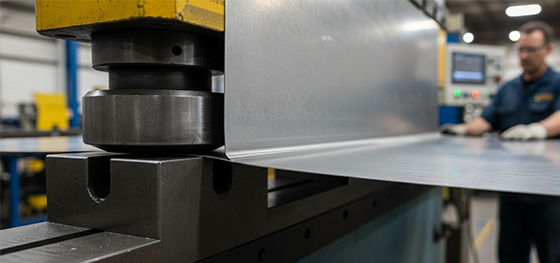
The defining characteristic of 5052 aluminum is its excellent formability. This means it can be easily bent, formed, and worked into complex shapes at room temperature without cracking.
This property comes from its primary alloying element, magnesium. Unlike the heat-treatable alloys like 6061 and 7075, 5052 is a "work-hardening" alloy. It is not as strong, but it has much higher elongation and ductility.
This makes it the number one choice for sheet metal fabrication that involves complex bending or forming. You can create parts with very tight bend radii that would simply fracture if you tried to make them from a stronger, less ductile alloy. This is its superpower.
Its Second Talent: Resisting the Elements
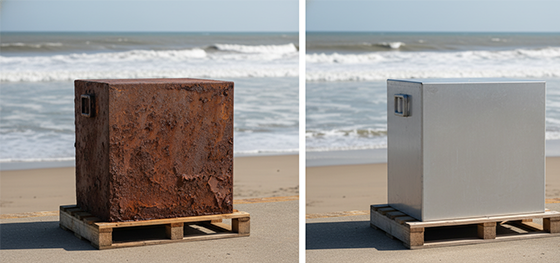
The magnesium in 5052's recipe gives it another huge advantage: excellent corrosion resistance, especially in saltwater environments.
Of all the non-heat-treatable aluminum grades, it has the highest resistance to marine and industrial atmospheres. This makes it the default "marine grade" aluminum for a huge range of applications.
You see it used for the hulls of small boats, for fuel tanks, and for any type of enclosure or hardware that will be used near the ocean. Its ability to be both easily formed into a complex shape and to survive in a corrosive environment is a powerful combination.
A Machinist's Approach: A Softer Touch
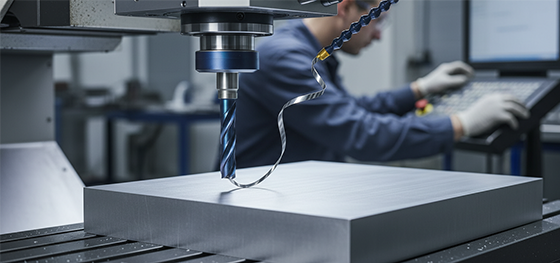
The process of Machining 5052 Aluminum presents a different challenge from its harder cousins. Because it is a softer, gummier alloy, it requires a different approach.
It has a tendency to produce long, stringy chips, and can be prone to a "built-up edge" on the cutting tool. To achieve a good surface finish, a machinist must use extremely sharp tools, often with a polished coating designed for aluminum.
High spindle speeds and aggressive feed rates are essential. This strategy is designed to form a chip and eject it from the cutting zone as quickly as possible, before it has time to stick to the tool. A generous supply of coolant is also critical to wash away chips and prevent heat buildup.
While it is a friendly material to form, it demands a specific and expert touch to achieve a perfect machined finish.
5052 vs. 6061: A Clear Choice
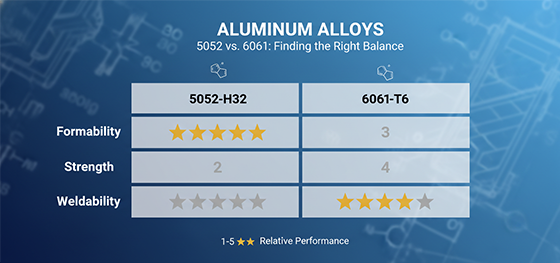
This is a classic decision for a designer. When should you choose 5052, and when should you choose the more common 6061?
The answer is a clear trade-off between formability and strength.
Choose 5052 when your part will be made from sheet metal and involves significant bending or forming. Its superior ductility is a massive advantage here. You should also choose 5052 if your part will be used in a saltwater environment and does not require the high strength of 6061.
Choose 6061 when your part is a structural component that will be primarily machined from a solid block. Its higher strength and hardness make it a better choice for these applications. 6061 is also heat-treatable, which gives you more options for increasing its strength after machining.
| Property | Aluminum 5052-H32 | Aluminum 6061-T6 |
|---|---|---|
| Primary Use | Sheet Metal Fabrication | CNC Machining |
| Formability (Bending) | Excellent | Fair |
| Strength | Fair (~193 MPa) | Good (~276 MPa) |
| Marine Corrosion Resistance | Excellent | Good |
Understanding this clear distinction is key to making the right material choice. As a partner with deep expertise in both sheet metal fabrication and cnc machining aluminum, JUCHENG can provide unbiased advice to help you select the perfect alloy for your specific design needs.

