


Silicone is unique among elastomers, prized for its flexibility and exceptional resistance to extreme temperatures—from medical device seals that withstand autoclaving to high-performance gaskets in aerospace engines. Yet, when discussing its thermal stability, a fundamental misunderstanding often arises: silicone doesn't have a melting point.
For B2B buyers and engineers, understanding the difference between silicone's curing temperature (how it's made) and its working temperature (how it performs) is critical to correct material specification. This guide demystifies silicone’s unique thermal behavior and the processes—from Liquid Silicone Rubber (LSR) Injection Molding to Vacuum Casting—that guarantee its incredible heat resistance.
The Melting Myth: Why Silicone Doesn't Melt, It Decomposes
The Curing Science: Temperature Control for Optimal Cross-Linking
High-Heat Management: Utilizing Silicone’s Extreme Thermal Stability
Manufacturing Processes: LSR Molding vs. Vacuum Casting
The Melting Myth: Why Silicone Doesn't Melt, It Decomposes
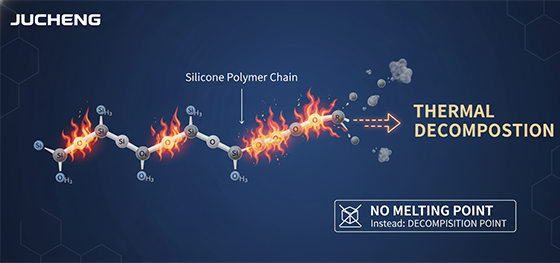
Unlike thermoplastics (like PC or ABS) which soften and melt when heated, silicone rubber (a thermoset polymer) is cross-linked. This means its molecular chains are chemically bonded together in a three-dimensional network, giving it its elasticity and making it structurally stable against heat.
The Difference: When silicone is heated past its working temperature, it does not turn into a liquid. Instead, it begins to thermally decompose (break down) at temperatures typically above 300°C (572°F), eventually turning into an inert ash or silica powder.
Working Temperature vs. Decomposition: Most industrial silicones are rated for continuous use between -60°C and 230°C. This range is achieved because the cross-linked structure remains intact, allowing the material to maintain its elasticity and sealing function.
Material Specification: When sourcing, always specify the maximum continuous working temperature for your application (e.g., in a car engine bay), as this is a more critical metric than a theoretical melting point.
The Curing Science: Temperature Control for Optimal Cross-Linking
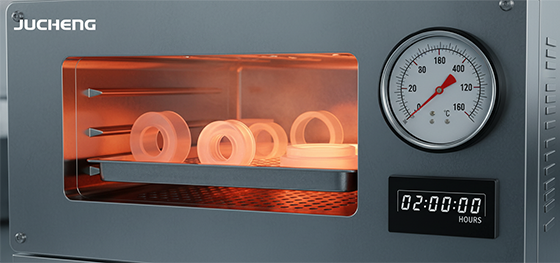
The heat that causes breakdown is also the heat required to create the structure. Curing, or vulcanization, is the chemical process that creates the molecular cross-links, and it must be precisely controlled for mechanical integrity.
Primary Curing: For standard silicone rubber, this involves initial heating in the mold (for Injection Molding) or in a vacuum chamber (for Vacuum Casting) to initiate the cross-linking. Temperatures typically range from 120°C to 200°C.
Post-Curing (Baking): This is a crucial, secondary heating process often performed in a dedicated oven (baking). It removes volatile byproducts and unreacted material, significantly enhancing the part's physical properties, especially compressive set and heat resistance.
Medical Compliance: For medical components (ISO 13485), post-curing is often mandatory to ensure the silicone is free of residue that could leach out, making the process safe for bodily contact.
High-Heat Management: Utilizing Silicone’s Extreme Thermal Stability

Silicone's ability to withstand both high and low temperatures without losing its flexibility makes it indispensable in several high-stakes applications:
Automotive Engine Bays: Silicone is used for complex seals, hoses, and wiring harnesses that must withstand continuous high temperatures from the engine and remain flexible in freezing cold for reliable function.
Medical Autoclaving: Components like seals, tubing, and grips used in surgical environments must be able to withstand repeated sterilization cycles (autoclaving), which subject the material to high-pressure steam often above 121°C.
Thermal Conductivity: Certain silicone compounds are specifically formulated to be thermally conductive, acting as efficient heat dissipation pads while also providing electrical isolation—a key function in electronic cooling.
Manufacturing Processes: LSR Molding vs. Vacuum Casting
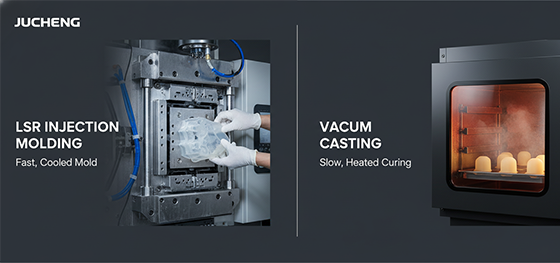
The desired volume and material fidelity determine the manufacturing technique, each with its own specific thermal management requirements:
Liquid Silicone Rubber (LSR) Injection Molding: Used for mass production (thousands of units). The process involves injecting two-part liquid silicone into a heated mold, where it rapidly cures (cross-links) in a matter of seconds, making it extremely fast and cost-effective at scale.
Vacuum Casting (Urethane Elastomers): Used for prototypes and low-volume production (20-500 units). While it uses polyurethane material, specialized elastomers can mimic the feel and moderate heat resistance of silicone. The process relies on curing in an oven (high-temperature post-cure) to achieve final material properties.
Tooling: LSR molding requires expensive, high-precision steel tooling (often water-cooled runners). Vacuum Casting uses low-cost silicone soft tooling made from a master pattern (often 3D printed), making it ideal for rapid design iteration.
Silicone's true value lies in its reliable thermal stability and flexibility, properties engineered through precise curing and post-curing protocols. Jucheng Precision Technology offers expertise across LSR Injection Molding and Vacuum Casting, ensuring your components are manufactured to withstand the most extreme working temperatures and meet required regulatory compliance.
Secure your high-performance, heat-resistant elastomer parts. Contact us today to discuss the best manufacturing strategy for your silicone and rubber-like components.

